

Residents of the border town of Goris expressed hope for peace with Azerbaijan after the elections.
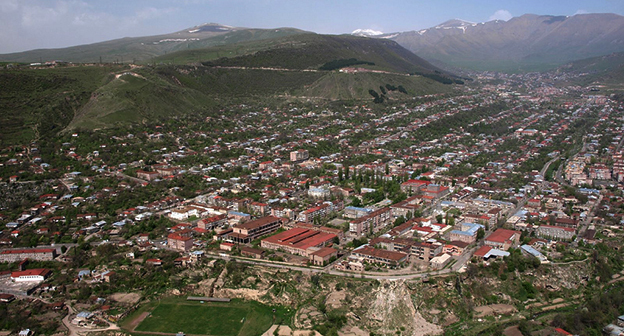
Armenia needs a lasting peace with Azerbaijan, which would enable further development of economic relations with the neighboring country, Goris residents said, expressing hope that the parliamentary elections will not lead to an escalation of the situation in the region.
As "Caucasian Knot" reported, the issue of Karabakh and the border with Azerbaijan has become one of the most pressing issues of the election campaign in Armenia. In the struggle for votes, this issue has ceased to be part of the foreign policy agenda; it is being discussed in the context of internal security and the survival of the state. The pre-election rhetoric of the main political forces in Armenia is built around the country's relations with its closest neighbors. The ruling party takes credit for normalizing relations with Azerbaijan and Turkey, while the opposition criticizes the government for acting to the detriment of national interests and for waging an economic war with Russia.
Elections to the National Assembly of Armenia will be held on June 7. According to analysts, the parties of Samvel Karapetyan, Prime Minister Nikol Pashinyan, and former President Robert Kocharyan will be key competitors in the elections. Samvel Karapetyan's "Strong Armenia," along with Robert Kocharyan's "Armenia" bloc and Gagik Tsarukyan's "Prosperous Armenia" party, is one of the most pro-Russian parties in the Armenian parliamentary elections. The "Caucasian Knot" has prepared a report "2026 Elections to the National Assembly (Parliament) of Armenia."
Following the 44-day war in 2020, the Goris community became a border community with Azerbaijan. The community includes the city of Goris and the villages of Akner, Bardzravan, Khndzoresk, Artashen, Nerkin Khndzoresk, Shurnukh, Vorotan, Verishen, and Karahunj. As of 2026, the community had a population of approximately 29,000, according to a "Caucasian Knot" correspondent.
According to the administration, the Goris community is home to a number of industrial enterprises, stone processing plants, and a developed energy sector. The city of Goris has seven schools, three universities, and two colleges. There are seven preschool educational institutions, four children's cultural and sports schools, the Gusan Ashot Cultural Center with its branches, a local history museum, a city art gallery, a centralized library system, a film library, the State Drama Theater, the A. Bakunts House Museum, and the Goris branch of the Yerevan Center for Aesthetic Education.
Goris became the first city where Armenia's ruling Civil Contract party came to campaign for the parliamentary elections.
Goris residents expressed hope for peace
Pensioner Bella Avetisyan believes that "if given time and opportunity, both peoples will live well together - if there are no provocateurs, these peoples will find common ground and understand each other very well." According to her, "issues must be resolved through the right policies."
Avetisyan is positive about Armenia purchasing oil and gasoline from Azerbaijan.
"All the same, this oil and gasoline come to Armenia through a different route, through third parties," she noted.
The pensioner does not rule out developing relations with Azerbaijan in other areas, but believes that for this to happen, Armenia "must become stronger as a nation," "increase in numbers," and "keep its baton in hand."
The woman shared that she believes in peace with the Azerbaijani side, noting that "people on both sides think about their children, their loved ones—both here, in Azerbaijan, and in other countries."
"Whoever wants to be president or prime minister, let them be the main thing is that there is peace in the country," said a refugee from Nagorno-Karabakh. Arsen Vardanyan, currently living in the city of Goris. A father of five, he works in municipal utilities.

He noted that if the heads of state can "negotiate," then peace between Armenia and Azerbaijan is possible.
"God forbid there should be war. Let the country, the people, the whole world be peaceful... Let the roads be open, including the Zangezur Corridor, but let them not say: this is ours or theirs. "Let the soldiers be stationed, but let trade continue, and let it be cheap, not expensive like now," the man told a "Caucasian Knot" correspondent.
He fears that "the current situation will lead to war" with Azerbaijan.
"In Karabakh, they also said there would be peace, but in the end, war broke out. I joined the militia. If things continue as they are now, there will be war again. After all, wars all over the world are over land, money, and power," Vardanyan believes.
On September 19-20, 2023, Azerbaijan carried out large-scale military operations and took control of the territory of Nagorno-Karabakh, which began a mass exodus of the Armenian population. By October 7, 2023, 100,632 internally displaced persons from Nagorno-Karabakh had arrived in Armenia, and by September 2024, only 14 Armenians remained in the region. The "Caucasian Knot" has prepared a report, "The Beginning and End of the Unrecognized Republic of Artsakh," which provides historical background.
At the same time, "if the country (Armenia) has a good prime minister and president who, in consultation, govern, then perhaps the country will achieve peace."
"But everything depends on Russia. When there was a war, I was in position, and so was my son. The Russians said there would be peace, but then the war began. If this continues, there will be war again. "Everything is in Russia's hands: if it wants, there will be war; if it wants, there will be peace; if it wants, it will take everything," the man said.
Vardanyan believes that neighboring countries should have trade relations.
"Trade with neighbors is good, as long as they don't go to war. Just let it be cheap, and don't raise prices; let whoever is in power. I watched the news, there are lines at gas stations, and the price of autogas has gone from 160 drams (US$0.43) to 270 drams (US$0.73). If our people don't have gas, it will be like in Karabakh: a blockade. "There will be war and a blockade," the man shared his opinion.
The country's leadership is responsible for relations with its neighbors.
Varditer Aghabekyan from the village of Khndzoresk in the Goris community believes that "it is impossible to establish peace with Azerbaijan; there will be no peaceful coexistence."
"There will be no peace, that's for sure. I personally haven't suffered, but many of our Armenians have. I don't like the fact that gasoline is being brought in from Azerbaijan. It's dangerous, I think. I don't expect anything from our leaders; I don't recognize them. Trade between Armenians and Azerbaijanis is possible. But the danger for us will always remain. Relations with the Azerbaijani side will not benefit the Armenian people. Pashinyan said that if he's not elected, there will definitely be war. In other words, he's threatening Armenians and will continue to surrender Armenian lands. "He's also a bad leader – he gave pensions a 10,000 drams (about 27 US dollars) increase, and in return, all food prices went up," the woman said.
Goris resident Artyush Ambartsumyan, speaking about peace between Armenia and Azerbaijan, noted that "everything is possible, it depends on the leadership, it's entirely in their hands."
If they were going to give up so much land, if they were going to cede it all, then why was it necessary to sacrifice so many lives?
"If neighbors should live as neighbors, that's the formula for peace. If you fight every day, what will it lead to? Why were all those sacrifices necessary in the war? "If they were going to give up so much land, if they were going to cede all of this, then why did they have to sacrifice so many lives?" the man said.

He believes that it is beneficial for the people of Armenia to import oil from their neighboring country.
"That's right. If you want peace, then yes, eventually there will be oil and much more. I used to see goods coming here from Turkey, and we sold some things. "After all, man has created wealth, and it needs to be sold somewhere. We're neighbors now, we're not planning to move; we have to get along somehow," the man said.
War brings no benefit. We've lost loved ones, others are crippled. The people clearly want peace.
He believes it's necessary to develop more than just economic relations with Azerbaijan, but that will take years.
"That will take years. Over the years, they can educate the people so that such things will be possible. I don't know right now: there are Azerbaijanis who like Armenian songs, and there are those who don't. It takes time and human relationships. If you're going to live with neighbors, you have to live with them. We also live with neighbors of different levels: one doesn't understand one way—you have to explain it, another understands it differently. War brings no benefit. "They've lost loved ones, others are crippled. The people clearly want peace," said Ambartsumyan.
Armen Gevorgyan from Goris, a supporter of the ruling Civil Contract party, said that "even more awaits us, more peace and warmth, but our society lacks unity."
"We already have economic relations with Azerbaijan. We send cognac, they send oil and gasoline. There is an exchange of goods. Moreover, trade brings wealth to the people. If a train car arrives, the goods become cheaper," the activist said.
Translated automatically via OpenAI from https://www.kavkaz-uzel.eu/articles/423849


![Tumso Abdurakhmanov. Screenshot from video posted by Abu-Saddam Shishani [LIVE] http://www.youtube.com/watch?v=mIR3s7AB0Uw](/system/uploads/article_image/image/0001/18460/main_image_Tumso.jpg "Tumso Abdurakhmanov. Screenshot from video posted by Abu-Saddam Shishani [LIVE] http://www.youtube.com/watch?v=mIR3s7AB0Uw")