


A Rostov region resident recounted her escape from forced labor in Kalmykia.
While being forced into labor slavery on a farm in Kalmykia, a resident of the Rostov region claims to have been beaten and raped. The republic's Ministry of Internal Affairs denies the victim's account, citing the lack of a statement from her.
As reported by "Caucasian Knot," in January 2024, it became known that a former SVO participant accepted an offer to work on a farm in Kalmykia at the Rostov-on-Don train station and was forced into labor slavery. He only managed to escape on his second attempt. This case is not unique. In southern Russia, the problem of labor slavery is most acute in the Rostov Region and Stavropol, according to the anti-slavery movement "Alternative."
"Recruiters" are looking for potential workers at train stations in large cities. The most common victims of slave traders are people from the provinces coming to work, according to the "Caucasian Knot" report "Slavery in the North Caucasus."
Woman received a job offer at the Rostov bus station

A 35-year-old resident of a small village in the Rostov region was taken to a farm in Kalmykia in November 2025 after being caught at a bus station in In Rostov-on-Don, a Kalmykia resident who introduced himself as Alexey offered her a job herding sheep on his farm, 161.ru reports today.
The woman is identified as Margarita in the article, but the publication noted that the names of some of the people featured in the article have been changed at their request. Margarita told the publication that after meeting her employer, she ended up on a farm near the village of Achinery in Kalmykia. Another woman, a native of Stavropol, worked there and, after a year of work, received only enough money for clothes and shoes.
He brought her back, and she was beaten for escaping.
Margarita demanded to be taken back, but was refused. The women lived in a small outbuilding and went out every day to herd sheep in the steppe. One day, Margarita decided to escape, but she was caught by a law enforcement officer and returned to the farm. "He brought her back, and they beat her for running away," Margarita's husband, Oleg, told the publication.
The second escape attempt also ended in a beating. That day, according to Margarita, a relative of the farm owner arrived and raped her "as punishment" for running away. The farm owner, Alexei, then promised her that the rape "would not happen again."
Margarita managed to escape from the farm on her third attempt.
After a month of slavery, Margarita persuaded the second woman to give her a phone number so she could contact her husband. He contacted volunteers from the Alternative movement, after which Margarita, who had escaped from the farm for the third time, was found. They then went to a nearby police station.
The man Margarita accuses of rape also arrived there. She filed a report, but did not receive a registration slip for her complaint in the incident report register. According to the woman, she learned later that she was supposed to receive such a coupon.

The security officer who, according to Margarita, twice returned her to slavery also came to the station and denied bringing her to the farm, the woman's husband said.
However, at the end of December, employees of the department of Kalmykia's Ministry of Internal Affairs security officers visited Margarita and Oleg to take their statements. "The Ministry of Internal Affairs officer who interviewed the couple contacted 161.ru. He said the Internal Security Directorate is investigating the police officers' actions," the publication stated.
Meanwhile, Rostov Oblast police confirmed to the publication that Oleg had filed a complaint claiming that Margarita was being "forcibly detained by her employer." The police passed this statement on to their colleagues in Kalmykia, the publication notes.
Kalmykia police denied the victim's version.
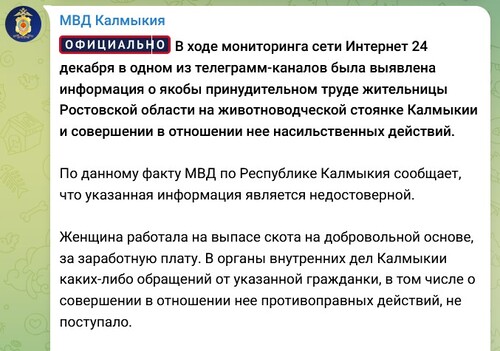 The Kalmykia Ministry of Internal Affairs commented on the story of the Rostov Region resident on December 24, 2025, in its Telegram channel.
"Information about alleged forced labor was found in one of the Telegram channels. A resident of the Rostov Region was found at a livestock camp in Kalmykia and violent acts were committed against her. Regarding this incident, the Ministry of Internal Affairs of the Republic of Kalmykia reports that the information provided is false," the agency stated.
She worked grazing livestock on a voluntary basis, for wages.
The woman "worked grazing livestock on a voluntary basis, for wages," the publication claims. "The Kalmykia internal affairs agencies have not received any complaints from the aforementioned citizen, including allegations of unlawful acts against her," the ministry reported.
The ministry did not specify whether a procedural review of the woman's rights violation was conducted.
As a reminder, in June 2025, it became known that volunteers, with the assistance of the police, freed 11 people who were being held at an agricultural enterprise in the Slavyansky district of Kuban. "They were recruited near metro stations and train stations, promised good living conditions, work in the gardens outdoors, and pay of up to 3,000 rubles per shift with daily allowances. Residents reported that any independent movement outside the fenced area, or even within it, was prohibited; all movement required permission and an escort. Violations of the rules were met with beatings, and escape attempts were suppressed. Among the residents were people who had worked for anywhere from a few days to a year and a half. None of them had ever received a salary," reported the Alternative movement.
We encountered about 20 such cases in Kalmykia.
Labor slavery is a problem characteristic throughout Russia, including in the south of the country, Oleg Melnikov, head of the Alternative movement, reported in May 2019. "We've encountered about 20 such cases in Kalmykia, a little more in Dagestan, a little less in Chechnya, 5-7 in Ingushetia, about 40 in Krasnodar Krai, and about 20-30 in Rostov Oblast," he said.
Only those who declare themselves to be forced laborers can be helped out of forced labor, Oleg Melnikov said in January 2020, after the release of three people in Dagestan. Criminal charges against slave labor exist, but they are practically ineffective, lawyer Abusupyan Gaitayev confirmed at the time.
People who are unaccustomed to defending their rights and fear retaliation end up in labor slavery, which allows their recruiters and exploiters to remain unpunished, the Alternative movement previously noted. In the North Caucasus, slavery was the norm until the early 20th century, noted ethnographer Olga Shafranova.
Translated automatically via OpenAI from https://www.kavkaz-uzel.eu/articles/420055



![Tumso Abdurakhmanov. Screenshot from video posted by Abu-Saddam Shishani [LIVE] http://www.youtube.com/watch?v=mIR3s7AB0Uw](/system/uploads/article_image/image/0001/18460/main_image_Tumso.jpg "Tumso Abdurakhmanov. Screenshot from video posted by Abu-Saddam Shishani [LIVE] http://www.youtube.com/watch?v=mIR3s7AB0Uw")