

Descendants of Volga Germans share memories of victims of Stalinist repressions
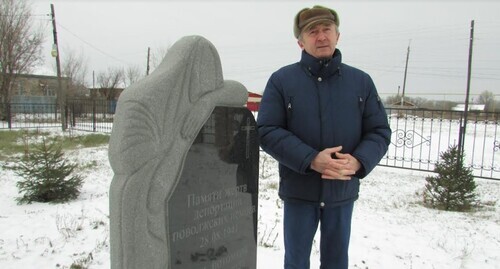
Some of the Germans who had lived near the Volga River, and who suffered from deportation during Stalin's time, after returning to Russia found their houses occupied and settled in other territories, the members of the German community in the village of Verkhniy Eruslan, Volgograd Region, have reported. Now, the descendants of the deportees are studying those events trying to restore the historical memory.
In October 2021, the deportees' descendants reported that even 80 years after the deportation of Volga Germans from Volgograd, the issue of reasonable actions of the Soviet authorities remains open.
After the invasion of German troops into the USSR, the Autonomous Republic of Volga Germans was liquidated. On August 28, 1941, USSR authorities issued a decree on the resettlement of Germans from the Volga region; and about a million of them were deported to Kazakhstan, Siberia and Central Asia; others were mobilized into labour armies. The deported and mobilized Germans died en masse from exhaustion, diseases and unbearable conditions.
On December 13, 1955, the Presidium of the Supreme Soviet of the USSR issued a decree on lifting the restrictions from the Soviet Germans that had been placed into special settlement. This date is marked by Russian Germans as the moment of the end of repressions and start of their return to their homeland. Now, there are four German communities in the Volgograd Region. According to the 2010 census, more than 17,000 Volga Germans live in the region. One of the German communities is in the village of Verkhniy Eruslan, Staropoltavsky District, which was visited by the "Caucasian Knot" correspondent.
Anatoly Zyakin, the chairman of the church council of the Lutheran community of the village, showed the interiors of the local Lutheran church. 21 years ago, a Lutheran community was registered in the village; now it has 15 members. According to Zyakin, the church is gradually being restored with the help of the community and at the expense of sponsors.
Anatoly's maternal family was deported in September 1941. According to him, the whole grandmother's family was scattered to different places in the USSR. Anatoly's grandmother ended up in the village of Ladyzhenka, Akmola District of Kazakhstan. According to her stories, the deported Germans were "very much helped by local Kazakhs"; they sheltered the newcomers.
In 1958, the family returned to Russia; but they were not allowed into Laub, as their house had been occupied long ago. They settled in the village of Gnadentau, which was renamed as Verkhniy Eruslan after the war. Other Anatoly's relatives had already settled there before.
Lydia Damzen, a member of the Lutheran community of Verkhniy Eruslan, also told the story of her family. Her ancestors – the Miller family – had lived in Gnadentau. During the deportation, Lydia's parents were children.
The woman has noted that her family members did not express any resentment against authorities for the deportation and the deprivations and sufferings associated therewith.
Let us remind you that in Soviet times, the mass deportations of Balkars, Chechens and other Caucasian nations were justified by myths about their mass betrayal and desertion.
This article was originally published on the Russian page of 24/7 Internet agency ‘Caucasian Knot’ on December 19, 2022 at 04:45 pm MSK. To access the full text of the article, click here.
Source: СK correspondent



![Tumso Abdurakhmanov. Screenshot from video posted by Abu-Saddam Shishani [LIVE] http://www.youtube.com/watch?v=mIR3s7AB0Uw](/system/uploads/article_image/image/0001/18460/main_image_Tumso.jpg "Tumso Abdurakhmanov. Screenshot from video posted by Abu-Saddam Shishani [LIVE] http://www.youtube.com/watch?v=mIR3s7AB0Uw")