

Human rights defenders called the pressure on voters a standard practice in Chechnya.
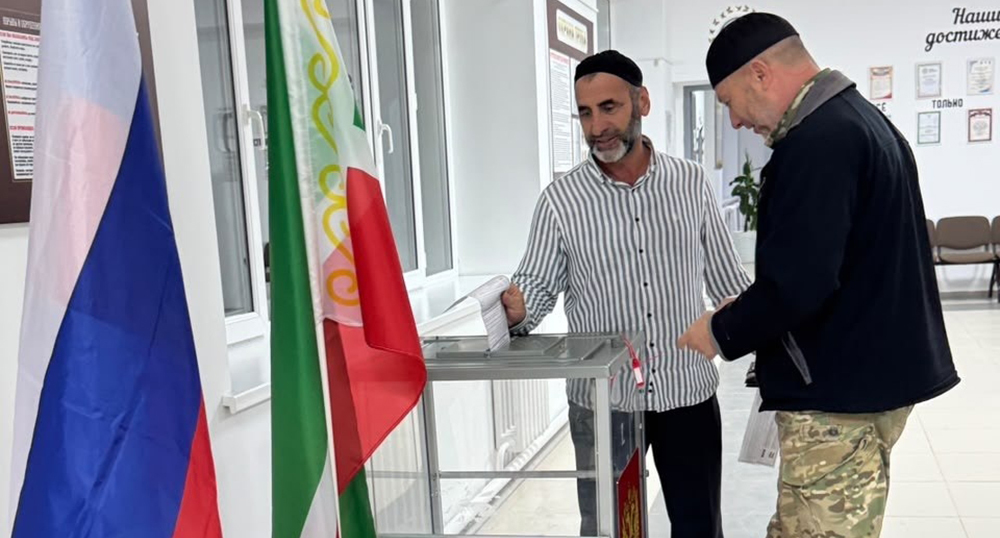
Threats of dismissal and expulsion, coercion to participate in voting and other mass events, as well as pressure through a network of informants are constantly applied in Chechnya, not only during elections, human rights defenders interviewed by "Caucasian Knot" noted.
As reported by "Caucasian Knot", on September 19, a human rights defender reported that security forces in Chechnya conducted unofficial raids on the homes of residents registered with the Ministry of Internal Affairs before the elections, and school class leaders gather parents of students and organizedly send them to polling stations,
An opposition Telegram channel to the Chechen authorities published an audio message on September 19, in which the head of one of the district departments of the Ministry of Internal Affairs allegedly demanded that residents of the village of Geldagan participate in the elections. According to him, "we have (our) people sitting in every school," and by surnames "it will be clear who came and who did not." He threatened those who did not participate with "deterioration of relations."
Reports of raids by security forces in Chechnya came even before the official meeting of the authorities, at which the head of the republic, Ramzan Kadyrov, demanded to intensify the fight against "hostile ideology," noted human rights defender Maxim Rudnev. "In general, a well-known village, in terms of such stories, similar events are often recorded there," he told a correspondent of "Caucasian Knot."
This is a classic situation not only before elections but also generally a usual daily agenda in Chechnya, he continued. "The network of informants is very large, many receive quite large sums of money for their reports, and suddenly they may acquire new cars and houses, to the surprise of their fellow villagers," Rudnev said.
He noted that attention is primarily paid to those who have already had some "misdeeds" before the Ministry of Internal Affairs, were registered or are simply informally under surveillance.
"All this is closely related to that very network of informants. Someone reported either out of revenge, since, for example, inter-clan relations in Chechnya are quite "hot" and one clan can fall out of favor with another, for example, because at some point a person from one clan insulted a person from another, or he said something carelessly. Or due to careless statements, or simply for personal gain," Rudnev explained.
He found it difficult to say where the detained individuals might be taken. "It depends on what this person did. They can be held for a couple of days, they can be released, or they may not be," the human rights defender believes.
Residents of Chechnya mainly reported threats of dismissal, expulsion from schools and universities, he continued. "Again, all this exists in Chechnya regardless of the election period. If you, as a student, for example, did not vote, did not attend some mass rally, did not contribute money for something – then you can put a cross on your student life/studies. At the same time, you will most likely also be subjected to a "comradely court," saying that you are such a bad person for not attending the event. The administrative resource works fully both during elections and outside of them," Rudnev pointed out.
Another human rights defender, familiar with the situation in Chechnya, also stated that the administrative resource in the republic is used permanently, regardless of whether there are elections or not.
"We did not monitor these elections because everyone already knew the result. Whether there were violations during the elections – it did not matter, they never influenced the result. This is true across Russia. In Chechnya, election results are always fabricated long before the voting day. Protocols with final results are prepared about a week in advance," the human rights defender explained to a correspondent of "Caucasian Knot" on condition of anonymity.
Pressure on voters in Chechnya is a common picture, noted Chechen political scientist Ruslan Kutaev*. "Everything is as usual: people were herded, asked, came, results were fabricated. But this is an exclusively general picture. I have no information about detentions or any obvious violations related to the elections in any particular locality or at any particular polling station," Kutaev told a correspondent of "Caucasian Knot."
Recall that according to the Central Election Commission, after processing 100% of the ballots, Kadyrov received a record 99.85% of the votes in the elections for the head of Chechnya, while his opponents Ismail Denilkhanov and Khalid Nakayev received 0.05% each.
On September 9, it became known that Ramzan Kadyrov instructed security forces to maintain heightened vigilance before the elections and to suppress the spread of extremist and other, in his wording, alien ideologies. He also demanded to check residents at their place of residence if there are suspicions against them. On September 12, the Chechen election commission reported the early completion of house-to-house visits of voters: 2260 visitors attended 288,475 addresses, and in Argun, schoolchildren and representatives of youth organizations were involved in informing residents.
We have updated the applications on Android and IOS! We would appreciate feedback, ideas for development both in Google Play/App Store and on the KU pages in social networks. Without installing a VPN, you can read us on Telegram (in Dagestan, Chechnya, and Ingushetia – with VPN). Through VPN, you can continue to read "Caucasian Knot" on the website, as usual, and on social networks Facebook**, Instagram**, "VKontakte", "Odnoklassniki" and X. You can watch videos of "Caucasian Knot" on YouTube.
* included in the register of foreign agents by the Ministry of Justice of Russia.
** the activities of the Meta company (which owns Facebook, Instagram, and WhatsApp) are banned in Russia.
Translated automatically via OpenAI from https://www.kavkaz-uzel.eu/articles/426873

![Tumso Abdurakhmanov. Screenshot from video posted by Abu-Saddam Shishani [LIVE] http://www.youtube.com/watch?v=mIR3s7AB0Uw](/system/uploads/article_image/image/0001/18460/main_image_Tumso.jpg "Tumso Abdurakhmanov. Screenshot from video posted by Abu-Saddam Shishani [LIVE] http://www.youtube.com/watch?v=mIR3s7AB0Uw")