

Mirza Sakit: situation in Azerbaijani prisons is horrifying
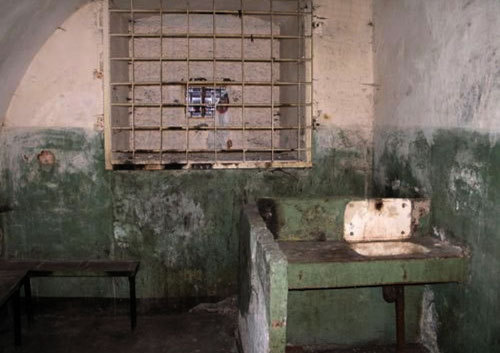
The "Caucasian Knot" correspondent reports that on April 17 at a press conference held in the Institute of Reporters' Freedom and Safety (IRFS) poet-satirist Mirza Sakit (Sakit Zakhidov), journalist of the "Azadlyg" (Freedom) newspaper, stated that the situation in prisons of Azerbaijan is horrifying: prisoners are humiliated and exposed to torture; bribe-taking flourishes.
According to Mr Sakit, in Azerbaijani prisons practically all prisoners' rights are trampled upon, including the suffrage. In particular, at the Penitentiary Establishment No. 10, where he spent his last six months, the outcomes of the voting at the March 18 referendum on amendments to the Constitution were falsified.
"None of 600 prisoners was given a ballot paper," said the satirist. The voting was done by the colony personnel. The inmates were just given lists to sign, but they saw no ballot papers.
"I wanted to send a telegram to the Central Electoral Commission (CEC), but it wasn't sent from the colony. Then, I delivered my appeal to the "Azadlyg", and it was published on March 22, but the CEC took no measures," Mirza Sakit continued.
Speaking about the facts of corruption, Mirza Sakit has noted that colony managers, acting together with judges, abuse legislation provisions. Thus, after a prisoner has served one third of his or her term of punishment, he or she can be transferred to the so-called "commandant's office regime" (the prisoner is actually released and has only to come and get registered periodically at the penitentiary establishment). For every year of such regime the prisoner shall pay 1000-1500 manats (1200-1800 US dollars). Besides, during his or her "commandant's office regime" the mandatory monthly bribe to the administration makes 100-200 manats (120-240 US dollars).
In Colony No. 14, where Mirza Sakit spent his first 2.5 years, along with corruption, conditions for inmates are intolerable.
A refined torture there was harnessing of prisoners to a plough like horses. "They have a land plot there about 0.1 hectares, and inmates were forced, with no real sense, to dig land with shovels. Besides, inmates were harnessed in pairs to a plough of 60-70 kilos and forced to plough," said Mirza Sakit. Only after interference of human rights activists the plough was removed from the colony.
The former prisoner recalls that colony boss Arshad Gasanov personally participated in scorning prisoners. "In particular, he pissed on Turkish citizen Gamid Dogan. I told human rights activist Chingiz Ganizade about it, but he had preferred to hide this fact," said Mirza Sakit.
Prisoners' food is also horrifying. "Meals are cooked on already used vegetable oil, which causes gastric diseases in prisoners," he added.
Human rights activist Chingiz Ganizade, a member of the Public Committee for monitoring the Penitentiary System, refuted, in his conversation with the "Caucasian Knot" correspondent, Mirza Sakit's accusation about concealment of prisoner's humiliation fact.
Mr Ganizade has confirmed that he met the above Turkish citizen in the colony. "We discussed his complaint at the Public Committee and delivered the information to the bosses of the Penitentiary Service. After Mirza Sakit was haircut by force, we also managed to meet Fikret Mamedov, Minister of Justice. After our appeals, a commission was send to check Colony No. 14," said Mr Ganizade. He added that the Turkish citizen had no claims to him and even called him after getting at large.
Evaluating the situation with torture in prisons as a whole, Ganizade said that "inmates very seldom complain of physical violence." "In prisons, inmates stick to their unwritten laws and rules and prefer not to complain," he added.
In his turn, Mekhman Sadygov, head of the PR department of the Penitentiary Service has treated the statements about bribery and torture in prisons as "fiction and ravings ".
Source: CK correspondent
![Tumso Abdurakhmanov. Screenshot from video posted by Abu-Saddam Shishani [LIVE] http://www.youtube.com/watch?v=mIR3s7AB0Uw](/system/uploads/article_image/image/0001/18460/main_image_Tumso.jpg "Tumso Abdurakhmanov. Screenshot from video posted by Abu-Saddam Shishani [LIVE] http://www.youtube.com/watch?v=mIR3s7AB0Uw")