


Analysts in Baku and Yerevan assessed the idea of enclave exchanges.
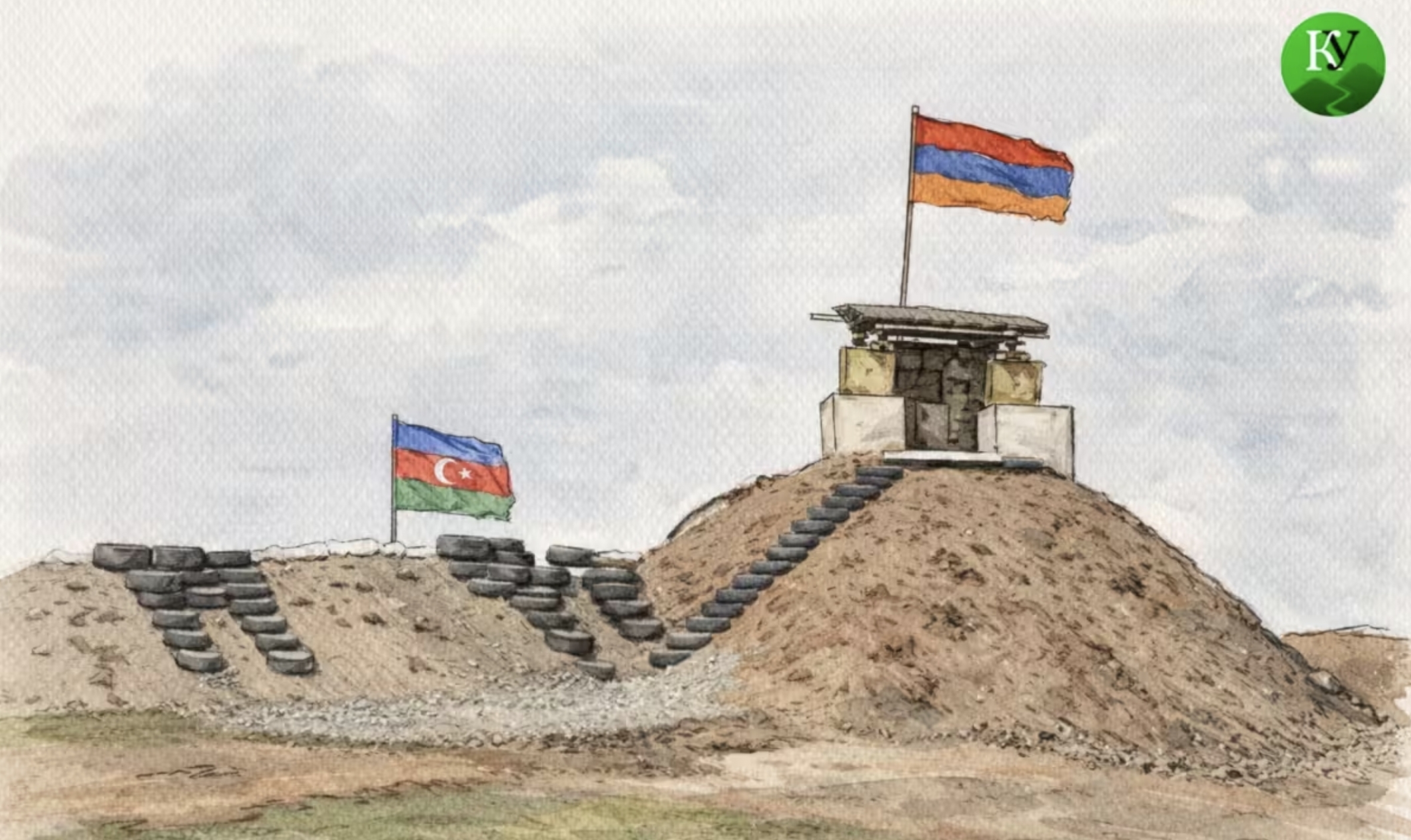
The proposal by Nikol Pashinyan to exchange territories with Azerbaijan was perceived ambiguously by the political scientists from Armenia interviewed by "Caucasian Knot," pointing to legal complexities and security risks. Azerbaijani analysts considered the idea rational but opposed the retention of Artsvashen by Armenia.
As reported by "Caucasian Knot", on October 14, Armenian Prime Minister Nikol Pashinyan proposed to resolve the issue of enclaves and exclaves on the border with Azerbaijan by exchanging territories of equal area. According to him, after the delimitation of the border, there should be no enclaves left on either side, and all communications should be unblocked. Pashinyan referred to his preliminary impression from conversations with Azerbaijani President Ilham Aliyev in Turkmenistan.
Analysts from both countries interviewed by "Caucasian Knot" assessed the realism of the exchange, legal obstacles, and the impact on the TRIPP project – a route through Armenian territory that is supposed to connect Azerbaijan with Nakhchivan. Opinions differ within each country: Armenian speakers evaluate the idea itself differently, while Azerbaijani ones discuss the necessity of a referendum.
Assessments in Armenia: from a realistic idea to a threat to defense
Political scientist Mikael Zolyan called the exchange of enclaves realistic and cited regional precedents. "The exchange of territories is quite real, and there are many similar examples in international practice. Even in the post-Soviet space, we have observed similar processes relatively recently in Central Asia – between Kyrgyzstan and Uzbekistan, as well as between Tajikistan and Kyrgyzstan. In the second case, there were initially military clashes, but ultimately the parties reached an agreement," he told "Caucasian Knot."
The legislation of both countries generally allows for such a step, but a referendum may be required, Zolyan explained. "There are different points of view: one of them is that if the total area of the state does not change, then a referendum is not necessary. However, from a political point of view, a referendum would be extremely desirable. This is necessary for the decision to gain final legitimacy from both sides and not to raise doubts in the future," he added.
The exchange does not threaten TRIPP, the political scientist believes. "The process of exchanging territories does not threaten the TRIPP project but mutually helps its implementation. As for the reaction of Armenian society, the transfer of enclaves in their historical enclave status would be perceived much more negatively than their 'mirror' accounting. If there are specific nuances, the state can provide compensation. Compared to the protests that accompanied the first stage of delimitation and the 'Tavush for the Homeland' movement, the current process should not cause significant social upheaval," Zolyan summarized.
Political scientist David Stepanyan believes that the transfer of territories will require overcoming complex constitutional procedures. "From a legal point of view, the exchange procedure will require both countries to hold nationwide referendums or to find the most complex formulations for demarcation. According to Article 205 of the Constitution of Armenia, any issues regarding changes to the territory of the republic are resolved exclusively by referendum, which carries significant domestic political risks. Similarly, Article 11 of the Constitution of Azerbaijan enshrines the indivisibility of territory and allows changes to state borders only through a nationwide vote. To avoid voting, the authorities will have to interpret this process not as the alienation of land but as a technical clarification and fixing of the interstate border based on agreed maps," he told "Caucasian Knot."
The main obstacles to the exchange are the painful reactions of residents of border villages, who fear losing security, water, and pastures, the need for compensation for private property, and the relocation of interstate highways, such as the Yerevan – Meghri road, Stepanyan noted. "The peaceful and institutional exchange of territories does not threaten the TRIPP project but serves as its logical guarantee. Risks for transit will only arise if the process drags on, provokes mass protests within the countries, or if the issue of enclaves is used as a pretext to delay the signing of a peace agreement, creating a threat of renewed hostilities," the political scientist summarized.
Political scientist Artak Khachikyan is convinced that unilateral concessions under the guise of demarcation undermine Armenia's defense capability. "Any discussions about surrendering so-called enclaves are a direct step towards national catastrophe and the destruction of Armenia's military logistics. Unilateral discussions of this issue by the authorities under the dictation of Baku jeopardize key strategic highways connecting Yerevan with the south of the country and with Iran, as well as routes towards Georgia. The exchange of enclaves is an illusion of a peace process that Baku uses as a tool for the bloodless capture of dominant heights and critical nodes. Surrendering strategic positions for dubious projects like the 'Trump corridor' or unblocking is a direct undermining of state sovereignty," he told "Caucasian Knot."
In Khachikyan's opinion, such actions have no legal force: Soviet administrative maps were developed in the interests of the center, without regard to the sovereign rights of Armenia. He believes that demarcation cannot be conducted under conditions of ongoing pressure and without resolving the issue of Armenian territories, which, in his assessment, remain under Azerbaijani control.
"It is impossible to talk about enclaves and the exchange of territories when Azerbaijan itself continues to occupy hundreds of square kilometers of sovereign Armenian territory seized as a result of aggressions in 2021-2022. No referendum and no legitimization of concessions will justify in the eyes of the people the surrender of strategically important heights. If the authorities proceed with the transfer of these territories under the pretext of conducting borders or advancing logistical projects, it will not only provoke a profound domestic political crisis but also finally deprive Armenia of the means for self-defense," Khachikyan noted.
Assessments in Azerbaijan: the idea is rational, but Artsvashen is disputed
Editor of the analytical service of the Turan agency Shahin Gadzhiev noted that Pashinyan stated twice within two days about the possibility of exchanging territories for the purpose of a final peace settlement. If on October 14 the Prime Minister spoke about this in principle, then on October 15 at a government meeting he detailed his vision somewhat, the analyst noted.
On October 15, at a briefing after the government meeting, Pashinyan stated that there is no agreement yet, but "there is an understanding." He mentioned the villages of Kyarki, Barkhudarli, Sofulu, Askipara, and Artsvashen (Azerbaijani name – Bashkend). Artsvashen, according to him, "should be part of Armenia," and the configuration of the village can be slightly changed so that there is no foreign land between it and the main territory of the country, the publication "Voice of Armenia" reported. A similar approach is possible on the other side, the Prime Minister added.
At the same time, Pashinyan did not present maps, areas of the plots, or exchange schemes, Gadzhiev pointed out. "It is unclear whether the transfer of connecting territories is implied, whether the outlines of the plots will change, or whether another mechanism will be used. Pashinyan's words also do not allow us to conclude that the parties have agreed to return all enclaves to their former owners. It is unclear whether in all cases there can be an exchange of connecting territories," he told "Caucasian Knot."
The order of legal formalization also remains open, the expert added: Armenian Foreign Minister Ararat Mirzoyan stated that the transfer of part of the territory to another state in exchange for another territory implies a nationwide vote.
Under the control of Yerevan, the analyst emphasized, there are more territories of Azerbaijan than Baku has of Armenia. According to him, these are the villages of Yukhary Askipara, Barkhudarli, and Sofulu of the Gazakh district, which came under Armenian control in the early 1990s, and the village of Kyarki of the Sadarak district of the Nakhchivan Autonomous Republic. Yukhary Askipara and Kyarki are separate enclaves, while Barkhudarli and Sofulu form one enclave. Under Baku's control, the analyst added, is the village of Artsvashen (Bashkend) in Armenia.
According to Gadzhiev, the idea of an exchange has a rational basis. "When enclaves are preserved, it is necessary to address issues of transport communication, the procedure for crossing the interstate border, and ensuring the safety of returning populations, considering that they will be surrounded by residents of the country with which their state was recently in conflict," he explained.
Pashinyan's proposal to retain Artsvashen for Armenia seems irrational, the analyst believes. "This village is deeply embedded in the territory of Azerbaijan – the Goychay district. Moreover, it is a high mountainous area with a complex terrain. The distance from the border of Armenia to the center of the settlement is 7-8 kilometers, and if a road is built from the nearest settlement in Armenia, it will be about the same distance," Gadzhiev said. According to him, it is more expedient to conduct the exchange of territories without deepening the bends of the border line but by straightening it.
The optimal solution, the expert called the legal transfer of Artsvashen to Azerbaijan: this would preserve communications between remote villages of the Goychay district and the district center. In exchange, Armenia could receive the village of Yukhary Askipara of the Gazakh district. For Yerevan, it is especially important, as the main highway to Georgia runs nearby. The village of Kyarki (Armenian name – Tigranashen), through which the road from Yerevan to Iran passes, Armenia could retain for itself.
The villages of Sofulu and Barkhudarli, in Gadzhiev's opinion, should remain with Azerbaijan, and Armenia should concede territories that will connect them with the rest of the country. The area of Kyarki and Yukhary Askipara together is larger than that of Artsvashen and the territory needed to connect Barkhudarli and Sofulu with Azerbaijan. The remaining difference can be compensated to Azerbaijan during delimitation and demarcation at other sections of the border, the expert believes.
According to the constitution of Azerbaijan, changes to borders are allowed only through a referendum, Gadzhiev reminded. Member of the Azerbaijani National Committee for Eurointegration Togrul Juvarly believes that the issue can be resolved without it. Since it concerns small border territories, the border line can be determined during delimitation and demarcation, fixed by an interstate agreement, and ratified in the Azerbaijani parliament, he explained to "Caucasian Knot."
Residents of villages whose territories will be transferred to another state may be compensated by the state, Juvarly added. In the variant described by Gadzhiev, Azerbaijani residents will not have to be relocated anywhere, as they have already settled in other regions of the country. There they can receive housing and land in private ownership. Residents of Barkhudarli and Sofulu can return to their villages after they come under Azerbaijani control.
Juvarly cited precedents for the exchange of territories in the resolution of disputes between states: agreements between Israel and Egypt, India and Bangladesh. Both experts stated that the exchange of territories will not affect the TRIPP project: enclave villages are located in completely different sections of the border.
Translated automatically via OpenAI from https://www.kavkaz-uzel.eu/articles/427510



![Tumso Abdurakhmanov. Screenshot from video posted by Abu-Saddam Shishani [LIVE] http://www.youtube.com/watch?v=mIR3s7AB0Uw](/system/uploads/article_image/image/0001/18460/main_image_Tumso.jpg "Tumso Abdurakhmanov. Screenshot from video posted by Abu-Saddam Shishani [LIVE] http://www.youtube.com/watch?v=mIR3s7AB0Uw")