


The human rights defender called the apologies of the Nalchik resident through the newspaper a precedent.
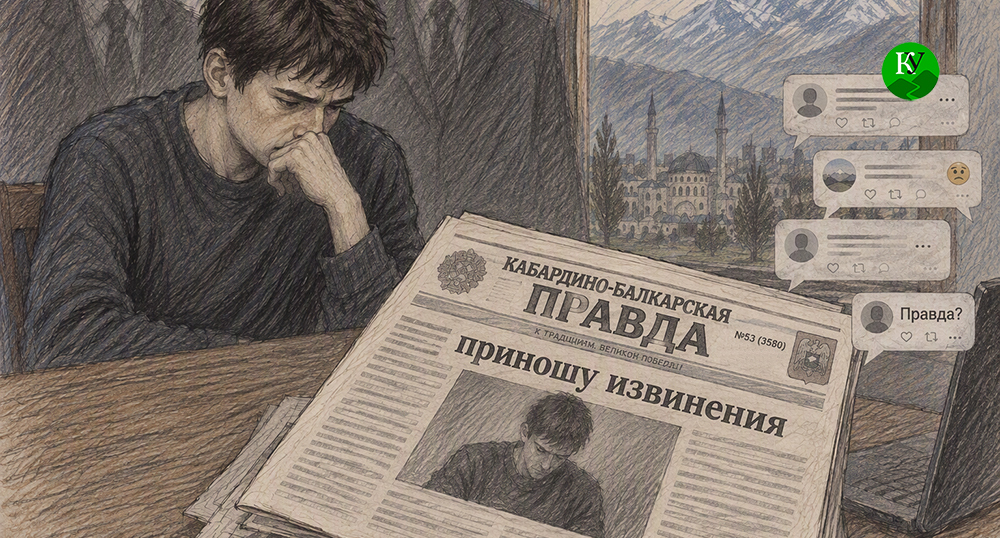
The publication in "Kabardino-Balkarian Truth" of the apologies of Nalchik resident Eldar Aloev, accused of preparing a terrorist act, became the first such case in the republic, noted human rights defender Zaur Shokuev. The special status of Chechnya, where public apologies have become widespread, may encourage leaders of other regions to adopt and develop this practice, believes human rights activist Svetlana Gannushkina*.
As reported by "Caucasian Knot", on September 30, social media users considered the public apologies of 25-year-old Nalchik resident Eldar Aloev, arrested on charges of preparing a terrorist act and involvement in a terrorist organization, to be excessive, and doubted that the text of the apologies was written by him. Earlier, Aloev appealed to the human rights commissioner in Kabardino-Balkaria for help in publishing a statement of remorse and public apologies. In a note published on September 26 in "Kabardino-Balkarian Truth", Aloev publicly apologized and acknowledged his guilt.
The practice of public apologies, initiated by Ramzan Kadyrov, has spread beyond Chechnya to other regions of Russia. More about this practice can be read in the "Caucasian Knot" reference "The Fashion for Apologies: From Chechnya to the Outskirts". "Caucasian Knot" also maintains the "Chronicle of Public Apologies in the Caucasus".
There have been no appeals from the relatives or lawyers of Nalchik resident Eldar Aloev to the Kabardino-Balkarian [........], reported a representative of the center Zaur Shokuev. "No appeals have been received from either the lawyer or the relatives," he told a correspondent of "Caucasian Knot".
Shokuev described the publication of apologies through official press as a new phenomenon for Kabardino-Balkaria. "Such cases were not observed before," he noted.
Shokuev did not rule out that the text of the apologies could have been prepared under dictation. "Few would publicly apologize of their own accord, excluding external pressure," he pointed out.
The publication of apologies in an official media outlet surprised Shokuev. "As a rule, we learned about such cases not from unofficial channels, like Telegram channels, YouTube, and the like," he explained.
Previously, the human rights commissioner in Kabardino-Balkaria did not act as a channel for publishing such statements, Shokuev noted. "I don't know about other regions, but for us it definitely was not the norm," he emphasized.
The newspaper "Kabardino-Balkarian Truth" was established by the parliament and government of the republic.
The special status of Chechnya in Russia may evoke a desire among leaders of other regions to imitate and surpass its authorities in such practices, believes the chairperson of the "Civic Assistance" Committee* Svetlana Gannushkina*. "This may provoke a desire among other leaders to imitate and surpass. Why not do it this way: loudly and noticeably?" she told a correspondent of "Caucasian Knot".
It cannot be confidently asserted that Aloev's apologies were written under dictation, but they were certainly coordinated, believes Gannushkina*. "Otherwise, how would such an official newspaper publish them?" she pointed out.
Regional human rights commissioners vary significantly in their work, Gannushkina* added. "I won't name names to avoid discrediting them by proximity to a foreign agent, but we work quite closely with some of them," she explained.
We have updated the apps on Android and IOS! We would appreciate feedback, ideas for development both in Google Play/App Store and on the KU pages in social networks. Without installing a VPN, you can read us on Telegram (in Dagestan, Chechnya, and Ingushetia – with a VPN). Through a VPN, you can continue to read "Caucasian Knot" on the website, as usual, and on social networks Facebook**, Instagram**, "VKontakte", "Odnoklassniki" and X. You can watch videos of "Caucasian Knot" on YouTube.
* included by the Ministry of Justice of Russia in the register of foreign agents.
** the activities of the company Meta (which owns Facebook, Instagram, and WhatsApp) are banned in Russia.
Translated automatically via OpenAI from https://www.kavkaz-uzel.eu/articles/427184


![Tumso Abdurakhmanov. Screenshot from video posted by Abu-Saddam Shishani [LIVE] http://www.youtube.com/watch?v=mIR3s7AB0Uw](/system/uploads/article_image/image/0001/18460/main_image_Tumso.jpg "Tumso Abdurakhmanov. Screenshot from video posted by Abu-Saddam Shishani [LIVE] http://www.youtube.com/watch?v=mIR3s7AB0Uw")