

Residents of the flooded villages of Dagestan complained about difficulties in receiving payments.
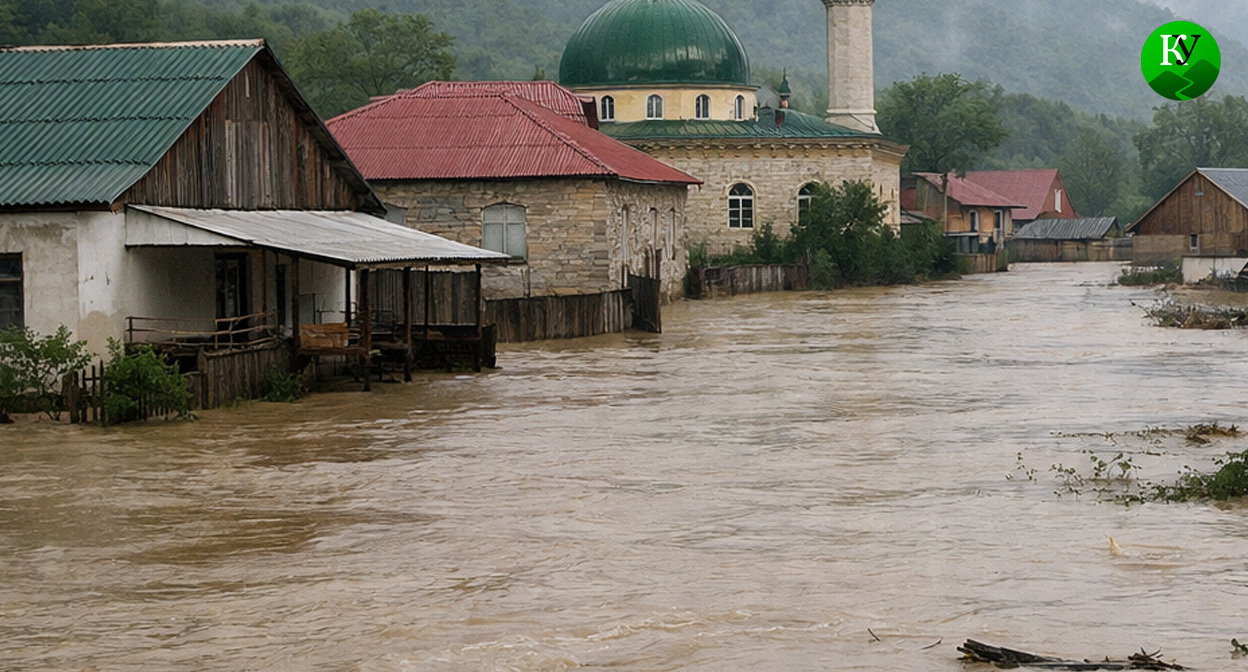
Residents of the Khasavyurt district affected by the spring flood reported that they had to seek payments through the prosecutor's office, undergo repeated inspections of their homes, and turn to independent experts. Officials did not explain the reasons for the refusals and canceled previously made decisions regarding the need for major repairs, the villagers complained.
As reported by "Caucasian Knot", the floods caused by heavy rains occurred in the North Caucasus in late March - early April and became one of the most destructive in recent years. In Dagestan, six people died as a result of the flooding. On July 23, residents of the flood-affected village of Adilyotar in the Khasavyurt district reported that they received payments for the loss of property, but the amount covered only part of the damage: crops were damaged, livestock perished, and repairs to homes are needed. At the same time, housing certificates for those who lost their homes have still not been issued. The head of the village indicated that the authorities are doing everything necessary, but payments take time, and the livestock that arrived in the village is being distributed to those in greater need.
The most affected by the elements were Dagestan and Chechnya, according to a report from "Caucasian Knot" "Spring Flooding in the North Caucasus-2026". Materials on flooding in the republics of the North Caucasus in the spring of 2026 were collected by "Caucasian Knot" on the thematic page "Flooding in the North Caucasus".
The head of the Dagestan government Magomed Ramazanov reported on the completion of the inspection of the housing stock affected by the flood. "In Dagestan, the inspection of the housing stock affected by the large-scale spring flood has been fully completed," the government of the republic quoted Ramazanov's words on its website on July 10, expressed during a meeting of the commission for eliminating the consequences of the floods.
At the same time, it is too early to talk about the final completion of the inspection of the housing stock, Ramazanov added. "Currently, the authorities are re-examining applications from citizens who were initially denied payments. Based on the provided act of independent expertise and pre-trial claims, the government of the republic has already approved about 2,000 previously rejected applications," explained the head of the Dagestan government.
Residents of Tutlar spoke about the first phase of the flood
To prove that the house needed major repairs, a lot of time and health had to be spent, complained a resident of the village of Tutlar Zumrut Ezhueva. It is quite possible that among the unsatisfied complaints, the lists of which "were not announced by the authorities," would be her name, she added.
"When my husband was alive, he resolved all disputed issues outside the home quite quickly. Now I am the head of the family, and solving all problems is my concern. For the first time after my husband's death, our life went according to a well-established routine. The older daughters Liana, Rayana, and Sumaya studied, helped around the house, and looked after the younger brothers - Idris and one-and-a-half-year-old Dzhavathan. We had chickens, a vegetable garden, an orchard - everything that is supposed to have if you live in a village. We were preparing for spring, the buds on the trees had already swollen. And then such a disaster happened," Ezhueva told a correspondent of "Caucasian Knot".
The heavy rain that began on the night of March 28 to 29 did not bode well, said a resident of the village of Tutlar Ibrahim.
"Our village is small, about 100 houses, and almost half are located near the Akhtash River, which that night literally overflowed its banks before our eyes. The water was rising rapidly, entering homes, destroying adobe buildings. Women, children, and sick elderly people were urgently evacuated. Mostly men remained in the village. The downpour did not stop, and it was clear: real danger had come to the village, and if no measures were taken, all village buildings would be underwater," he told a correspondent of "Caucasian Knot".
According to Ibrahim, residents made cuts on the road with shovels and other improvised means to partially drain the flooded area into the fields.
Zumrut was evacuated from the village with five children as soon as the flooding began.
"We live on the edge of the village, the water had not yet entered the house, but the entire yard, where the outbuildings, vegetable garden, and orchard were, was all underwater. At first, I thought: if the water did not enter the house, why leave? The rain will stop, and the water will recede, as it had happened before. But the people who came for us urged us, saying that the downpour was intensifying and the water level could rise even higher and flood the house. At that time, I had no idea of the scale of the flooding. I only noticed that the outbuildings, including the chicken coop, were already flooded. Moreover, while I was gathering the children, the water in the yard was already ankle-deep. The downpour was so strong that behind the curtain of rain, I could not see the fence of my house. I realized that the situation was indeed very serious. Staying with the children in a house that could soon be flooded was risky and unsafe," Zumrut recounted.
Having packed mainly what was necessary for the youngest, she decided to leave with her family. "We were taken from Tutlar by bus. I realized that our entire village was literally flooded when I saw that the wheels of the truck in front, which was carrying many people who were also evacuated, were sinking in the water," the woman recalled.
Initially, the evacuated residents were placed in the school of the village of Saleh, Zumrut reported.
"We were brought to the village of Saleh. There, conditions were already being created in the school for those evacuated from three villages. There were many people. And my grandmother lives in Kalininaul. I called her, and it turned out that their village was spared by the flood. And we were taken there. As I thought, just for a week," she added.
The repeated flood caused significant damage to the villagers
The hopes of the residents of Tutlar that the downpour would stop and the night trials for the villagers would end were not fulfilled, Ibrahim reported. The second wave occurred on April 5-6. The repeated and, as everyone thought, more powerful flow came when residents began to clean their homes and yards of the dirt and silt left after the first flooding.
One of the residents of Tutlar lost almost all his livestock during the second wave of the flood, a villager told visiting Dagestan after the second flood Russian blogger and musician Eldar Dzharkhov.
"Before the second flood, I still had 200 rams, but now only one is left. The others were swept away by the water along with the chickens," he told Dzharkhov.
Even elderly residents of the village participated in the fight against the elements, with one villager particularly noting the role of excavator operator Zalikhman Dudaev.
"Everyone fought against the flood, even 80-year-old old men did not sit at home, they went out with shovels to make barriers against the water. However, if it weren't for our village excavator operator Zalikhman Dudaev, 55 houses would not have been flooded, but all 100! The guy did not leave the excavator cabin for two days! He saved our Tutlar, I tell you!" he told Dzharkhov.
The words of Eldar Dzharkhov's interlocutor were confirmed by the editor of the popular newspaper "Niyso-Dagestan" Umar Yakiev. In his opinion, thanks to Zalikhman, the village avoided major problems during the second flood.
"On his excavator, he dug a deep trench through which water from the village streets and yards literally flowed into the fields, carrying away fences and already half-destroyed adobe buildings. The guy spent almost two days on this titanic work, while the rain was pouring non-stop, and the excavator's bucket was struggling to bite into the heavy, silt-laden soil. At times it seemed that the equipment would not hold up, that Zalikhman himself would not have enough strength. But both held up, thus saving about forty houses that were in the zone of severe flooding," Yakiev told a correspondent of "Caucasian Knot".
Residents from various regions came to help the villagers
During his visit to Dagestan, blogger Eldar Dzharkhov appealed to fellow musicians and admirers of his talent to provide financial support to the flood-affected residents of the republic. On the same day, bloggers Ida Galich and Victoria Bonya transferred one million rubles each to the account indicated by Dzharkhov for helping the flood victims in Dagestan. Ksenia Borodina organized the delivery of 16 tons of drinking water. Musician and entrepreneur Dmitry Maslennikov, singer Basta (Vasily Vakulenko), TV presenter and entrepreneur Goar Avetisyan, singer Anya Pokrov, and many others actively supported the large-scale fundraising, thanks to which the total amount of donations exceeded approximately 500 million rubles.
Bloggers, artists, and athletes not only raised hundreds of millions of rubles but also personally visited the flooded villages. Famous athlete Askhab Tamayev came to the Khasavyurt district to coordinate assistance on the ground. Popular video blogger Mikhail Litvin flew to the republic and participated in the aftermath of the flooding in the first months. Khasbik (Khasbulla Magomedov) sold one of his cars and donated four million rubles to charitable foundations, as well as personally helped clear the debris.
Assistance was provided not only financially. The heads of Karachay-Cherkessia, Adygea, and Kabardino-Balkaria offered their help in accommodating families affected by the elements, reported an employee of the Khasavyurt district administration Vakhid Kasumov. Humanitarian aid began arriving from these republics from the first days. In addition, they offered to accommodate affected families in the best holiday homes, sanatoriums, and recreation centers with full board and medical care. Residents of several villages in the Nozhai-Yurt district, bordering the Chechen Republic, were ready to shelter large families whose homes were destroyed by the flood. Many, especially teachers, helped financially.
Residents of the most affected villages of Adilyotar, Kadyrotar, and Tutlar were grateful to their neighbors in southern Russia for their attention and willingness to help, but preferred to stay at home, Kasumov explained.
"They can be understood. Just as one cannot abandon a person during a serious illness, one cannot leave their home, even if it is half-destroyed, in the hope of restoring it. Because this house, although old and adobe, was built here, on this land, in the early years after returning from a thirteen-year exile. It was from these lands that the residents of the former Aukhovsky district, Chechen-Akkins, were sent into exile in Central Asia in February 1944," he told a correspondent of "Caucasian Knot".
Zumrut Ezhueva spoke about returning to Tutlar
Three days after the second wave of flooding, Zumrut Ezhueva, leaving her children in the care of her grandmother, went to Tutlar to see the condition of her house after the repeated flooding.
"The yard was flooded with a viscous mass of mud brought by the flood. It was hard to walk, my feet sank into the thick sticky mud, and I struggled to cover the distance from the gate to the house, risking losing my boots with every step. The barn was destroyed. The bodies of chickens were frozen in the mud," Zumrut recounted.
According to her, she hoped that the water had not entered the house, but upon opening the door, she had to leave that hope at the threshold. She saw puddles in the kitchen, the large room, and the children's rooms.
"I walked and felt the linoleum springing under my feet, with water sloshing underneath. The wallpaper in the kitchen sagged - which means the wall was damp. Water was in all the rooms during the flood. Now small puddles are visible in places, but a lot of water was clearly felt under the linoleum," she recounted.
Zumrut understood that she had a lot of work ahead to make the house dry and warm again.
"I immediately turned on the heating. The walls need to be dried so that the plaster does not fall off. The house is made of clay bricks, and moisture is deadly for them," the woman explained.
She immediately recognized the danger of increased humidity for her house. "I thought: if my husband were here, the head of the house, he would not stand there in confusion," she recalled. Zumrut sighed: now all decisions had to be made by her alone.
Ezhueva recounted that her husband died even before the birth of their youngest son.
"This happened far from home, in Crimea, where he went to earn money. In Dagestan, it is almost impossible for a family man to find work. We lived frugally, but there were, of course, ongoing expenses: to dress and shod the children, three study in school in Adilyotar - money is needed for the bus, and also for school supplies, for transport costs for trips to Khasavyurt: you can't mention it all. To conduct home heating, I had to take out a loan. The eldest daughter entered a law college, studied for a year on a budget, but then she had to continue her studies on a commercial basis. And there was no money, and there was no work for my husband," Zumrut recounted.
According to her, many were leaving for other places to find work at that time.
"Someone from our fellow countrymen suggested to my husband to go to Crimea to work in construction. The salary, living conditions - everything suited him: he calculated that after a year and a half of work, he could pay off the loan and pay for the eldest girl's college education. He was leaving and knew that we would have another child. He called every week on Saturdays, asking how the children were doing, inquiring about their health. He always spoke sparingly about himself: 'There is a lot of work, I am tired, I miss the children.' That day in the morning I was in Khasavyurt when my husband unexpectedly called. He asked me to sit all the children next to me in the evening and turn on the video on the phone. He said he missed us and wanted to see me and the children. I was on the bus, already returning home, when the phone rang, and an unfamiliar male voice informed me that my husband had passed away a few minutes ago. It seems he felt something when he called during the day, he wanted to see the children before he died. He didn't make it..." Zumrut recounted in a barely audible voice.
"A month later, I gave birth to a son, we named him after his father, Dzhavathan," she added.
How to live on, as a widow with five children, was dictated by the circumstances. According to the woman, this had always been the case in her life since she was a 15-year-old girl who was abducted, brought into a strange family, and called the wife of a little-known man. She recalls that she had to come to terms with her fate. She felt more compassion and warmth from her grandmother, especially on those days when her barely born firstborn, a boy, died.
"Endure," the old woman advised her granddaughter. "The Almighty will not leave you in trouble," Zumrut recalled her grandmother's teachings.
Officials demanded Zumrut to prove the actual existence of her children
The loss of her husband and father of the children became a great trial for the family, noted Ezhueva.
"But, thank God, I have two older daughters, my helpers, my hope, and support. I can't even imagine how I would solve all the problems caused by the officials of the Ministry of Labor and Social Development of the Republic of Dagestan without my daughters' help, with a small child in my arms. Just to restore justice and obtain financial assistance for victims of natural disasters in the amount of 15,675 rubles for each family member, I had to travel to Khasavyurt for almost half a month!" she recounted about her visits to the Ministry of Labor and social protection agencies, endless queues in each office, and communication with irritated officials.
Payments of financial assistance to victims of natural disasters were made in a relatively short time, but only for four family members, Zumrut noted.
"The youngest daughter and one-and-a-half-year-old son were inexplicably excluded from the list," she recounted.
After that, her "walks through torments" began: she had to prove that these two children really exist.
"Officials demanded to provide some more information that was already in the application: birth certificates, registration, information that the children are registered and live at the specified address. What other documents are needed? And in social protection, they keep saying: we are checking, there are doubts, come back in a day. But what doubts - they do not say. The officials did not provide any legal grounds for excluding the two from the list of recipients. Some officials behaved as if they were paying this money from their own pockets. At times I was in despair: how to prove that the children exist, are alive, and, thank God, healthy! I was advised to contact the prosecutor's office, and I did. Only after that were measures taken by the prosecutor's office regarding the fact of underpayment of benefits for two minor children. The Ministry of Labor and Social Development of the Republic of Dagestan was obliged to include the two children in the payment lists," Zumrut recounted.
Trips to Khasavyurt and communication with officials completely exhausted her.
"There are no buses, it takes an hour and a half to two hours to get to the district center. At seven in the morning, I am already on the road, waiting for a ride. I need to get there by the start of the working day, to take a queue. Usually, I had to stay in social protection almost until noon. Sometimes I needed to get to the Pension Fund or MFC, and that is in different parts of the city. It takes public transport to get there, and if "time is running out," you take a taxi. Considering the queues in government agencies, meetings with officials, and moving around Khasavyurt, it takes at least half a day, there is no time even for a snack - the sandwich taken from home remains in the bag. Leaving Tutlar at seven in the morning, I returned home at best by 4:00-5:00 PM, completely exhausted. That is if I was lucky with transport," Zumrut provided the chronology of just one day.
When asked how much money was spent on transport costs during this period, Zumrut just waved her hand.
"I didn't count exactly, but one trip by ride-sharing in one direction costs 600-800 rubles, depending on luck. And how much I had to travel around the city is also not free. And now, with the rise in gasoline prices, it will be more expensive," the woman suggested.
Ezhueva demanded to check the activities of the housing commission
Communication with officials did not end there. About two weeks after Zumrut's family finally moved from her grandmother's house back to Tutlar, two people came to them. They introduced themselves as members of the municipal commission and reported that they needed to inspect the condition of the house and draw up an act.
The first commission carefully inspected the house and concluded that it needed major repairs, Zumrut recalled.
"They carefully examined the house, went into all the rooms. They noted all the cracks, lifted the linoleum, thoroughly inspected the foundation, noted several cracks there. They recorded all this. Then they said that the house certainly needed major repairs. They would inform about the decision made," she recounted.
According to Zumrut, no one informed her about the decision made. Instead, three more inspectors came to her.
"They said they represented the municipal commission of the Khasavyurt district. They immediately headed to the kitchen, went through all the rooms. I told them that ten days ago there were people who drew up an act stating that the house needed major repairs," Zumrut recounted.
The senior of the arriving inspectors waved his hand in annoyance and reported that the previous act did not contain a specific conclusion about the need for repairs or demolition of the house.
"I saw that act, nothing specific is said in it: do you need repairs or is your house to be demolished? Nothing like that was written. And we see nothing terrible here," Zumrut conveyed his words.
The woman pointed out to the inspectors the through cracks in the load-bearing wall and foundation, as well as the rotting boards and mold from dampness.
"How do you see nothing terrible? And the fact that there are through cracks in the load-bearing wall and foundation, is that not terrible? That the boards are rotting under the linoleum from dampness and mold is also nothing terrible?" Zumrut recalled her words.
One of the commission members interrupted her and said that he had the same cracks in his house, but he did not require major repairs and was independently eliminating all defects.
"And in general, we think that these through cracks are old and were in your house long before the flood, especially the one in the foundation," Zumrut conveyed the words of the senior member of the commission. After that, the inspectors left.
Zumrut was taken aback by such a statement.
"Later I learned: it turns out that representatives of the district municipal commission visited three more of our villagers, who were told that the initial decision about the major repairs of their properties was erroneous and that they were not entitled to any money for major repairs. Just like me," she added.
Seeking justice in the offices of the district administration proved futile, Zumrut decided. In her application to the republican prosecutor's office, the woman requested a check on "the legality of the actions of the municipal commission of the Khasavyurt district in drawing up the act of inspecting her property."
The commission did not record the damage to the house, Zumrut indicated in her application. "During the inspection of the house, the commission did not record the through cracks in the foundation and load-bearing wall," the appeal states.
Commission members refused to conduct instrumental inspections of the house, it is also indicated in it. "Commission members categorically refused to conduct instrumental inspections. Before the flood, the foundation was intact, the destruction occurred due to soil erosion and the fact that the water did not leave the house for a long time. The house is adobe; if major repairs are not carried out, the house may collapse," Ezhueva noted in her application.
Zumrut asked the state supervisory authority to "oblige the commission to conduct a repeated inspection with the involvement of specialized construction experts for an objective assessment of the condition of the foundation."
The repeated commission demanded an expert examination of the house
A week later, a commission of three people arrived in Tutlar from Makhachkala in response to Zumrut's application. The arriving members initially refused to inspect the house, Zumrut's eldest daughter Liana reported.
"According to our custom, people from the road, tired, need to be offered tea. Rayana, my sister, dashed to the kitchen to put the kettle on, I climbed into the cupboard for glasses. One of the arrivals gestured with his hand: no need. Then mom, to avoid wasting time, suggested inspecting the house," she told a correspondent of "Caucasian Knot".
The senior of the three commission members refused to inspect the house, Liana conveyed his words. "No, we don't need to see anything!" she quoted him.
When the commission members were finally shown the through cracks, the largest of which was on the load-bearing wall, as well as the wet floor under the linoleum, the senior of the arrivals stated that all the damage had appeared before the flood.
Immediately after that, a commission member asked what the family planned to spend the money on in case they were included in the list for major repairs. The mother was taken aback by such a question, Liana recounted. "I don't plan to buy anything; I will spend the money on repairs," she conveyed her mother's answer.
According to Liana, the question "what will you buy?" was asked in various forms by all members of the arriving commission.
"The questions were different, but the answer was the same - the money would go to repair the house. Mom tried to explain that the house was really damaged by the flood and urgently needed repairs. But they did not listen to her. It seemed that they had already decided: a person who receives a large sum will immediately throw the money at something, but not for repairs. Finally, the commission members, it seems, understood that no matter how convoluted the questions were, the answer was simply: the money is needed for the repair of the house," Liana recounted.
As a result of the visit, the commission members advised finding a certified expert who would inspect the house, Zumrut reported.
"As a result of this visit, the commission members advised finding a certified expert who would conduct the examination. Only based on the act of inspection will a decision be made on the issuance of money for major repairs," Zumrut summarized this stage of her struggle for a fair resolution of difficult life problems.
She found, as advised, an independent expert. According to her, he carefully examined the entire house, working with some instruments. She was told that she had the right to demand payment for the examination - 30 thousand rubles. But she refused it.
"I don't want to deal with officials anymore! Demand money for the examination? What if it gets worse!" Zumrut said and added that these two problems seemed to be resolved, but there are some that cannot be solved anymore. At least not this year.
The flood destroyed the garden at Ezhueva's house
In early November last year, Zumrut planted winter garlic and expected to harvest it in early July. "In late March, green shoots appeared, which means I will harvest garlic in early July, part of the harvest will go for sale. That's how I planned it," she said.
The garden was prepared for spring, Zumrut recalled. "In the garden, all the fruit trees were ready for spring: pruned, whitewashed. Some sticky leaves were already breaking through, and flowering had begun in some places. We had a large garden, 40 trees: cherries, "Shpanka" cherries, apricots, peaches, apples. In spring, when the trees began to bloom, it was such beauty!" she recalled.
But when a few days after the second wave of flooding, Zumrut returned home, she thought she had entered someone else's plot. According to her, the entire area of the vegetable garden and orchard was covered with a thick layer of mud brought by the rushing waters.
"This was not just dirt, but a viscous mixture of silt and mud that could not be shoveled with a shovel to remove. The winter garlic planted last fall had to be dug up because it rotted a week after the first wave of flooding - moisture is harmful to it. But my trees... By their appearance and the fallen buds of flowers that never bloomed, it was clear: they are sick. I tried to clear the space around the trunks so that air could reach the root system of the trees - it didn't work. The sunny weather dried this muddy mass and turned it into a hermetic "shell," depriving the roots of all the trees of the oxygen they so desperately needed," Zumrut continued.
According to her, she made every effort to save the garden, but could not. Of the 40 fruit trees, only three survived: medlar, fig, and plum.
The mud dried and cracked under the hot May sun, turning the entire garden into bizarre geometric shapes.
"Now this dried mud was easy to remove, laying it in layers on a cart and taking it out of the garden. We will dig everything up; this year we will not plant anything. Let the land rest; it has suffered this year. And even then: what if we plant something, and there will be another flood, and everything will perish. We are not insured against floods, against disaster," Zumrut sadly noted. She added that many think so.
The villagers demanded effective solutions to the flooding problem from the authorities
Perhaps for this reason, trying to rid themselves of such hopelessness, the residents of the villages of Adilyotar, Kadyrotar, and Tutlar in the Khasavyurt district of Dagestan recorded a video appeal to the country's leadership, asking to solve their long-standing problem with floods. They particularly emphasized that the problem is systemic: similar large-scale and destructive floods have hit these same settlements three times already - in 2002, in May 2005, and in the spring of this year.
In the video appeal, the residents of these villages asked many questions to the leadership of the republic and officials of the relevant ministries and departments of the country. The flood problem should not be solved by simply "throwing stones" into the channels, one of the initiators of the appeal to the leadership of Russia, a resident of Tutlar, Ibrahim, pointed out.
"Only after the Akhtash River overflowed its banks and completely flooded all three villages did the Ministry of Natural Resources of Dagestan begin to urgently pull equipment into the Khasavyurt district to clear blockages and strengthen the coastline. But where was this equipment before?" he asked in the video appeal.
The residents hope that their appeal to the president will allow this work to be transitioned from a "fire-fighting" mode to a full-fledged federal engineering project that will forever protect the villages of Adilyotar, Kadyrotar, and Tutlar from floods.
Translated automatically via OpenAI from https://www.kavkaz-uzel.eu/articles/425471



![Tumso Abdurakhmanov. Screenshot from video posted by Abu-Saddam Shishani [LIVE] http://www.youtube.com/watch?v=mIR3s7AB0Uw](/system/uploads/article_image/image/0001/18460/main_image_Tumso.jpg "Tumso Abdurakhmanov. Screenshot from video posted by Abu-Saddam Shishani [LIVE] http://www.youtube.com/watch?v=mIR3s7AB0Uw")