

The justification of violence became the subject of discussion about the conflict with the tourists in Kakheti.
The hotel administration and the police were supposed to resolve the conflict with Russian-speaking tourists in Kakheti and the wedding participants; violence against women is unacceptable. The court's decision to release the man who hit the girl, Giorgi Chigladze, is highly controversial and justifies violence, social media users believe. The girls themselves provoked the incident, their opponents pointed out. The rage towards the tourist in a domestic conflict has a social and political subtext, the journalist noted.
As reported by "Caucasian Knot", the beating of a Russian-speaking tourist by a resident of Georgia, Giorgi Chigladze, caused a resonance on social media. Georgian police stated that Chigladze attacked the tourist due to insults directed at the wedding participants. The victim's friend claims that the conflict arose because of the Russian language. A march took place in Tbilisi, where participants expressed support for Chigladze. The court in Telavi released Chigladze on bail. In court, he stated that he regretted what happened. Georgian media reported that the victim holds citizenship of Russia and Turkey. In the recording that preceded the beating of the tourist by a wedding participant in Telavi, the girl waves from the window to the wedding participants, but in response, she faces accusations of having poured water on the equipment and insults. The victim herself stated that they did not provoke the wedding participants.
The Ministry of Internal Affairs of Georgia reported, citing witnesses, that during the wedding celebration in one of the hotels in Telavi, the tourists staying in the hotel insulted the wedding participants and splashed water on the equipment from which music was playing. Subsequently, a resident of Georgia, Giorgi Chigladze, struck one of the tourists. She was taken to a clinic, and Chigladze was detained. In a letter from the detention center, he expressed regret for having succumbed to emotions. "I am very sorry that this woman was hurt, but I did not want this," Chigladze wrote, among other things.
On the page of "Caucasian Knot" on Facebook*, two posts about the court's decision regarding Chigladze and his release on bail garnered more than 3000 comments.
The discussion turned out to be polarized: some participants focused on the unacceptability of using violence regardless of the circumstances, while others focused on the reasons for the conflict. A separate topic became questions of responsibility, the impact of the incident on the perception of the country, as well as disputes about the accuracy of certain details of what happened.
Violence drew condemnation from social media users
Many commentators stated that hitting a woman cannot be justified regardless of the behavior of the conflict participants.
"A real man would never allow himself such a thing. No matter what, a woman should not be hit," believes Mikhail Lukyanskiy.
"Not a man. Such behavior cannot be justified," noted Svetlana Kiladze.
"There is no justification for cruelty. Shame on such men," wrote Kristina Ratushnyak.
"He hit and ran away, even though he saw the girl fall. Is that normal for a man?" asked Elena Lazareva.
"Then teenagers will start beating girls, and they will be justified. This is a nightmare," wrote Yulia Rogachevskaya.
Commentators debated whether there is a situation in which the use of force can be considered justified.
"Even if the conflict is serious, force cannot be used," believes Mila Gert.
"Vigilante justice cannot be the solution," wrote Kolia Kacharava.
"The response must be legal, not violent," noted Sergey Loyko.
The version of provocation sparked a discussion about the degree of responsibility
Some users believed that the girls' actions preceded the conflict, but assessments of the acceptability of the response varied.
"The girls themselves provoked the situation. But that is still no reason to break someone's nose," wrote Sergey Kiryaynov.
"In my opinion, the girls are to blame for what happened," expressed Zoya Talipova.
"It seems that the conflict did not arise out of nowhere," suggested Edmond Jashi.
A whole wedding filmed these girls on their phones and not a single video of their "provocative" behavior
Others pointed out that there is no evidence of provocation on the part of the girls.
"A whole wedding filmed these girls on their phones and not a single video of their 'provocative' behavior. Just words," emphasized Anetta Markzitser.
"How did they ruin the wedding? Let's be specific," wrote Ekaterina R.
"There is no evidence of inappropriate behavior," believes Margarita Levi.
"Were you there?" noted Nadezda Cervinska, urging not to make categorical conclusions.
Users actively discussed whether both sides of the conflict bear responsibility.
"There is sympathy for the victim, and the one who could not restrain himself is also to blame," noted Elena Sobitnyak.
"Even if there was provocation, hitting is not allowed," believes Natalya Kravtsova.
"Responsibility should be assigned to the actions of all participants," wrote Natalia Luzik.
Commentators considered the resolution of such conflicts to be the responsibility of law enforcement
"There is police for this. Vigilante justice is unacceptable," believes Mila Gert.
"In such cases, law enforcement should be called, not vigilante justice," she pointed out.
Some users speculated on how those present should have acted during the conflict.
"If the wedding had been ruined, many would have intervened themselves," believes Tatyana Zvereva.
"There is security in the hotel and police for this," wrote Kolia Kacharava.
Users called such conflicts reputational damage to Georgia's tourism industry
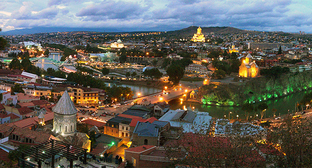
Some commentators discussed the possible consequences of the incident for Georgia's tourist attractiveness.
"After this, the desire to come has decreased," believes Irina Koldarova.
"This case may affect tourists' attitudes," wrote Ma Ku.
"Better to choose another country for vacation," noted Bocoev Loudmila.
In another country, one must respect local rules
A separate part of the discussion was dedicated to questions of guest behavior abroad.
"In another country, one must respect local rules," believes Natenadze Yulia.
"Every tourist must behave respectfully," noted Franko Wolf.
"It is important for guests to adhere to behavioral norms," wrote Victoria Gnedich Poniatowska.
"Let them learn to behave in a foreign country. She got what she deserved," expressed the opinion of Cəlal Cəlılov.
The court's decision to release on bail surprised commentators
A separate topic concerned the judicial process and the measure of restraint.
"The release on bail raised questions," wrote Mikhail Zubovich.
"The court's decision looks strange," believes Olga Jakobson.
"It is important to wait for the final court decision," noted Kolia Kacharava.
"It is a disgrace for the country that the court released him," believes Olga Rakovskaya-Bimba.
The domestic conflict took on a political hue
Marta Ardashelia, editor-in-chief of the SOVA publication, believes that the beating of a woman is condemned in any civilized society and is punished by law.
She noted that in what seems to be a domestic conflict, there is a social and political context. "Looking at the footage from social media, many have asked: why did the young man find himself in such rage? What must have happened for a person to lose control? The answer to this question lies not only in the events of that evening," the journalist, quoted by "News Georgia," believes.
According to her, the influx of Russians into Georgia after the start of the special military operation in Ukraine was not positively received by everyone, especially considering the political aspect—the role of Russia in Georgia's lack of control over Abkhazia and South Ossetia. "Therefore, in 2022, guests from the northern borders were met here with little enthusiasm. But even then, at the peak of tensions, there were no clashes, fights, or even skirmishes. What did Georgia gain along with the relocants from Russia? Economic growth, but also a sharp rise in prices. High competition in the service sector, but also entire so-called 'Russian places' where relocants spend their leisure time. Central, prestigious areas became their main concentration. Over four years, the issue of social inequality has come to the forefront—Russian relocants are significantly wealthier than the population of the host countries," she pointed out.
Social inequality is also associated with political instability. "For almost two years, daily protests against the ruling party 'Georgian Dream' have been taking place in the capital. The reason is the freezing of the process of rapprochement with the EU. The 'Dream's' refusal of the country's European future is automatically perceived by most citizens as a return to the Russian orbit. Perhaps the incident in Kakheti is domestic. But behind this story, everyone sees something of their own: some—unacceptable violence, others—the consequences of accumulated public irritation, and others—a reflection of the political and social crisis," she emphasized.
Translated automatically via OpenAI from https://www.kavkaz-uzel.eu/articles/425158



![Tumso Abdurakhmanov. Screenshot from video posted by Abu-Saddam Shishani [LIVE] http://www.youtube.com/watch?v=mIR3s7AB0Uw](/system/uploads/article_image/image/0001/18460/main_image_Tumso.jpg "Tumso Abdurakhmanov. Screenshot from video posted by Abu-Saddam Shishani [LIVE] http://www.youtube.com/watch?v=mIR3s7AB0Uw")