

The PACE call for the release of political prisoners came alongside an interest in dialogue with Baku.
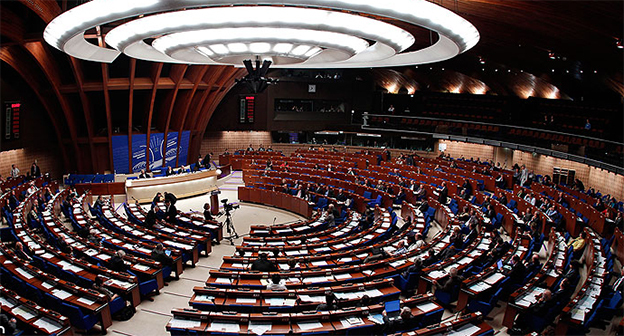
PACE adopted a resolution, "Silencing Critical Voices in Azerbaijan," calling on Baku to release political prisoners, cease persecution of journalists and human rights defenders, and fulfill its obligations to the Council of Europe.
As "Caucasian Knot" reported, in May, the PACE Committee on Legal Affairs and Human Rights, having approved the rapporteur's report on the topic: "Threats to the Life and Safety of Journalists and Human Rights Defenders in Azerbaijan," recommended the document for consideration by the Assembly's plenary session. The Committee called on Azerbaijan "to comply with its international obligations under the Statute of the Council of Europe, the European Convention on Human Rights and other international human rights treaties."
Yesterday, June 24, at the plenary session of its summer session, PACE adopted a resolution, "Silencing Critical Voices in Azerbaijan." The resolution, based on a report by Belgian MP Christophe Lacroix, was supported by 68 members of parliament, 8 against, and 6 abstentions, according to the PACE website.
The resolution expressed concern about the “climate of silencing critical voices in Azerbaijan,” including through restrictive legislative measures, which have resulted in “the suppression of independent journalism, genuine political opposition, civic space, and freedom of expression.”
The Assembly condemned the continued detention and criminal prosecution of Anar Mammadli, a human rights defender, election observer, and laureate of the 2014 Václav Havel Human Rights Prize. It also condemned the repressive policies against journalists and independent media employees who previously worked in Azerbaijan, bloggers, pro-democracy activists, opposition figures, and human rights defenders who are in detention or under house arrest. arrest.
In this regard, PACE expressed concern about the significant increase in the number of reports of political prisoners - up to 328 people as of May 2026.
Among them, in addition to Mammadli, are the names of the head of the Institute for Democratic Initiatives (IDI) Akif Gurbanov, media law expert Alesker Mammadli, another IDI member Ruslan Izzetli, journalists Elnara Gasimova, Nargiz Absalamova, Ali Zeynal, Farid Mehralizade, activist Bakhtiyar Hajiyev, chairman of the Popular Front Party of Azerbaijan Ali Kerimli, and special mention is made of the persecution of economist Gubad Ibadoglu, who is currently under police surveillance.
In addition, the document addresses issues of treatment of persons in custody. The document contains a demand to investigate reports of conditions of detention women journalists and their treatment. The resolution calls on the Azerbaijani authorities to investigate all allegations of torture and ill-treatment, bring detention conditions into line with international standards, and ensure access to medical care for detainees.
The parliamentarians called on the Azerbaijani authorities to cease threats and criminal prosecution of individuals who have been subjected to pressure because of their journalistic activities, pro-democracy stance, or human rights advocacy, and to ensure the immediate release of those detained. They also demanded the release of individuals recognized as political prisoners, in accordance with the definition contained in the PACE resolution adopted in 2012.
On October 3, 2012, PACE adopted a resolution on the concept of "political prisoner." It defines five criteria for the concept of "political prisoner": a) if the detention was carried out in direct violation of one of the fundamental guarantees, set out in the European Convention on Human Rights and the Protocols thereto; b) if the detention was ordered for purely political reasons without connection with any criminal offence; c) if, for political reasons, the length or conditions of detention are manifestly disproportionate to the offence; d) if, for political reasons, a person is detained on a discriminatory basis compared with other persons; e) if the detention is the result of proceedings that were manifestly unfair and this appears to be linked to political motives on the part of the authorities.
The final part of the resolution also calls on Council of Europe member states and the European Union to “keep the issue of the release of political prisoners on the international agenda”, to take measures to protect Azerbaijani citizens at risk of political persecution, and to take these circumstances into account when examining Baku’s extradition requests.
At the same time, the importance of continuing dialogue with the Azerbaijani authorities is emphasized. The Assembly notes that the restoration of cooperation with the institutions of the Council Europe can create opportunities to discuss issues related to human rights, media freedom, and the rule of law.
Finally, PACE called on the Milli Majlis to resume dialogue with the Assembly to address the identified problems and emphasized that "it is in Azerbaijan's own interests to effectively cooperate with all Council of Europe bodies and fully benefit from such cooperation."
According to Togrul Juvarli, an analyst at Turan's Analytical Service, the new resolution will increase tensions in relations between Azerbaijan and the Council of Europe. "In it, PACE proposes practical actions against Azerbaijan for non-compliance with its obligations not only within the Assembly itself, but throughout the organization as a whole. Thus, it calls on the Secretary General of the Council of Europe to invoke Article 52 of the European Convention on Human Rights. This is not a sanction. But it is a step toward creating an official dossier on systemic non-compliance with obligations. "Such a dossier could subsequently be used by the Committee of Ministers, PACE, and other Council of Europe structures to initiate more stringent procedures," the analyst believes.
"The next step could be the application of the Joint Response Procedure, with the issue of suspending Azerbaijan's membership rights or even terminating its participation in the organization being put on the agenda. Currently, such a scenario seems unlikely. But just two years ago, stripping the Azerbaijani delegation of its credentials also seemed almost impossible," Juvarli said in an interview with a "Caucasian Knot" correspondent.
However, in his opinion, the parties will try to avoid a complete rupture. "Despite the harsh rhetoric, both sides are currently avoiding the point of no return. Baku maintains participation in a number of the organization's conventions and other Council of Europe monitoring mechanisms. For Azerbaijan, leaving the Council of Europe would mean the loss of an important international platform for legitimization, positioning the country as a secular, rule-of-law state, and a further deterioration in relations with Western structures in general." For the Council of Europe itself, the loss of another state following Russia's exclusion would be a severe institutional blow. This would particularly undermine the Council of Europe's influence in the South Caucasus, especially against the backdrop of Georgia's growing distancing from PACE," Juvarly said.
Translated automatically via OpenAI from https://www.kavkaz-uzel.eu/articles/424396

![Tumso Abdurakhmanov. Screenshot from video posted by Abu-Saddam Shishani [LIVE] http://www.youtube.com/watch?v=mIR3s7AB0Uw](/system/uploads/article_image/image/0001/18460/main_image_Tumso.jpg "Tumso Abdurakhmanov. Screenshot from video posted by Abu-Saddam Shishani [LIVE] http://www.youtube.com/watch?v=mIR3s7AB0Uw")