

The report about fuel oil near Dzhemete came amid reports about the tourist season in Anapa.
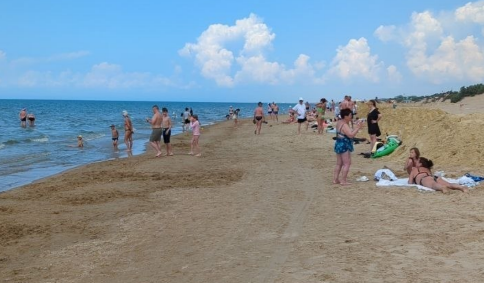
As reported by the "Caucasian Knot," three officials assured the safety of Anapa's beaches on June 6, comparing them to the French Riviera and the sand to that of Thailand. The officials' claims are unsubstantiated, and the protracted sand-filling process is discouraging tourists, Telegram users noted. The following day, Russia's Deputy Prime Minister stated that a decision on reopening Anapa's beaches could be made on June 15. Krasnodar Krai Governor Veniamin Kondratyev commented on the summer vacation season, stating that fuel oil "has always been present" on the beaches. Telegram users found the regional governor's reasoning absurd.
Activists are concerned that the quality of the sand used to fill Anapa's beaches differs markedly from the sand found in the dunes. This, they believe, could destroy the city's reputation as a resort. Authorities reported that more than 136,000 cubic meters of sand have been delivered to Anapa's beaches, and over five kilometers of shoreline have already been filled. New sand after rain hardens and turns into a suspension in water, Telegram users noted.
Scientists have discovered layers of fuel oil near Dzhemete
The Institute of Oceanology of the Russian Academy of Sciences reported on the results of soil, benthic organisms, and water samples taken in late April to analyze oil products and assess the consequences of man-made pollution in the Anapa area.
"In the Dzhemete area, fuel oil has been preserved in the form of layers on the seabed and found on the shells of mollusks and live crustaceans. Contaminated Kalyaev nets were also recorded," the Institute of Oceanology of the Russian Academy of Sciences wrote on its Telegram channel.
"Nevertheless, during sampling, we encountered live mollusks, jellyfish, ctenophores, crustaceans, Fish and dolphins. These are common inhabitants of the coastal sands of Anapa. Their high activity indicates the normal course of seasonal processes in this area – one of the most affected by the fuel oil spill, says Galina Kolyuchkina, PhD in Biology, Senior Researcher at the Institute of Oceanology of the Russian Academy of Sciences, and Head of the "Black Sea 2026" Expedition.
The resort season in Anapa opened amid a sharp contrast in the state of the coast. Some beaches are open and considered safe, while others are closed due to erosion, unstable soil, and environmental risks. Which beaches are ready for visitors and which are dangerous is described in the "Caucasian Knot" report "Anapa Beaches: Open and Dangerous" zones".
Swimming is taking place on all beaches.
Blogger Andrey Makovozov posted a video of a subscriber from the beach on Krivoy Proezd in Dzhemete on his Telegram channel.
"There's still backfilling going on nearby, but people have been flocking from the Lukomorye, Kurortny Olympus, Vesta, Pontos, and Zarya hotels since the morning!" he wrote.
"The infrastructure has already been installed on the open beaches, and secretly on some of the closed ones as well, and people are already relaxing, despite everything, on all the beaches," writes blogger Max Anapsky.
Social media continues to discuss Kondratyev's statement that the fuel oil was Always
"But someone wants to see it..." Is this about boring volunteers or about Rospotrebnadzor, which still hasn't given a positive opinion on opening beaches with old sand?" the volunteer headquarters "Volunteers SSL" asked on its Telegram channel.
"Perhaps the governor of Kuban, along with the deputy prime minister, are right, and the presence of fuel oil, palm oil, clay, and all sorts of additional things has already become the norm. And perhaps in our lifetimes we will never see the clean sea and coastline of Anapa, Taman, Tuapse, or Novorossiysk, just as most Russians have never seen the beaches of the Côte d'Azur. So there's nothing to compare it to. Whether this is good or bad, I don't know. But this is the reality, and it makes me sad," activist Yana wrote on her Telegram channel Antonova..
On December 15, 2024, two tankers carrying fuel oil sank in the Kerch Strait. A crew member of one of the tankers died. In addition, an oil spill occurred, leading to catastrophic environmental consequences, according to the Caucasian Knot report "Fuel Oil Spill in the Kerch Strait".
Materials on the consequences of the fuel oil spill have been collected by the Caucasian Knot on the page "Eco-disaster in Kuban".
We have updated the apps for Android and IOS! We would be grateful for criticism and ideas for development both in Google Play/App Store and on KU pages in social networks. Without installing a VPN, you can read us on Telegram (in Dagestan, Chechnya and Ingushetia - with VPN). Using a VPN, you can continue reading "Caucasian Knot" on the website as usual, and on social networks: Facebook*, Instagram*, "VKontakte", "Odnoklassniki" and X. You can watch the "Caucasian Knot" video on YouTube.
* Meta (owner of Facebook, Instagram, and WhatsApp) is banned in Russia.
Translated automatically via OpenAI from https://www.kavkaz-uzel.eu/articles/424002





![Tumso Abdurakhmanov. Screenshot from video posted by Abu-Saddam Shishani [LIVE] http://www.youtube.com/watch?v=mIR3s7AB0Uw](/system/uploads/article_image/image/0001/18460/main_image_Tumso.jpg "Tumso Abdurakhmanov. Screenshot from video posted by Abu-Saddam Shishani [LIVE] http://www.youtube.com/watch?v=mIR3s7AB0Uw")