

Participants in the screening of a film about Yuri Shchekochikhin praised his work as a journalist and politician.
THIS MATERIAL (INFORMATION) WAS PRODUCED AND DISTRIBUTED BY FOREIGN AGENT MEMO LLC, OR CONCERNING THE ACTIVITIES OF FOREIGN AGENT MEMO LLC.
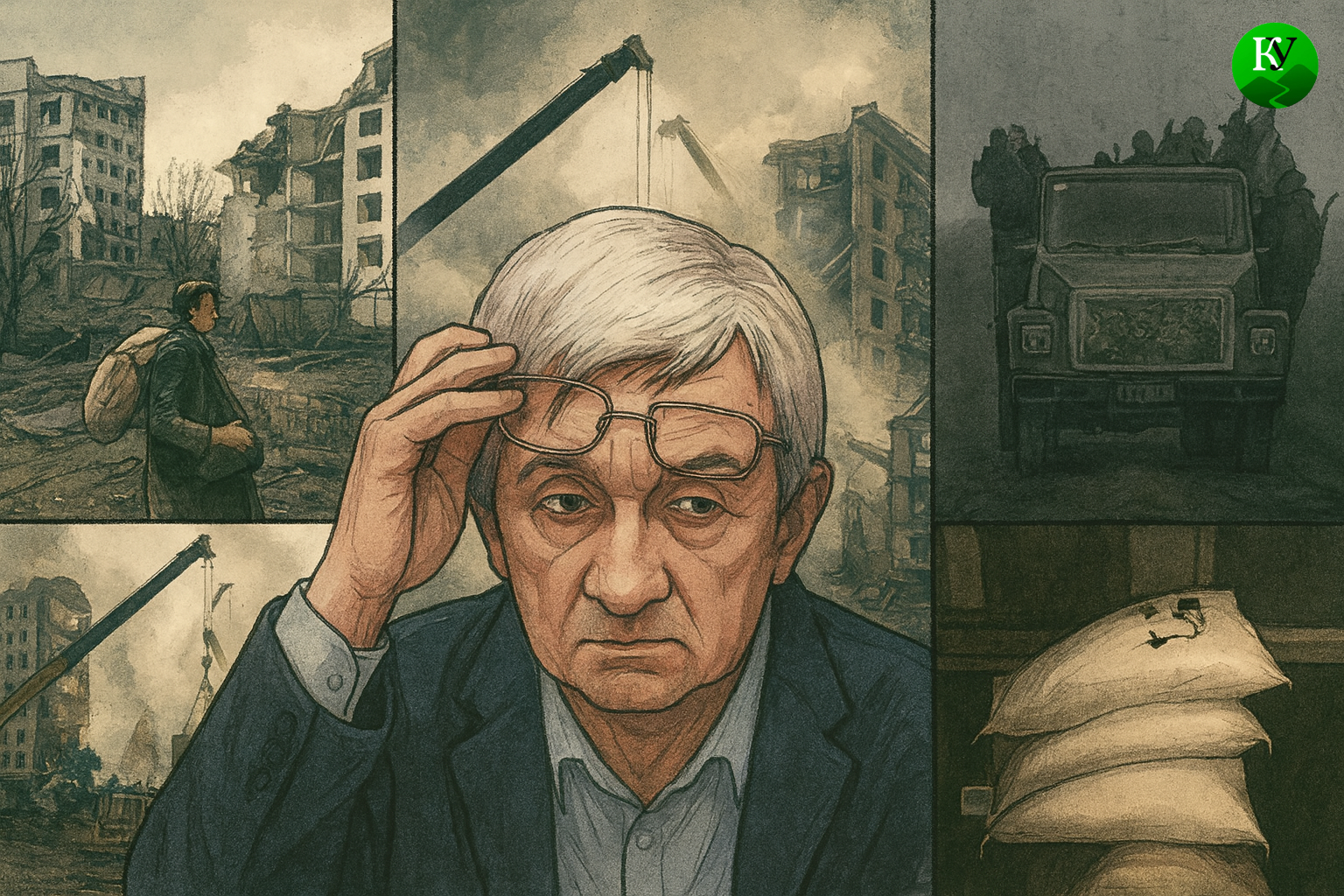
The premiere of a film about journalist and politician Yuri Shchekochikhin took place in Moscow. Participants in the screening praised his work both as a journalist and in politics, noting his integrity and commitment to investigating high-profile cases, including those in Chechnya.
As reported by the "Caucasian Knot," Yuri Shchekochikhin was deputy chairman of the State Duma Committee on Security, a member of the executive committee of the organizing committee of the Memorial Historical and Educational Society (designated a foreign agent by the Ministry of Justice and liquidated by court order), and deputy editor-in-chief of Novaya Gazeta. He died on the night of July 3, 2003 in Moscow. Five years after Shchekochikhin's death, a criminal case was opened under the article "Murder," the investigation of which was soon closed, only to be reopened in 2010. Two pharmaceutical ingredients that shouldn't be present in the human body were found in Shchekochikhin's body. However, the investigation was later closed again, citing "the absence of a criminal offense."
The Novaya Gazeta staff disagreed with the official version of Shchekochikhin's death: two pharmaceutical ingredients that shouldn't have been present were found in his body. In July 2013, the newspaper published an article, "We're Closing the Case," describing the results of a parallel investigation. Among the theories surrounding Shchekochikhin's murder were threats the journalist received after criticizing security forces for the special operation to free hostages at the Dubrovka Theater Center in October 2002. "We have exhausted all our resources and cannot document the fact of murder in any way that would give the investigators any formal grounds to keep the case open," the article emphasized. In 2018, Novaya Gazeta pointed out similarities in the circumstances of Shchekochikhin's death with the details of the high-profile poisoning of former GRU officer Sergei Skripal and his daughter in the UK. According to colleagues, Shchekochikhin could have been killed by a Novichok-type nerve agent.
The premiere of the documentary about journalist and politician Yuri Shchekochikhin, "And the Ship Sails On," took place on March 3, a "Caucasian Knot" correspondent who attended the event reports.
Svetlana Vasilenko, First Secretary of the Board of the Union of Russian Writers, told a "Caucasian Knot" correspondent that she came to the premiere because, since 1973, when her first poem, thanks to Shchekochikhin, was published on the teen page of Komsomolskaya Pravda, "The Scarlet Sail," he had been "a saintly figure and a huge authority" for her.
The evening was hosted by Nadezhda Azhgikhina, the screenwriter of the film and Shchekochikhin's widow.
The evening was opened by Nikolai Rybakov reminded those gathered of Shchekochikhin's last, unrealized project – a steamship that would have carried children of parents from different sides of the war, allowing them to establish contacts with one another.
Grigory Yavlinsky, Chairman of the Yabloko Party's Federal Political Committee, noted that Shchekochikhin was a special person with a commitment to principles rare in Russian politics. "He declared that he would adhere only to truth and honesty, and this effectively became the principles of our entire faction. He was one of the purest people in Russian politics," Yavlinsky stated.
The film itself, which briefly recounted Shchekochikhin's life, was based on the recollections of people who knew him (many of whom are now deceased) and some newsreel footage. The Chechen theme was only touched upon indirectly: footage was shown of Shchekochikhin as a deputy demanding the resignation of Russian Defense Minister Pavel Grachev during the First Chechen War. And at the end of the film, where the story about the "children's ship" project was told, it was accompanied by newsreel footage, clearly filmed in Chechnya, showing the traces of war – both physical and moral – in the souls of the local population. The film's director, Yulia Mavrina, in response to questions, noted that the film is expected to be posted online in the future, including on the Yabloko party website, thanks to whose support it could appear, and also presented at various film festivals. After the first two films, we had numerous interviews left over that were used for this film. Responding When asked about the reasons for the film's "schematic" nature, Nadezhda Azhgikhina explained that "And the Ship Sails On" is the third part of a trilogy planned back in the late 2000s (which is why many of the interviews in the film were listed as having been conducted in 2011-2012). "The first film, "Yuri Shchekochikhin. Once I Was There," was directed by Evgenia Golovnya, who even managed to secure funding for it from the Ministry of Culture. Then, after her death, Yulia [Mavrina] took over the films. And everything dragged on. But a lot was told about his life in the second film, "The Weight of the Unfinished." From the first two films, we had a ton of interviews left over that were used for this film. "Furthermore, the film incorporated discussions of the two previous films with journalism students I taught and with members of the Youth Yabloko party in 2024," she noted. The premiere of the documentary film "Yuri Shchekochikhin. Once I Was..." took place in Moscow in June 2011. The film consists of several parts. The "Once I Was at War" section features footage from Chechnya. The film also touches on Shchekochikhin's death, the circumstances of which remain unclear. The second film about the journalist's life, "The Load of the Unfinished," was shown in Moscow in April 2017.
Azhgikhina noted with regret that the HSE students she recently taught couldn't recall any of the famous journalists of the recent past. "But that just means we need to remind them," she emphasized.
Dmitry Gasanov, winner of the "Young People about Young People" competition held by the Y. Shchekochikhin Charitable Foundation, posed a question to Azhgikhina and Mavrina, noting that young journalists in Russia are usually unaware of Shchekochikhin: "What are young people missing for new Shchekochikhins to emerge?" Yulia Mavrina responded that what's missing is, first and foremost, knowledge about the journalist himself. "Yuri Petrovich evoked such a blissful feeling that, upon learning about him, people wanted to fight for justice," she noted. Former Human Rights Commissioner Vladimir Lukin noted that Shchekochikhin was "an amazing person" for him. "He was an idealist, pushing through to make some of his ideals take on real form. People like this are always needed, striving for the impossible, because then there's a chance of achieving something," he said. He made people like me feel uneasy about compromises. Playwright Alexander Gelman recalled that Shchekochikhin was a very principled person. "He made people like me feel uneasy about compromises," he said. Gelman emphasized the importance of the new documentary: "It's important that people learn who Yura is—everyone should know about him." Shchekochikhin's student, Boris Minaev, noted that wherever he worked, he quickly became the center of a close group of friends. "The amazing light that emanated from him drew people," he emphasized. Minaev stated that Shchekochikhin should have become Russia's greatest journalist, but he didn't have the chance because the newspapers he worked for—Komsomolskaya Pravda and Literaturnaya Gazeta—faded, while Novaya Gazeta was prevented from becoming one due to the changing political situation. The evening repeatedly touched on the topic of Shchekochikhin's death, which occurred under very strange circumstances. Speaking about his death, Grigory Yavlinsky stated that his death left many unanswered questions and resembled a crime. "I hope this will be clarified in the future," he remarked. Nadezhda Azhgikhina noted that the investigation into Shchekochikhin's death is a "complex matter." "If they couldn't get to the truth then, it's even more difficult now," she emphasized. Vladimir Lukin clearly noted that, although "the legal details haven't been studied," Shchekochikhin's death was likely caused by the fact that he "very harshly stepped on the toes of those in power, who were tainted by one, two, or three corruption cases, and his death was a consequence of that," he stated. Concluding the evening, Azhgikhina urged those present to "gather stories." "This is important because it shows what was done in even more difficult conditions than now," she concluded. I think the focus here isn't on geography, but rather on the fact that it was in Chechnya that something systematically happened that shouldn't have left anyone indifferent. Natella Boltyanskaya, a journalist with sotaproject.com (the SOTA online project has been added to the Ministry of Justice's register of foreign agents), commented to a "Caucasian Knot" correspondent following the film's release, touching on the relationship between Shchekochikhin and Novaya Gazeta journalist Anna Politkovskaya, who was murdered in 2006. "It's difficult for me to judge who followed in whose footsteps. Both Anya and Yuri Petrovich were independent thinkers. I don't think the focus here is on geography, but rather on the fact that it was in Chechnya that something systematically unfolded that shouldn't have left anyone indifferent. And she's also a journalist, so she asks questions, goes, and investigates. But don't forget, Shchekochikhin wasn't just investigating Chechnya; he was, at a guess, investigating the "Three Whales" case. And Politkovskaya, too, was investigating abuses and corruption. Did they read each other's work? I think they did, even jealously. After all, they were both passionate and greedy in their work. Did Anya consult with each other? On the one hand, it's common practice at Novaya Gazeta, but on the other, it all depends on the specific assignment and its organizers," she emphasized. Anna Politkovskaya, known for her articles on the war and human rights violations in Chechnya, was killed in Moscow on October 7, 2006. The court found that Lom-Ali Gaitukayev organized the murder and sentenced him to life imprisonment. Rustam Makhmudov was found to be the actual perpetrator, according to the Caucasian Knot report "The Murder of Anna Politkovskaya." Boltyanskaya also noted a number of common factors in the fates of the two journalists that made them dangerous to the authorities: "Empathy, interest in specific fates, a desire to understand and learn. And, to a certain extent, an inability to ignore them. Plus the common factor of 'Novogazetstvo.' That's a diagnosis, and I would say an excellent one." Speaking about Shchekochikhin's death, Boltyanskaya noted that his death, presumably from poison, was not a "dress rehearsal" for Politkovskaya's murder. "Poisoning as a method continued with the poisonings of Litvinenko, Navalny, Bykov, and Kara-Murza. Murder with a firearm is a different story. What these murders have in common is the very fact of eliminating those who were undesirable and asking sensitive questions. It's a proven theorem that the Russian government has continued to unleash its excesses since the decision to murder Shchekochikhin. It has continued and isn't stopping," she noted. The film presentation took place at the Moscow office of the Yabloko party. About 100 people, including many young people, gathered in the hall on the fourth floor of the building. Student Makar told a "Caucasian Knot" correspondent that he attended the film screening because he is interested in the events and figures of the 1990s, and Yuri Shchekochikhin is a prominent democratic figure. Yabloko supporter Fedor told a "Caucasian Knot" correspondent that he came because there are very few liberal democratic events in Moscow that are not held underground. "Yuri Shchekochikhin is one of the wonderful, bright journalists, and one of the first victims of the changed situation," he stated. Yuri Shchekochikhin was elected to the State Duma in December 1995 on the Yabloko list and joined the Yabloko faction. In February 1996, he became a member of the parliamentary security committee, and in April 1997, he joined the commission investigating the involvement of officials of state authorities of the Russian Federation and state authorities of the constituent entities of the Russian Federation in corrupt activities. In December 1999, he was again elected to the State Duma on the Yabloko list and became a member of the corresponding parliamentary faction. In March-April 1997, he participated in the liberation of Russian army servicemen forcibly detained in Chechnya during military operations. In 2002-2003, he was a member of the "Public Commission for the Investigation of the Circumstances of the Apartment Building Explosions in Moscow and Volgodonsk and Exercises Conducted in the City of Ryazan in September 1999." His most recent investigations involved corruption in the Russian Prosecutor General's Office. He worked, in particular, on the "Three Whales" case involving furniture smuggling, the investigation of which was personally overseen by President Vladimir Putin, Lenta.ru reports. We have updated the apps on Android and IOS! We would be grateful for criticism and ideas for development both in Google Play/App Store and on KU pages in social networks. Without installing a VPN, you can read us on Telegram (in Dagestan, Chechnya and Ingushetia - with VPN). Using a VPN, you can continue reading "Caucasian Knot" on the website as usual, and on social networks Facebook*, Instagram*, "VKontakte", "Odnoklassniki" and X. You can watch the "Caucasian Knot" video on YouTube. Send messages to +49 157 72317856 on WhatsApp*, to the same number on Telegram, or write to @Caucasian_Knot. * Meta (owner of Facebook, Instagram, and WhatsApp) is banned in Russia.
Translated automatically via OpenAI from https://www.kavkaz-uzel.eu/articles/421301


![Tumso Abdurakhmanov. Screenshot from video posted by Abu-Saddam Shishani [LIVE] http://www.youtube.com/watch?v=mIR3s7AB0Uw](/system/uploads/article_image/image/0001/18460/main_image_Tumso.jpg "Tumso Abdurakhmanov. Screenshot from video posted by Abu-Saddam Shishani [LIVE] http://www.youtube.com/watch?v=mIR3s7AB0Uw")