


Residents of two villages in the Astrakhan region are without a crossing after a tugboat accident.
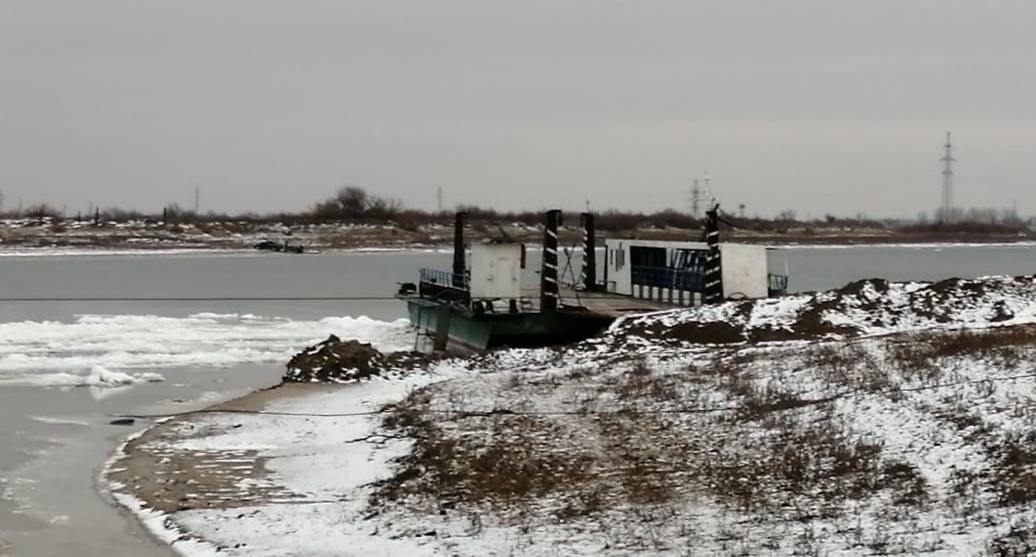
Villages living on an island in the Kamyzyak district were left without transportation after a towboat service failed. Astrakhan inventors have long unsuccessfully proposed their design for inexpensive self-propelled ferries to the authorities, noted the head of the Geographical Society branch.
As reported by the "Caucasian Knot," on October 21, 2024, in the Krasnoyarsk district of the Astrakhan region, residents of the island villages of Krivoy Buzan, Baklanye, and the settlement of Dolginsky (Dolgino) were left without transportation after part of the pontoon bridge sank. The restoration of the crossing was only completed on November 8th.
Earlier, residents of the Krasnoyarsk district reported that the problem of the pontoon and ferry crossing to the island zone is a "long-standing" problem. The crossing has been repeatedly disrupted, with old pontoons sinking, cutting off villagers' means of communication with the outside world.
In the Kamyzyak district, two villages (Alekseyevka and Poldnevoye) have been cut off from the mainland for the fourth day due to a ferry accident, forcing villagers to cross the river on ice. Cars can't cross to the island, so ambulances and firefighters can't reach the isolated villages, local residents told a "Caucasian Knot" correspondent on February 2.
For example, 68-year-old Tatyana Shakieva lived her entire life in the village of Alekseyevka, ended her working career as the director of a local club, and is now retired, but continues to work at a fish farm.
How can I take him home? There's no crossing.
"My husband is currently in the hospital in Astrakhan. He's being discharged in a week. So, how can I take him home?" "There's no crossing," she complained.
Alekseyevka belongs to the rural settlement of Samosdelsky Village Council, which, according to the 2020 census data posted on the Rosstat website, has a population of 1,463. The village of Poldnevoye belongs to the rural settlement of Obraztsovo-Travinsky Village Council. According to Rosstat, 3,012 people live in Obraztsovo-Travinsky Village Council, and 2,279 people live in "other rural settlements" of the village council. Rosstat's table does not include data on the population of each of the five villages of Samosdelsky Village Council and six villages of Obraztsovo-Travinsky Village Council.
According to Shakieva, there were severe frosts in January, and the Volga River froze over near the crossing. Last week, during an attempt to "break the ice hole" with a barge, the vessel was damaged and sank. Local residents managed to hook the barge with ropes using boat hooks. Shakieva borrowed a tractor from her employer, and with its help, the barge was pulled ashore. Neither the owner nor the ferry workers yet know what to do with the damaged vessel.
The woman explained that the island, isolated from the mainland, is home to two villages: Alekseyevka (population: about 190) and Poldnevoye (population: over 200). The ferry crossing across the Volga near Alekseyevka to the regional center of Kamyzyak is 20 kilometers away. Previously, according to Shakieva, the ferry was "state-owned" and cost 20 rubles per vehicle. Now it's privately owned, and the cost of transportation has increased "fivefold."
"And they're happy about that. As long as [the ferry] works." "After all, they used it to transport schoolchildren, deliver gas cylinders, bring groceries to our trailer (shop), and people went to work, and medical workers came to us, and the mail brought pensions," the woman said.
According to her, the electricity and gas supply in the village is stable, although not all residential buildings in Alekseyevka have gas equipment, and many heat their homes with wood. A local entrepreneur brings groceries (mainly bread) on his own boat. His trailer-shop hasn't seen any shortages or price increases yet. Schoolchildren are studying remotely; phone and internet service are stable. People commute to work across the ice near the village of Poldnevoye and near the farm.
"But the ice there has already darkened from the thaw. People built the path on the ice themselves. Overall, such a crossing is dangerous. "Well, what we need to breathe a sigh of relief is a proper ferry crossing and a road from the ferry to the village. In the spring, it gets so muddy it's impassable. We need to compact it with gravel. That's all we need," the woman sighed.
Sergey, a resident of the village of Poldnevoye, said that residents of the cut-off villages cross the Volga River on the ice "at their own risk" and then hitchhike.
It's scary to walk on the ice. It's dark and crumbling.
"We're going to a farm; the people there themselves paved a road on the ice. Then we cross the river and hitchhike along the road. "And then everyone goes their separate ways: some to the farm and the ponds, others to Samosdelka on business, to Kamyzyak, to Astrakhan. But now it's scary to walk on the ice. It's dark and crumbling. If you fall through, no one will help you; you'll be pulled under the ice, and it's all over," Sergei told a "Caucasian Knot" correspondent.
A resident of Alekseyevka, who introduced herself as Elena, expressed the opinion that the village is gradually "dying out." The villagers live on three streets: Molodezhnaya, Naberezhnaya, and Koklyuy. Almost all of them are pensioners, many are elderly and disabled. Almost all the young people have left for Astrakhan and Kamyzyak, "since there's no work in the village," but "they visit their parents," and "it's hard to do without a ferry," she noted.
Our pensioners' mail and pensions are now being delivered from the mainland.
"We had a school, then they optimized it. This school is almost 80 years old. Our elders all used to go there. They left a branch of the Samosdelskaya School and a post office in the building. Well, they recently closed them too. We asked them to at least keep the post office, but no. Our pensioners' mail and pensions are now being delivered from the mainland. Pensions are supposed to be paid on February 4th. "All the old people are worried: how will it be delivered?" Elena told a "Caucasian Knot" correspondent.
She said that members of the Samosdelsky village council had forwarded the islanders' complaints to the district authorities and the prosecutor's office. Officials promised to resolve the problems with the ferry and the road to the village.
"We asked for our ferry to be state-owned, not private. A ticket at state-owned ferry terminals costs 22 rubles, while ours costs 100 rubles (per vehicle). And now: the barge can be scrapped. How can a private owner solve this problem on their own? Where will they get the money for repairs? How will the authorities help us in our plight?" "I, for one, can't imagine it," the woman said.
This isn't an emergency, but a systemic problem.
The problem of crossings in the Volga Delta is getting worse every year, said Astrakhan political scientist Mikhail Doliev (included in the register of foreign agents). "People need to go to work, to see doctors, to resolve everyday issues... This isn't an emergency, but a systemic problem that recurs every winter," he told a "Caucasian Knot" correspondent.
In his opinion, both regional and federal authorities have the financial resources to solve such problems, but they are spent "not on ensuring people's safety and infrastructure," but on military operations.
"The crossings have been in a deplorable state for years because the contracts are awarded to 'insiders' – relatives and people close to the local administrations. "The result is the same: the barges sink, and ordinary residents pay the price," Mikhail Doliev stated.
Inventors propose replacing towboat crossings with self-propelled ferries
The head of the Astrakhan branch of the Russian Geographical Society, Professor Pyotr Bukharitsin, told a "Caucasian Knot" correspondent that the territory of the Astrakhan region, especially its delta and floodplain areas, is cut by numerous branches fanning out from the head of the Volga Delta and the city of Astrakhan to the southwest, south, and southeast. This circumstance has determined the traditional location of settlements, many of which are located on islands, "which creates a host of problems for residents, as workplaces, schools, and medical facilities are located on the mainland."
"Currently, about 20 ferry crossings operate in this area, using outdated and non-self-propelled ferries, which are towed by a tugboat along a cable stretched between the banks. Local residents are often forced to 'cross' the water barrier several times, risking their health and lives. Pontoon bridges also don't solve the problem, as they are extremely worn out and often fail or are constantly being repaired," Professor Bukharitsin reported.
On October 15, 2023, a pontoon bridge across the Bolshaya Prorva River sank after heavy equipment passed through. As a result, residents of three island villages—Krivoy Buzan, Dolgino, and Baklanye—were cut off from the rest of the island. Repairs to the pontoon bridge were only completed on November 3 of that year. During the repairs, a ferry service was installed to the village, but local residents told the "Caucasian Knot" a permanent bridge would have effectively solved the long-standing problem.
The Astrakhan scientist noted that he and a group of his associates approached the Astrakhan regional administration back in 2017 and 2018 with a proposal to upgrade the ferry system in the problematic area. They even proposed a project to create a modern complex aimed at optimizing traffic flows. They invented a "self-propelled ferry (patent for invention No. 2596044 (2016)) for transporting vehicles, people, and livestock in icy conditions."
From 2004 to 2017, the governor of the Astrakhan region was Alexander Zhilkin. He resigned in September 2018, and Sergey Morozov took over as governor. Morozov served as acting governor for only eight months; in June 2019, he was succeeded by the current governor, Igor Babushkin.
We can build up to 15 of these, which will replace the old ferry systems.
"A simple, inexpensive, and reliable self-propelled ferry design. We can quickly build up to 15 of these, which will replace the old ferry systems, and we will provide the necessary design documentation. Any shipyard can build them." "I handed over the folder with documents to Babushkin personally in the presence of 300 experts more than once," said Pyotr Bukharitsin.
The lawyer considered the appeal to the prosecutor's office to be the right step.
According to lawyer Sergey Ivaschenko, the actions of the district authorities and the administration of the Samosdelskoye rural settlement contain "signs of a violation" of Article 16 (Issues of local importance of the municipal, urban district) of Federal Law No. 131-FZ "On the General Principles of Local Self-Government in the Russian Federation."
"An accident at the ferry crossing in the island conditions could lead to an emergency or various dangerous incidents. It is possible that the working conditions of medical teams, the supply of basic foodstuffs, pensions, and medicines to the population will deteriorate. The fragile ice on the Volga branches, which, according to local residents, formed during the thaw, poses a real danger. "For citizens. During fires, the fire brigade and emergency services will not be able to arrive at the scene," Sergei Ivaschenko explained the federal law to a "Caucasian Knot" correspondent.
The lawyer advised the villagers to file a collective complaint with the district administration and also to write a letter to the prosecutor's office, "since their constitutional rights to a safe living environment are being violated."
An employee of the Kamyzyak district administration, who wished to remain anonymous, refused to provide a "Caucasian Knot" correspondent with information on the progress of repairs at the problematic crossing. "Everything possible is being done to ensure that the ferry crossing near Alekseyevka resumes operations as soon as possible," he said succinctly.
On January 30, the head of the district, Mikhail Cherkasov, reported on his Telegram channel that he held an operational meeting of the commission for the prevention and elimination of emergency situations.
"This morning, due to the sinking of a barge carrying a ferry to the village of Alekseyevka in the Samosdelsky village council, transport links with this settlement were completely interrupted. About 140 people, including children, live in the village. While the ferry crossing is being repaired, residents will be fully supplied with food, medicine, and fuel. Also, if necessary, with the use of specialized equipment, medical workers, police officers, the Ministry of Emergency Situations, and social services will be transported to the settlement. A "An air ambulance was used. While the barge is being repaired, local schoolchildren are being transferred to distance learning," he wrote.
Translated automatically via OpenAI from https://www.kavkaz-uzel.eu/articles/420475




![Tumso Abdurakhmanov. Screenshot from video posted by Abu-Saddam Shishani [LIVE] http://www.youtube.com/watch?v=mIR3s7AB0Uw](/system/uploads/article_image/image/0001/18460/main_image_Tumso.jpg "Tumso Abdurakhmanov. Screenshot from video posted by Abu-Saddam Shishani [LIVE] http://www.youtube.com/watch?v=mIR3s7AB0Uw")