


The number of people hospitalized after the drone attack in Adygea has risen to nine.
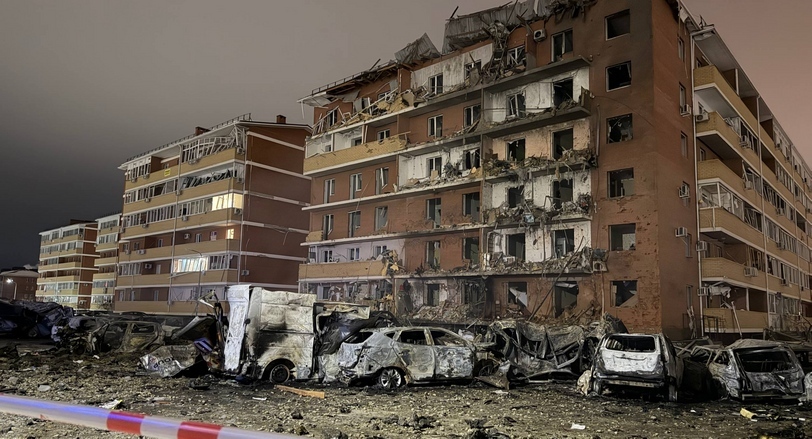
Eleven people injured in the drone attack in Adygea have sought medical attention, nine of them hospitalized. Two of the wounded have been transported to Krasnodar.
As reported by the "Caucasian Knot," a multi-story building was damaged last night in the village of Novaya Adygeya in the Takhtamukaysky District as a result of a drone attack. The head of Adygea reported that there were no fatalities, but eight people were injured, including a child. Seven people were hospitalized.
According to updated information, 11 people were injured, nine of whom were hospitalized, including two children, the head of Adygea, Murat Kumpilov, reported on his Telegram channel.
A temporary accommodation center for evacuees has opened at the Shapsug recreation center, and people are already being accommodated, the official noted. "They will be provided with everything necessary for a comfortable stay until all consequences of the incident are resolved. Social workers, doctors, and psychologists will also be on duty," the publication states.
Residents will be allowed into their homes and apartments "in stages, as security forces complete their inspection," and the area has been cordoned off by police to protect property, the head of the republic announced.
The municipal administration is declaring a state of emergency at the district level.
"The municipal administration is declaring a state of emergency at the district level. This will help more effectively integrate the work of all services and departments," he wrote.
Two victims in the Takhtamukaysky District of Adygea have been transported to Krasnodar for treatment, the Kuban emergency response center reported on its Telegram channel. "Also, ambulance crews from the regional center worked alongside their colleagues at the scene of the incident in the region neighboring Krasnodar Krai," the publication notes.
The state of emergency gives authorities expanded powers
As a reminder, the state of emergency is provided for by Federal Law No. 68-FZ of December 21, 1994, "On the Protection of the Population and Territories from Emergencies of Natural and Man-Made Nature." Depending on the level of emergency, the head of a city, district, governor, the Russian government, or the president can declare the state of emergency.
By law, after the state of emergency is declared, authorized bodies are obligated to ensure the protection of the population and respond to the emergency. "As a rule, the introduction of a state of emergency involves restricting the personal and public rights of citizens. Access to the emergency zone may be prohibited or restricted. Activities that could lead to new outbreaks are restricted. For example, during a state of emergency for forest fires, visiting forests is prohibited. Evacuations may also be organized," the Kalmykia Ministry of Emergency Situations explained on its website on May 7, 2019.
The authorities' ability to allocate budget funds for emergency situations depends on the state of emergency , lawyer Maria Spasibukhova explained to the "Caucasian Knot" in December 2024.
"This involves deploying the required amount of equipment, the financial capacity to deploy various points, establish cooperation between various structures, and engage paid specialists. This does not affect the rights and responsibilities of ordinary people, local residents," she said.
Translated automatically via OpenAI from https://www.kavkaz-uzel.eu/articles/420114



![Tumso Abdurakhmanov. Screenshot from video posted by Abu-Saddam Shishani [LIVE] http://www.youtube.com/watch?v=mIR3s7AB0Uw](/system/uploads/article_image/image/0001/18460/main_image_Tumso.jpg "Tumso Abdurakhmanov. Screenshot from video posted by Abu-Saddam Shishani [LIVE] http://www.youtube.com/watch?v=mIR3s7AB0Uw")