


Krasnodar residents consider the hushing up of teenage violence unacceptable
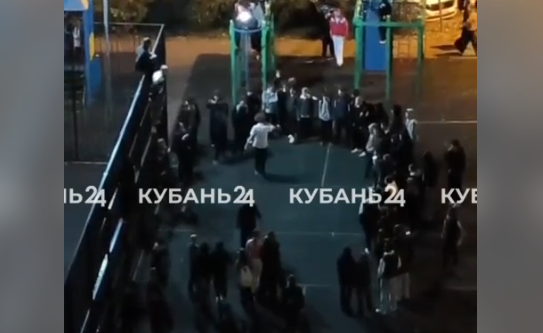
Numerous children were beaten in street fights in Krasnodar, after which three teenage girls were detained, but not all parents agreed to file police reports. Psychologists emphasized that violence and the desire to assert oneself through such behavior indicate psychological problems.
As reported by the " Caucasian Knot ," a criminal case for hooliganism was opened in Krasnodar following social media posts about street fights between teenagers. Sources reported the arrest of a minor.
In early November, a video of a mass brawl between teenagers on Hero Yatskov Street circulated on Krasnodar social media. Footage of a 15-year-old girl beating a 14-year-old schoolgirl sparked outrage. The girl suffered multiple bruises and hematomas, knocked out front teeth, and a broken nose.
Local residents complained on social media that schoolchildren had formed a gang and were intimidating other children, causing fights and violence. The scandal immediately became known as "Fight Club" and became the focus of public and law enforcement attention. The Investigative Committee opened a criminal case under hooliganism (Part 2, Article 213 of the Russian Criminal Code – hooliganism committed by a group of persons).
Krasnodar residents consider the hushing up of teenage violence unacceptable
A "Caucasian Knot" correspondent tried to find out what happened to the teenagers a month after the scandal.
One of the parents of the injured children told the "Caucasian Knot" that three girls who took an active part in the beating have been detained.
"The 15-year-old girl was immediately detained. Then they detained another girl who was helping her; she's 16 or 17, if I'm not mistaken. They're in isolation, in a closed facility. Then they detained a third girl who had health issues; she's under house arrest. Another four or five teenagers are involved in the case, but they haven't been detained. While the investigation is ongoing, we're waiting. The forensic examination showed that the severity of the harm caused was moderate," Anastasia said .
According to her, they all trained in different martial arts clubs, but were from the same area.
"They were involved in sports, competed in competitions, so they were physically strong guys who beat not only girls but also young men and even men. After this story, we learned that there were actually many victims of this group. But not everyone agreed to join the parents of the abused children," she noted.
The incident that occurred on November 7 was not the first involving these girls.
"They beat up another girl in roughly the same place on November 3rd, though she didn't have any serious injuries, just a few scratches. But she and her parents refused to go to the police; they settled the matter verbally and scolded the other girls. If they'd all been detained then, there wouldn't have been that beating on November 7th, you see. That's why we can't turn a blind eye to things like this," said Natalya , a resident of one of the buildings on Geroya Yatskova Street.
The local sports ground has always been a gathering place for these teenagers.
"They always gathered there, trained together, made a lot of noise, and had some kind of competitions, like who could do the most push-ups, who could wrestle who. But the first time I saw a fight was in early November," she noted.
A source familiar with the case said that an administrative protocol has been drawn up against the detained girl's father.
"An administrative charge was filed against the father of the girl who assaulted her peer under Article 5.35 of the Russian Code of Administrative Offenses—failure of parents to fulfill their responsibilities for the maintenance and upbringing of minors. He was also given a preventative talk, warned that they were failing to properly raise their child," he told a "Caucasian Knot" correspondent.
The court will most likely impose either a suspended sentence or a release from criminal liability with placement in a special closed-type educational and correctional institution for up to three years.
Lawyer Dmitry Dolgy explains the possible punishment for the detained woman.
"Part 2 of Article 213 of the Russian Criminal Code provides for a sentence of up to seven years in prison. However, a special sentencing procedure applies to minors. According to Article 88 of the Russian Criminal Code, the maximum prison term for individuals aged 14 to 16 cannot exceed six years, and this is only for serious and especially serious crimes. Hooliganism committed by a group of individuals is considered a moderately serious crime, so the maximum sentence is three years," he told a "Caucasian Knot" correspondent.
But in practice, actual imprisonment for a 15-year-old girl for her first crime is extremely unlikely.
"The court will most likely impose either a suspended sentence or a release from criminal liability with placement in a special closed-type educational and correctional institution for up to three years. Compensation for moral damages and medical expenses, as well as reconciliation with the victim and an admission of guilt, will be key to the final verdict," he emphasized.
Psychologists explain the reasons for the increase in violence among teenagers.
Crisis psychologist Natalia Nesterenko notes an increase in violence among teenagers.
"We seem to be getting used to these tragic events in which children and teenagers become the main actors. And not only do they become the protagonists, they also transmit violence and cruelty. All of this speaks to the rise of violence among children and adolescents. A group of teenagers can terrorize a section of a city or neighborhood. How is it that teenagers, children who should rely on adults, who haven't yet matured socially and emotionally, can control adults, control citizens, and aren't afraid of law enforcement? The fact is, at this age, teenagers strive for dominance, for power. This behavior is linked to the search for recognition, the desire to find oneself, to be recognized by their peers, and the desire to demonstrate one's strength," she told a "Caucasian Knot" correspondent.
At this age, cruelty indicates emotional immaturity and a lack of critical thinking.
According to her, the phenomenon of teenage "fight club" indicates deep psychological problems.
"Of course, when we talk about fight clubs, we can say that in some cases it's a youth trend, but we can also say that it's part of deeper problems, such as social alienation, aggression, and a lack of positive behavior models. Adolescence is one of the most vulnerable ages. Teenagers are not yet fully formed; their values and foundations are just beginning to form. This is the age of searching for these true guidelines. And violence and cruelty are precisely evidence of these complex internal conflicts and searches. At this age, cruelty indicates emotional immaturity, a lack of critical thinking. And, of course, I don't rule out a traumatic experience here: it's scary to imagine the environment, the kind of surroundings a teenager lives in who displays such cruelty. When we talk about the reasons why this happens to teenagers, of course, first and foremost is low self-esteem. It's clear that a teenager is not yet fully formed; they are emotionally immature; they need something to rely on. "They rely more on adults, but still strive for this autonomy. They want to rely on themselves. And often, cruelty is a way to feel stronger and more important. If a teenager has been subjected to violence, for example, among peers or older friends, then, of course, they will seek to restore their self-esteem at the expense of those who are weaker, those who are younger, by displaying such cruelty and violence," she explained.
There's a lot of domestic violence. It's often not criticized, society doesn't evaluate it, and doesn't try to understand the causes.
Another important reason for this behavior may be the family environment.
“Everything comes from family. Yes, it’s the most important and significant environment for teenagers. What’s going on in the family? Does the teenager have family support? What is cultivated in the family, if the family values empathy? Most likely, if we’re talking about cruelty, we’re referring to the fact that their life paradigm doesn’t include such categories as empathy, compassion, mercy, or sympathy. They don’t think in these terms. And, most likely, such concepts are absent in their family. If we’re talking about causes, then, of course, we’re also considering peer influence. A teenager always strives to fit in with the group and its aggressive norms if they’ve joined it. Of course, family problems can be the cause. We have a lot of domestic violence. More often than not, it’s not criticized; society doesn’t evaluate it or try to understand the causes. Essentially, they feel lonely. And if he also has psychological problems, such as depression, high anxiety, or other personality disorders, then, of course, he will resort to broadcasting cruelty and violence,” the psychologist said.
A fight club for teenagers is a way to build a reputation and authority among their peers, explains social psychologist and active member of the All-Russian Professional Psychotherapeutic League, Nailya Birarova .
"In this way, teenagers have made themselves autonomously stronger than other children. And through fear, they manipulate and control other, weaker children. It's important to understand that this is a social element, a sense of isolation that guarantees their inviolability. They've proclaimed themselves tough, the strongest. And indeed, other children who don't have wrestling or hand-to-hand combat skills or any other sports will be afraid of them, because they can't stand up for themselves. Moreover, seeing these children harming adults as an example, no one will bother them. In this way, they establish their authoritarian view and the subordination of all their peers," she told a "Caucasian Knot" correspondent.
Parents, perhaps because they are very busy, because they work a lot or are busy with some of their own adult affairs, do not notice that something is wrong with the child
This behavior of teenagers indicates that they have accumulated psychological problems that they are unable to cope with.
"This behavior often indicates that the child has pent-up anger, significant suppressed aggression, perhaps even heightened anxiety, neurosis, or psychosis, which they can't cope with. Parents, perhaps because they're very busy, working long hours, or preoccupied with their own adult affairs, don't notice that anything is wrong with their child. On the other hand, it could be a child with prolonged depression, apathy, or a moody, dejected, melancholy, or sad state. And this, too, is unnoticeable to parents. They think, 'Oh, what a good, pleasant, comfortable, calm child.' But they begin to express all their inner resentment in situations where they're respected. And then there's the added factor of the parent not noticing that their child has any deviations." “That is, the parent looks at their child with eyes of love, unconditional love, and they don’t notice that the child is anxious, that something is wrong with the child,” she noted.
In such situations, the role of school psychologists is especially important, says Birarova.
"Social workers, teachers, and psychologists at the school—they also don't have time to keep track of everyone. There's a huge influx of children in a class, 20-30 at a time. Keeping track of everyone and giving them a place is also impossible. Sometimes you miss someone, and that's understandable. And for a child, this fight club format speaks to the recognition of their importance, significance, and usefulness, of their social role, a significant role. In other words, they're basically putting themselves above adults. Is it possible to change their behavior? Well, I think that in this case, behavior can only be changed through punishment or some kind of corrective measures, perhaps even through work. That is, if they, say, work, work, work, for eight or ten hours a day—and work, as we know, ennobles. Perhaps this will give them some kind of inner support. And the focus of attention will shift from external social pressure on other people, to inward attention to oneself, to the fact that perhaps one needs to make some adjustments, to connect with oneself more, to develop one's emotional intelligence, to learn to exercise self-control and restraint, to avoid emotional aggression and impulsively rush into battle, and to curb one's feelings, one's emotions, and perhaps even learn to become a sage," she pointed out.
We've updated our Android and iOS apps ! We welcome your feedback and development ideas both on Google Play/App Store and on KU's social media pages. You can read us on Telegram without a VPN (with a VPN in Dagestan, Chechnya, and Ingushetia). Using a VPN, you can continue reading "Caucasian Knot" on the website as usual and on social media: Facebook *, Instagram *, VKontakte , Odnoklassniki , and X. You can watch "Caucasian Knot" videos on YouTube . Send messages to +49 157 72317856 on WhatsApp*, to the same number on Telegram, or write to @Caucasian_Knot.
* Meta (which owns Facebook, Instagram, and WhatsApp) is banned in Russia.
Source: https://www.kavkaz-uzel.eu/articles/419188




![Tumso Abdurakhmanov. Screenshot from video posted by Abu-Saddam Shishani [LIVE] http://www.youtube.com/watch?v=mIR3s7AB0Uw](/system/uploads/article_image/image/0001/18460/main_image_Tumso.jpg "Tumso Abdurakhmanov. Screenshot from video posted by Abu-Saddam Shishani [LIVE] http://www.youtube.com/watch?v=mIR3s7AB0Uw")