

Gravel mining in Liakhva threatens South Ossetia's ecosystem
The Liakhva is the only major river in South Ossetia, and economic activity there threatens not only its wildlife but can also lead to shallowing. Meanwhile, local residents have shown little interest in keeping the river clean, even though water samples have only met safety standards at its source.
Gravel mining in the Liakhva River causes significant damage to wildlife and threatens to worsen the environmental situation throughout the republic, Zalina Gabaeva, chair of the Green Alania movement, told a "Caucasian Knot" correspondent .
"Gravel is mined where trout migrate to spawn, thus blocking their access to their spawning grounds. Instead of spawning in the river branches where they swim, all the way upstream, to the very north, these poor trout deposit their eggs along the shore in shallow water. Overall, mining sand and gravel is definitely harmful because it lowers the river's water level. This eggs dry out on the banks, even when they're in the branches. Furthermore, the inhabitants of the river bottom also die, and the river's ecosystem is destroyed as a result," she told a " Caucasian Knot " correspondent.
Moreover, according to the leader of the environmental movement, intensive development of the river bed could lead to its shallowing and even disappearance in some areas.
"We have tectonic faults and karst voids. That is, there's a large crack underground, and the river could simply disappear into it where the largest crusher is located. It's about 70 kilometers from the city of Tskhinvali. And if we don't have a river for 70 kilometers, things will be very bad. A drought will ensue. It would be a huge disaster, a humanitarian disaster at that. But even if we're incredibly lucky and the river doesn't disappear underground, the layers of the riverbed—clay, sand, and silt—will still mix. Then the permeability of the bed will change. This will actually cause the river to become very shallow," Gabaeva explained.
She pointed out that Liakhva is of great importance for the ecosystem of South Ossetia.
"This is the largest river in South Ossetia, flowing along its entire length—from one border with South Ossetia, roughly where the river originates, to its exit beyond South Ossetian territory. The Liakhva is crucial not only for the environment but also for economic development: water supply, humidity, and irrigation. The Liakhva River provides the bulk of the water for irrigation. The presence or absence of an irrigation canal in some villages, for example, in the Leningor District, is extremely important. Without an irrigation canal, it's almost as dry there as a desert," Gabaeva emphasized.
In her opinion, the local population is not sufficiently informed and therefore does not react to gravel extraction as something that interferes with their lives. On the contrary, they perceive the actions of environmentalists without much understanding, believing that they are trying to restrict their economic activities.
"The problem is that there's no quarry there; the sand and gravel mixture is extracted directly from the river, and, in principle, it doesn't cause any inconvenience. If people don't understand that the river's structure and the riverbed are being disturbed, then, in principle, there are no problems. Moreover, our activity creates problems for local residents because we demand compliance with water protection zones. This means there shouldn't be any cowsheds or vegetable gardens there. Cattle shouldn't be grazing en masse along the banks. The fight to keep the river clean, according to local residents, can create problems for them. And the fact that this huge excavator is standing in the middle of the river, churning up the riverbed, doesn't seem to bother them," Gabaeva said.
In June, Green Alania appealed to South Ossetian President Alan Gagloev regarding the Prosecutor General's Office's ignoring violations of environmental legislation. "For years, we've been appealing to every authority, presenting facts, seeking a response—and have received either formal replies or outright indifference. The latest letter from Environmental Prosecutor V.V. Kachmazov acknowledged illegal mining in the Liakhva River water protection zone, but there was no legal assessment or response. This isn't just inaction; it's connivance at lawlessness," according to the letter, published on the organization's Telegram channel.
She noted that, along with the possible shallowing of the river, the issue of its pollution is acute, and this is a consequence of unregulated economic activity in the river's water protection zone and the discharge of wastewater.
"No environmental studies were conducted in the post-Soviet period. Only a month and a half ago, we took samples from the Liakhva River for water purity—bacterial and chemical. Of the six bacteriological samples, only the one taken closer to the river's source was acceptable. There are only two small villages there, and the sample met sanitary standards. All the other samples showed very severe fecal contamination," Gabaeva lamented.
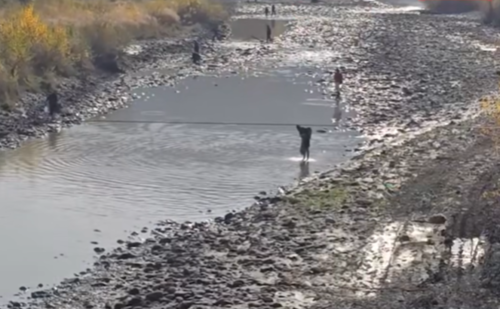 In November, the Liakhva River dried up near the town of Gori, causing massive fish deaths. Footage surfaced online of residents catching surviving fish in the dry riverbed. According to preliminary reports, the drying up of the river may be due to a sand and gravel mining operation, Quartli.ge reported.
Professor Alexey Gunya , a leading researcher at the Institute of Geography of the Russian Academy of Sciences, noted that to assess the scale of the negative impacts of gravel extraction, on-site research is needed.
"Gravel is mined in many river valleys. Typically, this mining doesn't cause significant disruption to the ecosystem. However, in some cases, the removal of construction material can affect the river's hydrological regime and lead to a number of negative processes," he said.
Ecologist Evgeny Vitishko believes that gravel mining in mountain rivers harms the ecosystem in any case.
"There are specific methods for calculating damage to aquatic biological resources. The damage is often quite significant. The entire ecosystem along the stretch of river where gravel miners operate is destroyed.
Plus, the river's water gets cloudy, which continues to spread. Therefore, I think the state should keep this under control. But sometimes, gravel mining is disguised as river clearing, saving residents from flooding, flooding, and so on. This is also a mechanism. As a result, the entire river is cleared, which in no way contributed to the flooding of adjacent, upstream, or downstream areas," he said.
According to the ecologist, if we are talking about the region's main resource, which is the Liakhva River for South Ossetia, then uncontrolled sand and gravel extraction could become a problem for the entire region.
"I don't know the details of the situation in South Ossetia, but for example, our main artery is the Kuban River, and it can't be so easily and thoughtlessly cleared of sand. It simply becomes shallow, the river stops flowing, and the aquifer in the wells drops. This creates turbidity in the lower reaches, making the water difficult to purify for drinking," Vitishko explained.
We've updated our Android and iOS apps ! We welcome your feedback and development ideas both on Google Play/App Store and on KU's social media pages. You can read us on Telegram without a VPN (with a VPN in Dagestan, Chechnya, and Ingushetia). Using a VPN, you can continue reading "Caucasian Knot" on the website as usual and on social media: Facebook *, Instagram *, VKontakte , Odnoklassniki , and X. You can watch "Caucasian Knot" videos on YouTube . Send messages to +49 157 72317856 on WhatsApp*, to the same number on Telegram, or write to @Caucasian_Knot.
* Meta (which owns Facebook, Instagram, and WhatsApp) is banned in Russia.
Source: https://www.kavkaz-uzel.eu/articles/418992


![Tumso Abdurakhmanov. Screenshot from video posted by Abu-Saddam Shishani [LIVE] http://www.youtube.com/watch?v=mIR3s7AB0Uw](/system/uploads/article_image/image/0001/18460/main_image_Tumso.jpg "Tumso Abdurakhmanov. Screenshot from video posted by Abu-Saddam Shishani [LIVE] http://www.youtube.com/watch?v=mIR3s7AB0Uw")