

Hunger strikers in Tbilisi have lost hope for a response from the Ministry of Health.
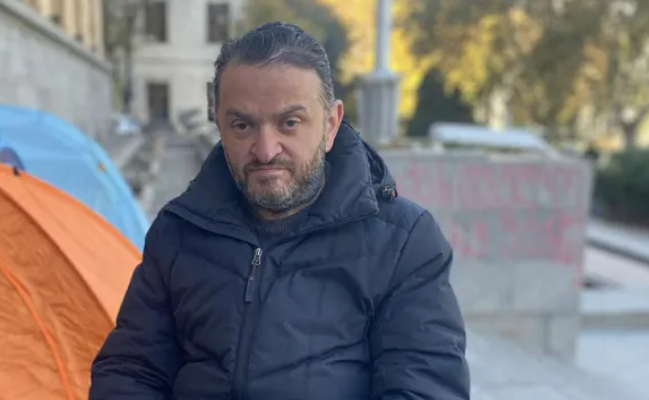
People on a prolonged hunger strike require round-the-clock medical supervision, but ambulances only arrive on call, according to hunger strikers outside the Georgian parliament, some of whom have been refusing food for 27 days.
As reported by the Caucasian Knot, on November 19, protester Isako Devidze joined the hunger strike outside the Georgian parliament. Nine people are participating in the strike, and on the 23rd day of the hunger strike, two of them reported a deterioration in their condition. On the 25th day, the hunger strikers called on those who disagree with the Georgian Dream party's policies to join the protests, including a rally scheduled for November 28, the anniversary of the start of the daily protests outside the Georgian parliament. On the 26th day of the protest, the condition of the protesters outside the Georgian Parliament has worsened, forcing them to regularly call ambulances.
On October 28, Gedevan Popkhadze, a leader of the Coalition for Change, Darejan Tskhvitaria, an activist with the United National Movement, and several others announced a hunger strike in protest against the persecution of supporters of European integration. The protest is taking place outside the Georgian Parliament building, where protesters gather daily. On November 4, the total number of hunger strikers reached eight. On the 16th day of the protest, one of the hunger strikers was hospitalized, but returned to the protesters.
The hunger strikers, which has been going on for 27 days, require 24-hour medical supervision, but emergency services only arrive when they call 112, according to Pirveli TV.
"The hunger strike has been going on for 27 days now." "We need systematic medical monitoring, but we no longer expect this from the Ministry of Health and the government," InterPressNews quoted protester Gedevan Popkhadze as saying.
"They come when called upon, but this protest is of no interest to them from a humanitarian standpoint. It's clear they don't consider themselves illegitimate and don't recognize the existence of political prisoners," the television station quoted him as saying.
Darejan Tskhvitaria reported that her health has worsened.
"Of course, there are some health issues. Yesterday, for example, my blood sugar levels dropped sharply," she said.
Currently, eight people are on a hunger strike in front of the legislative building. The demands remain unchanged: new parliamentary elections and the release of political prisoners.
We have updated our apps for Android and IOS! We welcome criticism and development ideas both on Google Play/App Store and on KU's social media pages. Without installing a VPN, you can read us on Telegram (in Dagestan, Chechnya, and Ingushetia, with a VPN). Using a VPN, you can continue reading "Caucasian Knot" on the website as usual, and on social networks: Facebook*, Instagram*, "VKontakte", "Odnoklassniki" and X. You can watch the "Caucasian Knot" video on YouTube. Send messages to +49 157 72317856 on WhatsApp*, to the same number on Telegram, or write to @Caucasian_Knot.
* Meta (owner of Facebook, Instagram, and WhatsApp) is banned in Russia.
Translated automatically via OpenAI from https://www.kavkaz-uzel.eu/articles/417443

![Tumso Abdurakhmanov. Screenshot from video posted by Abu-Saddam Shishani [LIVE] http://www.youtube.com/watch?v=mIR3s7AB0Uw](/system/uploads/article_image/image/0001/18460/main_image_Tumso.jpg "Tumso Abdurakhmanov. Screenshot from video posted by Abu-Saddam Shishani [LIVE] http://www.youtube.com/watch?v=mIR3s7AB0Uw")