


The drone attack in Makhachkala has raised questions for the authorities.
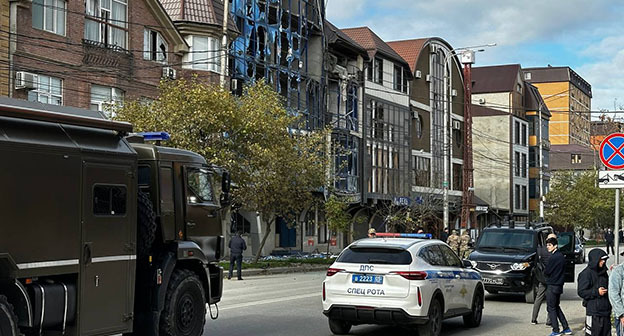
Traffic on one of Makhachkala's streets has been restricted due to a drone attack, the mayor's office announced. Telegram users have called for classes to be canceled at the city's schools, while some have asked authorities about the operation of the attack warning systems.
As reported by "Caucasian Knot," Dagestan's head Sergey Melikov announced that a drone attack on "one of the republic's enterprises" was recorded in the region today . According to sources, one drone exploded over the territory of a company in Makhachkala, damaging vehicles with shrapnel, while a second hit a shopping center under construction.
In Makhachkala, "due to operational measures related to the drone attack," traffic has been closed on a section of Kammayeva Street from the train depot to the Green Apple store, the city administration reported on its Telegram channel. "We also inform you that the drone threat remains," the post, published at 9:33 a.m. Moscow time, stated.
As of 10:30 a.m. Moscow time, seven comments had been posted under the post. Several of the authors called for the cancellation of classroom classes.
"Send schools to distance learning," suggested, in particular, Boss. "In this situation, it would be logical to switch classes in schools and educational institutions to remote learning," said kallaeva_di_art.
Cancel classes in schools! How can I send my child in this situation?
"Cancel classes in schools! How can I send my child in this situation?" wrote Ч1ег1ардиг. "I think it's better to cancel classes; remote learning is unlikely to work, given the limited internet connection," the same user added in another comment.
As of 10:30 AM Moscow time, Mayor Dzhambulat Salavov's post about the drone attack had 15 comments. Some of the authors addressed questions to the authorities regarding the drone attack.
"Where are the air defense and electronic warfare systems, or have you only deployed them near your home? Why aren't industrial facilities protected from drones with these systems and nets!" the Princess Committee expressed outrage.
"Why weren't the warning systems sounded? In other regions, the siren immediately starts wailing, even if it flies past the region," wrote Abasbekova_R. "The request has been forwarded to the relevant city administration specialists for response," responded a city control center representative.
In the Volgograd Region, drone attack threat alerts have become daily, but they can't always be relied upon. The actual appearance of UAVs over the region is not always preceded by a warning, local residents interviewed by the "Caucasian Knot" stated.
Aren't people supposed to know about explosions in the city?
"Why is there a ban [on publications about attacks]? Are people supposed to know about explosions in the city? How can anyone understand this? What kind of nonsense is this?" wrote Chitushkin. "Because information about these landings could be used by the country's enemies to adjust future launches," M explained in response.
As a reminder, on October 14, Melikov by his decree prohibited media outlets and internet users from publishing information about the consequences of terrorist attacks and sabotage, the arrival of Ukrainian drones, and the deployment of military and "critically important" facilities (bridges, fuel and energy complex facilities, communications, and industrial facilities) in Dagestan.
Melikov's decree contradicts the law on mass media, and it does not provide a list of critically important facilities, which increases the risk of arbitrary interpretation of the document by security forces, lawyers pointed out.
Similar bans are already in effect in other regions of southern Russia – in the Astrakhan, Volgograd, and Rostov regions, Adygea, Kalmykia, and North Ossetia. On August 28, it was reported that in the Rostov region, two people were fined under administrative law for filming the aftermath of drone attacks.
Banning the filming of drone attacks and their aftermath, imposed by regional authorities, contradicts the Constitution, which guarantees the inadmissibility of censorship and the freedom of information, lawyers previously pointed out.
Translated automatically via OpenAI from https://www.kavkaz-uzel.eu/articles/416549

![Tumso Abdurakhmanov. Screenshot from video posted by Abu-Saddam Shishani [LIVE] http://www.youtube.com/watch?v=mIR3s7AB0Uw](/system/uploads/article_image/image/0001/18460/main_image_Tumso.jpg "Tumso Abdurakhmanov. Screenshot from video posted by Abu-Saddam Shishani [LIVE] http://www.youtube.com/watch?v=mIR3s7AB0Uw")