

Volunteers complained that authorities are ignoring their contribution to cleaning up fuel oil in Kuban.
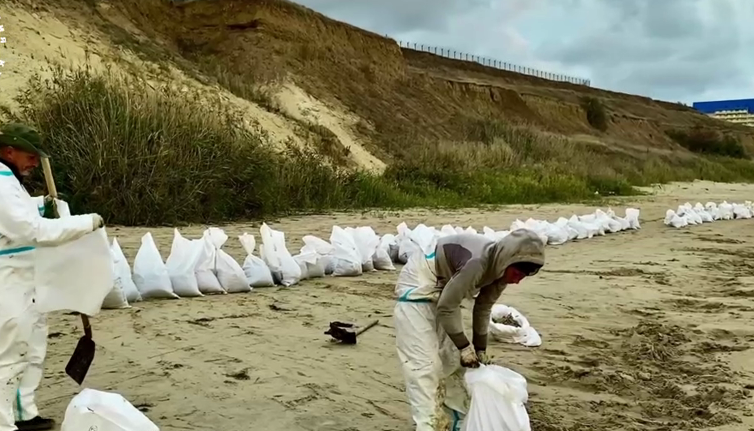
Volunteers have collected about half of the oil-contaminated sand, which authorities reported being removed for disposal. However, the official reports don't even mention the volunteers' work, the Dolphins headquarters emphasized.
As reported by the "Caucasian Knot," sand and oil from the coastline continue to arrive at the site in the Anapa village of Voskresensky. However, after sorting, it is quickly removed for disposal, authorities reported. On October 16, 162 tons of oil-contaminated soil were removed from the temporary storage site in the village of Voskresenskoye in Anapa.
Authorities had promised to remove all the sand from the temporary storage site in the village of Voskresenskoye in Anapa by April 1, but they postponed the deadline first to April 15 and then to the end of May, citing a lack of capacity at disposal facilities. Approximately 22,000 tons of contaminated sand remain at the site in Voskresenskoye; it will be removed by mid-July, the Kuban operational headquarters announced on June 23. On July 24, authorities reported that 5,000 tons of sand remained at the site and set a removal deadline of one and a half weeks. Meanwhile, the landfill will be used until the coastal cleanup is complete as a temporary storage site for freshly collected emissions. By the end of August, less than a thousand tons of sand and fuel oil remained at the landfill in Voskresensky.
The Dolphins headquarters commented on the official report on the removal of fuel oil from the landfill in Voskresensky. "On October 16, as reported by the Operational Headquarters, 162 tons of contaminated soil were removed from the temporary accumulation site in the village of Voskresensky (Anapa). Do you know how much of this was removed by the Dolphins volunteer headquarters alone? About 2,500 bags, which is comparable to 80-88 tons of fuel oil mixture (sand, fuel oil, algae)," the report says.
At the same time, "only a handful of people worked - 5-8 volunteers, in difficult conditions." "We're not in the reports. We're not thanked at meetings. We're not even mentioned. But we're here. Thank you to our volunteers, thank you to the heroes who stay on shore after everyone else has left," the headquarters declared.
"We continue to clean up—while others think it's all over," the volunteers emphasized.
Black Sea fuel oil pollution continues; satellite images showed leaks from sunken tankers in August. Most of the fuel oil settled to the seabed, including in the areas of Taman, Anapa, and the Bugay Spit, according to scientists from the Institute of Oceanology of the Russian Academy of Sciences.
As a reminder, on December 15, 2024, two tankers carrying fuel oil sank in the Kerch Strait. A crew member of one of the tankers died as a result. In addition, an oil spill occurred, leading to catastrophic environmental consequences, according to the "Caucasian Knot" report "Fuel Oil Spill in the Kerch Strait".
As a result of the environmental disaster, Rospotrebnadzor declared 141 beaches in Anapa and nine beaches in the Temryuk district unsuitable for recreation. Fuel oil was detected on all beaches in Anapa, on the coast in the Temryuk district, and on the coast of the Sea of Azov in the Slavyansk district of Kuban, according to the Caucasian Knot report "The extent of fuel oil pollution in southern Russia".
We have updated the apps for Android and IOS! We would be grateful for criticism and ideas for development both in Google Play/App Store and on KU pages in social networks. Without installing a VPN, you can read us on Telegram (in Dagestan, Chechnya and Ingushetia - with VPN). Using a VPN, you can continue reading "Caucasian Knot" on the website as usual, and on social networks: Facebook*, Instagram*, "VKontakte", "Odnoklassniki" and X. You can watch the "Caucasian Knot" video on YouTube. Send messages to +49 157 72317856 on WhatsApp*, to the same number on Telegram, or write to @Caucasian_Knot.
* Meta (owner of Facebook, Instagram, and WhatsApp) is banned in Russia.
Translated automatically via OpenAI from https://www.kavkaz-uzel.eu/articles/416469

![Tumso Abdurakhmanov. Screenshot from video posted by Abu-Saddam Shishani [LIVE] http://www.youtube.com/watch?v=mIR3s7AB0Uw](/system/uploads/article_image/image/0001/18460/main_image_Tumso.jpg "Tumso Abdurakhmanov. Screenshot from video posted by Abu-Saddam Shishani [LIVE] http://www.youtube.com/watch?v=mIR3s7AB0Uw")