

Krasnodar residents called the discussion of embankment development a formality.
Activists in the Yubileyny microdistrict reported that they were unable to participate in the in-person discussion of the development of the green space on the embankment. They are holding pickets and distributing leaflets against the construction of a church, urging residents to submit their opinions online. They disagreed with the location proposed by the authorities for the rally.
As reported by "Kavkazsky Uzel," activists from the Yubileyny microdistrict submitted an application to the administration to hold a rally against the development of the green space, but they were permitted to hold the rally in Klenovy Park, which is ten kilometers from the microdistrict. Krasnodar authorities announced a public discussion of plans to build a church on the embankment, which residents of the Yubileyny microdistrict protested. Following the announcement, residents of the neighborhood held a series of solo pickets. Commenters on Telegram demanded that the authorities preserve the green space near the river.
In September 2024, residents of the Yubileiny neighborhood of Krasnodar protested against the development of Rozhdestvenskaya Embankment, where, according to the city's new general plan, a church was planned. They explained that this was the only major recreation area in the neighborhood. Activists collected signatures for a petition to Governor Veniamin Kondratyev against the development of Rozhdestvenskaya Embankment. More than 3,000 signatures were collected. Activist Vitaly Cherkasov and City Duma Deputy Alexander Safronov were detained while collecting signatures and fined by the court. However, in November, City Duma deputies adopted a new general plan despite residents' protests.
Public discussions of the project are taking place from October 13 to 19, but local activists consider them a formality and claim that residents' opinions are being ignored, blocked, and have no feedback. Officially, the hearings are conducted as a collection of opinions on the construction project via an email provided by the mayor's office, or people are invited to come and leave their notes in a log. In reality, people don't believe their opinions will be recorded electronically, and they can't physically leave notes in the log because the doors at the posted address are closed during the designated hours. Residents are sending video evidence of this, which they share on social networks, a "Caucasian Knot" correspondent reported.
Residents consider this form of feedback not only insufficient, but also downright vicious, and are organizing alternative daily actions: solitary pickets, distributing informational leaflets, recording video messages and posting them online, and writing comments.
"We are thus forming an alternative public opinion to that of officials, which they are unable to destroy or hide," said a resident of the microdistrict, who introduced himself as Sergey. According to him, the authorities are starting to "keep a close eye" on those who try to speak out openly.
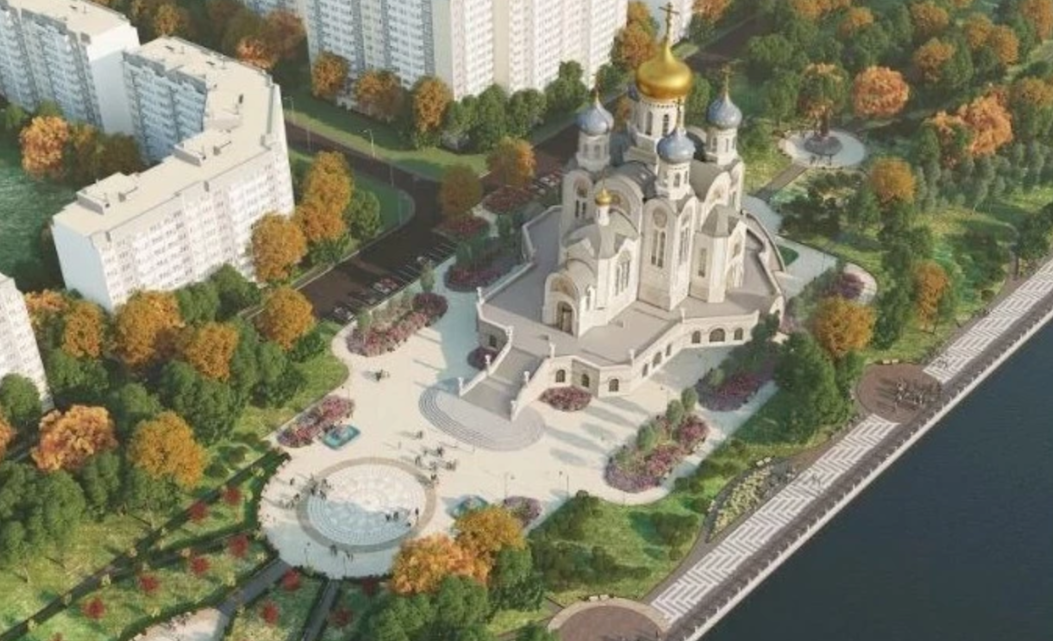
"According to the design documentation published on the administration's website, the construction of a cathedral with five domes, a conference hall, a Sunday school, and "The adjacent properties are located on a plot of approximately two hectares. The church building itself is allocated 0.4 hectares, while the rest of the territory is slated for improvement. Authorities claim that the project includes pedestrian zones, a bike path, and new plantings, but residents believe that in reality, this is essentially the destruction of the last large green space in the Southern Moscow region," said Sergey.
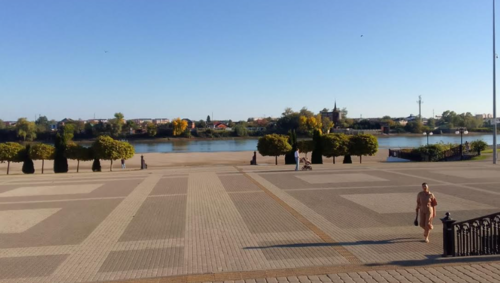 The park named after the 80th anniversary of the formation of the Krasnodar Territory, where construction is planned, was ceremoniously opened by the Governor of the Krasnodar Territory, Veniamin Kondratyev, in January 2019. "165 million rubles of budget money were spent on equipping the park. And then, five years later, they suddenly decided to develop it," says a resident of the neighborhood.
Residents of the neighborhood are holding pickets, sending petitions to government agencies and the president, and collecting signatures against the project, which should be clear that people reject this project, but it continues to be pushed through behind the protesters' backs.
In his opinion, the authorities are feigning interest in public opinion for the sake of formality, but in reality, they are "focused on their own interests."
"The development plans became known back in the fall of 2024. Since then, residents of the district have been holding pickets, sending petitions to authorities and the president, and collecting signatures against the project. It should be clear that people reject this project, but it continues to be pushed through behind the protesters' backs. The city refused to allow activists to hold a rally in Yubileiny, offering an alternative site 10 kilometers from the neighborhood, which the people refused," he noted.
Activist, neighborhood resident, and coordinator of the public movement "Yumr Council," Vitaly Cherkasov posted instructions on how to file objections through the public discussion portal and sample applications on the "Krasnodar Yumr" Telegram channel, which has over 7,500 subscribers.
"We're distributing thousands of leaflets on the streets because many don't even know the hearings are underway. The first batch of leaflets cost us 20 thousand rubles. We ask residents not to remain silent - every voice against counts," he said.
Officials were interested in people who held pickets and recorded appeals to the president against the construction of the church. Obviously, with the aim of putting pressure on them.
Activist and human rights defender Yana Antonova said that the regional authorities are not openly reacting to the protest, but confirmed reports that activists are being "taken into account."
«There was no public reaction from city and regional administration officials, but I know that officials were interested in people who held pickets and recorded appeals to the president against the construction of the church. Obviously, with the aim of putting pressure on them. "During the solitary pickets, police approached the picketers and took statements from them. I don't know about any harassment. I know they tried to find out who people were and where they worked," she told a "Caucasian Knot" correspondent.
Public discussions are taking place both online and in person, but they are merely formal, the activist pointed out. "In-person discussions are being held over two days. Tuesday and Thursday, for a couple of hours. Everything is poorly organized. At the addresses where the mayor scheduled public discussions, people who come to the discussions can't find anyone except security. I believe city officials are sabotaging the public discussions in this way. They understand that the embankment development will cause many problems for them and don't want it, so they're sabotaging it. Throughout this week, active residents of the area opposed to the embankment development have been distributing thousands of leaflets on the streets of Yubileyny calling for participation in the public discussions. I hope residents will respond to this call. How residents' opinions will be taken into account is not a question for me, but in this case, for Kondratyev," Antonova believes.
The city administration has not approved any of the four proposed sites for the rally in Yubileyny, she added. "The rally in the park The Klenovyi church will not be held. A new notice will be submitted for the rally in Yubileiny. Notices for the rally were submitted for four sites in Yubileiny. The administration has not approved any of them," the activist says.
She believes the authorities are under external pressure regarding the church construction. "As Yubileyny residents who met with Kondratyev in person a year ago told me, he is absolutely committed to building a church. The governor told Yubileyny residents that he and Metropolitan Vasily of Yekaterinodar and Kuban visited our district, saw the embankment, and liked it. The fact that there are no access roads to the embankment, that the district lacks green spaces and places for people to relax, and that the embankment is a familiar family recreation spot for Yubileyny residents—unfortunately, none of this has and does not concern Veniamin Ivanovich. I believe he is under intense pressure from someone, which he is powerless to resist. Kondratyev himself is not inclined to large, ambitious projects. He has been governor for ten years, and the issue of developing the embankment in Yubileyny with a huge church has only just arisen," said Yana Antonova.
There are already two churches in this part of the Yubileiny microdistrict, a local activist told the "Caucasian Knot" in 2024. "A chapel is a five-minute walk from the proposed construction site, and the large Nativity Church is 15 minutes away," he said.
Today, October 16, three days before the end of the discussions, some residents of the YMR who came with her to the location designated by the authorities were unable to leave their comments against the construction of the church on the embankment during the exhibition, Tamara said.
"At 173 Kommunarov Street, I was greeted by a huge castle and a sign that citizens were not being accepted," she told a "Caucasian Knot" correspondent. She said that "she specially came by taxi at the announced exhibition time of around 3 p.m. on Thursday, October 16, but was unable to express her opinion, and the exhibition itself will no longer be held." However, she has no way to submit objections online or through Gosuslugi.
Residents consider protests the only way to get feedback from the authorities and express their opinions. But when they are sent to protest as far away from the location as possible, it is simply impossible to reach the authorities. "Everything is done to block information," says Sergei.
Lawyer Yuri Ilyin called the practice of moving protests away from crowded areas a nationwide practice. "According to Federal Law No. 54 'On Assemblies, Rallies, Demonstrations, Marches, and Picketing,' authorities are obligated to offer an alternative location for a public event if the chosen site is truly occupied or if holding it poses a security threat. However, the practice of moving rallies a significant distance from the site of a conflict contradicts the law's intent, as it deprives citizens of the opportunity to be heard and receive feedback from authorities. Denying approval for a rally under the pretext of holding 'another event' at the same location, especially if it is not announced in advance, is often used as a tool to restrict the right to assemble, rally, and march. Such decisions can be challenged in court," he explained to a "Caucasian Knot" correspondent. However, in his opinion, going to court under the current circumstances would be a "waste of time."
Residents of the Yubileiny Municipal District, who spoke anonymously with a "Caucasian Knot" correspondent, said they are not opposed to churches, but to the development of capital structures in public spaces. Thus, in the microdistrict council's appeal to its residents (a copy is in the possession of "Caucasian Knot"), it is emphasized that the provision of green space in Yubileiny is less than 2 square meters per person, while the standard is 16. "We are obliged to preserve the last green spaces for our children and grandchildren. "Confiscating public lands for religious structures is immoral and illegal," the Council said in a statement.
Before the "discussions" are over, the activists intend to send a collective appeal to Governor Veniamin Kondratyev demanding that the project be halted and that a single recreational space be created on the site of the disputed site, connecting the Alley of the 80th Anniversary of the Formation of the Krasnodar Krai with the Kuban Embankment.
As a reminder, in September 2024, residents of the Yubileyny Microdistrict held two cleanup days in the recreation area where construction is planned. The goal of the protests was to show the authorities that this wasn't a wasteland, but a green space of interest to residents, according to those who participated in the cleanup days.
Back in December 2021, activists protested against the construction of a new church on the embankment in Krasnodar, and residents of the Yubileiny microdistrict also protested. Embankment defenders believe it's necessary to build educational and leisure facilities for children in the microdistrict. In January 2022, activist Yana Antonova held a solo picket against the transfer of land on the embankment to the Russian Orthodox Church for the construction of a church.
We've updated our apps for Android and IOS! We welcome criticism and development ideas both on Google Play/App Store and on KU's social media pages. You can follow us on Telegram without a VPN (with a VPN in Dagestan, Chechnya, and Ingushetia). Using a VPN, you can continue reading "Caucasian Knot" on the website as usual, and on social networks: Facebook*, Instagram*, "VKontakte", "Odnoklassniki" and X. You can watch the "Caucasian Knot" video on YouTube. Send messages to +49 157 72317856 on WhatsApp*, to the same number on Telegram, or write to @Caucasian_Knot.
* Meta (owner of Facebook, Instagram, and WhatsApp) is banned in Russia.
Translated automatically via OpenAI from https://www.kavkaz-uzel.eu/articles/416381


![Tumso Abdurakhmanov. Screenshot from video posted by Abu-Saddam Shishani [LIVE] http://www.youtube.com/watch?v=mIR3s7AB0Uw](/system/uploads/article_image/image/0001/18460/main_image_Tumso.jpg "Tumso Abdurakhmanov. Screenshot from video posted by Abu-Saddam Shishani [LIVE] http://www.youtube.com/watch?v=mIR3s7AB0Uw")