

Volunteers and environmentalists disagree with the authorities' assessment of the results of the fuel oil cleanup in Kuban.
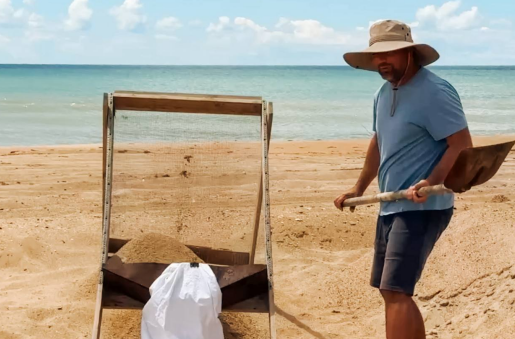
The cleanup of the Anapa and Taman coastlines is not yet complete. Fuel oil remains hidden by a layer of sand on the shore, and uncollected emissions could re-enter the water and subsequently end up on another stretch of coastline, volunteers believe. The risk of further emissions remains at least until cofferdams are installed, the ecologist noted.
As reported by "Caucasian Knot," a small number of volunteers continue their work in the Temryuk district of Kuban, removing fuel oil from areas inaccessible to equipment. Authorities have stopped volunteer activity on official beaches and report that the cleanup of the fuel oil spill is complete. The Dolphins headquarters announced that, as of October 1st, they will be without government support, and active cleanup efforts in the Temryuk district will therefore cease. The operational headquarters for the cleanup of the fuel oil spill in Krasnodar Krai reported that the situation has stabilized and there are no new oil spills, which explains why they are refusing to involve volunteers.
Despite the official government statement about "stabilization," volunteers believe the coastline still needs cleanup and are prepared to continue the work even at their own expense. They believe it's important to remove all fuel oil, including deposits under the sand.
"In the Temryuk district, a colossal amount of fuel oil remains under the sand, and the sea periodically releases oil products from leaking tankers. Is the surface cleanliness of the coastline really the only indicator of cleanliness and removal? Doesn't anyone care that the deposits under the sand extend a meter deep?" "Alexander Kirpa, head of the Dolphins headquarters, told a "Caucasian Knot" correspondent.
In his opinion, the authorities' assessment of the situation does not reflect reality. If Cape Tuzla and Cape Panagia are cleaned, the main part of the coast will be cleared, but timely removal of fresh emissions is necessary.
"The situation is constantly repeating itself: fuel oil hits the shore, is not removed, is washed out to sea, and the sea dumps it elsewhere. The new fuel oil behaves the same as the old one we found back in 2007—it's loose and remains under the sand," Kirpa noted.
He emphasized that authorities are only superficially assessing the coastline's condition. "For the Minister of Civil Defense and Emergencies of the Krasnodar Territory and his subordinates, the indicator is this: if there's a spill, there's a problem; if there's no spill, there's no problem. And the fact that fuel oil remains under the sand doesn't bother anyone," the volunteer believes.
Zhanna Rybak, a participant in the fuel oil spill cleanup on the Bugayskaya Spit from the "Network. Sieve, Shovel" headquarters, said that their headquarters has fewer than ten volunteers working full-time, and they are completely self-sufficient: food, housing, and equipment. "If there are just over 10 volunteers, "On a permanent basis, we'll gradually cope with all the tasks," she told a "Caucasian Knot" correspondent.
According to her, the "Network. Sieve, Shovel" headquarters is essentially finishing the cleanup on the Bugaz Spit, but this will only last until new emissions appear. Volunteers note that local authorities are showing little interest in the problem, and there is no assistance from municipal services, despite the availability of fuel oil.
Igor Shkradyuk, a candidate of technical sciences and an expert with the International Socio-Ecological Union, explained that in the summer, the water in the Kerch Strait warmed up to the bottom, and the fuel oil in the sunken tankers expanded and leaked to the surface. "Now the sun is warming less, the water is not warming up. But in winter, the Black Sea will be stormy, with waves reaching seven meters high. If the waves rock the wreckage of the tankers on the seabed, the fuel oil will leak again. It's unclear whether cofferdams will be installed in time before the storms begin. "So far, all the deadlines set by the task force have been missed," he told a "Caucasian Knot" correspondent.
He also emphasized that the state no longer wants to help genuine volunteers, depriving them of support (accommodation, transportation, and equipment, without which work on the coast is impossible).
Pollution of the Black Sea with fuel oil continues; satellite images showed leaks from sunken tankers in August. Most of the fuel oil settled to the seabed, including in the area of Taman, Anapa, and the Bugay Spit, concluded scientists from the Institute of Oceanology of the Russian Academy of Sciences.
As a reminder, on December 15, 2024, two tankers carrying fuel oil sank in the Kerch Strait. As a result, A crew member of one of the tankers died. In addition, an oil spill occurred, leading to catastrophic environmental consequences, according to a Caucasian Knot report, "Fuel Oil Spill in the Kerch Strait."
As a result of the environmental disaster, Rospotrebnadzor (the Federal Service for Surveillance on Consumer Rights Protection and Human Wellbeing) has declared 141 beaches in Anapa and nine beaches in the Temryuk district unsuitable for recreation. Fuel oil was found on all beaches in Anapa, on the coast in the Temryuk district, and on the coast of the Sea of Azov in the Slavyansk district of Kuban, according to a Caucasian Knot report. "The extent of fuel oil pollution in southern Russia".
We've updated our apps for Android and IOS! We appreciate your feedback. Development ideas both in Google Play/App Store and on KU pages in social networks. Without installing a VPN, you can read us on Telegram (with a VPN in Dagestan, Chechnya, and Ingushetia). Using a VPN, you can continue reading the Caucasian Knot on the website as usual and on social networks: Facebook*, Instagram*, VKontakte, and Okrug rel="noopener">Odnoklassniki and X. Watch "Caucasian Knot" videos on YouTube. Send messages on WhatsApp* to +49 157 72317856, on Telegram to the same number, or write to @Caucasian_Knot.
* Meta (owner of Facebook, Instagram, and WhatsApp) is banned in Russia.
Translated automatically via OpenAI from https://www.kavkaz-uzel.eu/articles/415930

![Tumso Abdurakhmanov. Screenshot from video posted by Abu-Saddam Shishani [LIVE] http://www.youtube.com/watch?v=mIR3s7AB0Uw](/system/uploads/article_image/image/0001/18460/main_image_Tumso.jpg "Tumso Abdurakhmanov. Screenshot from video posted by Abu-Saddam Shishani [LIVE] http://www.youtube.com/watch?v=mIR3s7AB0Uw")