

The Dolphins headquarters announced the forced cessation of fuel oil cleanup.
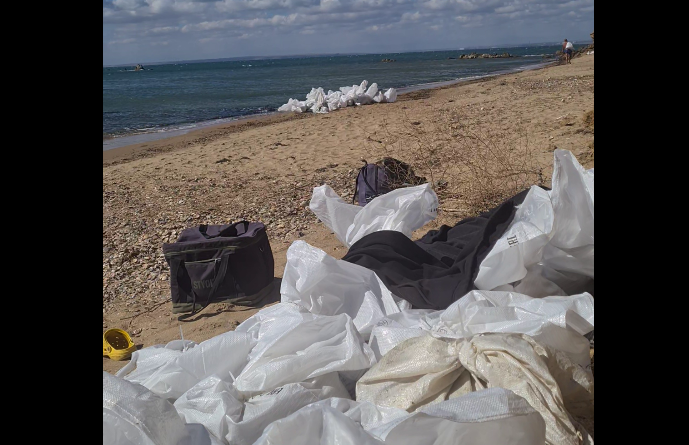
Since October 1, the "Dolphins" volunteer headquarters has been without government support. Volunteers have reported the cessation of active fuel oil cleanup efforts in the Temryuk District.
As reported by "Caucasian Knot," a small number of volunteers continue to work in the Temryuk District of Kuban, removing fuel oil from areas inaccessible to equipment. Authorities have curtailed volunteer activity on official beaches and report that the cleanup of the fuel oil spill is complete. On August 23, volunteers recorded emissions near Lake Tuzla. Since the beginning of August, volunteers from the Dolphins headquarters have collected approximately 600 bags of petroleum products from Taman beaches. The spill situation in some areas is catastrophic, and the removed contaminated sand simply sits in piles at the landfill.
As of October 1, 2025, the Dolphins headquarters has been left without government support, the headquarters announced on its Telegram channel. "We're forced to switch to standby mode. We can't afford to support volunteer groups. Public support is minimal. Personal funds have been exhausted, and personal debt to credit institutions has already exceeded 600,000 rubles. I've done everything I could. I've tried and helped as best I could. But there's a limit," said Alexander Kirpa, head of the "Dolphins" headquarters.
"For now, the headquarters will only operate in monitoring mode and searching for sponsors and supporters so we can resume full-scale fuel oil collection," he noted, thanking everyone who has helped throughout the effort. "Only with your help were we able to save the main coastline of the Temryuk district," reads a post dated September 26. This post garnered seven comments on the headquarters' Telegram channel, which has 621 subscribers. "Oh, it's too early to close, too early. We need to wait for the cofferdams to be installed, the remaining fuel oil to be pumped out, and weather the winter storms... and only then decide whether to close or leave it," wrote Ekaterina Kondratyuk.
"A national-scale disaster, and they think it will go away on its own? The money went to those who need it, and the volunteers will make do," fumed Olga Che.
Other users thanked the volunteers for their work. "Thank you so much for your concern and work," wrote Dina.
"Thank you for your incredible and heroic work, and it's a shame this is happening. You've done the incredible," commented a user with the nickname Comrade Wolf.
The headquarters is currently continuing its work. "Time and again, we encounter fuel oil in the Tuzla Cape area. It's everywhere; all you have to do is dig and there you have it. We continue digging, time is running out, October 1st is just around the corner. What next? The unknown," reads today's message.
The "Caucasian Knot" reported that volunteer data repeatedly contradicted official reports, which claim there are no fuel oil spills on the coast. For example, near the village of Volna, volunteers from the "Dolphins" headquarters recorded a fuel oil slick, followed by beaching. They asked local residents for help in cleaning up the new oil spills. Meanwhile, the task force did not record any new fuel oil emissions on the Anapa coast, although volunteers reported ongoing emissions during this period.
Fuel oil pollution in the Black Sea continues; satellite images showed leaks from sunken tankers in August. Most of the fuel oil settled to the seabed, including in the area of Taman, Anapa, and the Bugay Spit, according to scientists from the Institute of Oceanology of the Russian Academy of Sciences.
As a reminder, on December 15, 2024, two tankers carrying fuel oil sank in the Kerch Strait. A crew member of one of the tankers died as a result. In addition, an oil spill occurred, leading to catastrophic environmental consequences, according to the "Caucasian Knot" report "Fuel Oil Spill in the Kerch Strait".
As a result of the environmental disaster, Rospotrebnadzor declared 141 beaches in Anapa and nine beaches in the Temryuk district unsuitable for recreation. Fuel oil was detected on all beaches in Anapa, on the coast in the Temryuk district, and on the coast of the Sea of Azov in the Slavyansk district of Kuban, according to the Caucasian Knot report "The extent of fuel oil pollution in southern Russia".
We have updated the apps for Android and IOS! We would be grateful for criticism and ideas for development both in Google Play/App Store and on KU pages in social networks. Without installing a VPN, you can read us on Telegram (in Dagestan, Chechnya and Ingushetia - with VPN). Using a VPN, you can continue reading "Caucasian Knot" on the website as usual, and on social networks: Facebook*, Instagram*, "VKontakte", "Odnoklassniki" and X. You can watch the "Caucasian Knot" video on YouTube. Send messages to +49 157 72317856 on WhatsApp*, to the same number on Telegram, or write to @Caucasian_Knot.
* Meta (owner of Facebook, Instagram, and WhatsApp) is banned in Russia.
Translated automatically via OpenAI from https://www.kavkaz-uzel.eu/articles/415832





![Tumso Abdurakhmanov. Screenshot from video posted by Abu-Saddam Shishani [LIVE] http://www.youtube.com/watch?v=mIR3s7AB0Uw](/system/uploads/article_image/image/0001/18460/main_image_Tumso.jpg "Tumso Abdurakhmanov. Screenshot from video posted by Abu-Saddam Shishani [LIVE] http://www.youtube.com/watch?v=mIR3s7AB0Uw")