

The case of terrorist attacks in Adygea and Kuban has reached court
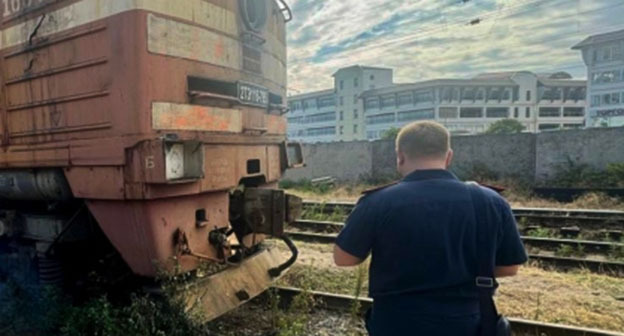
The case of three young people suspected of setting fire to a cell tower in the village of Tlyustenkhabl and a railway locomotive in Krasnodar has been sent to court.
As "Kavkazsky Uzel" wrote, in January it became known that a 16-year-old and a 19-year-old resident of Krasnodar were suspected of attempting to sabotage a communications facility; they faced up to 20 years in prison. Both suspects were arrested.
According to investigators, the suspects conspired with a foreign customer to disrupt the operation of a PJSC VimpelCom cell station in the Adygea village of Tlyustenkhabl. In August 2024, they set it on fire, after which they sent the video to the customer and received money from him.
The Western Interregional Transport Directorate of the Investigative Committee of the Russian Federation reported on the completion of the investigation today. The accused are three young people, two of whom "were minors," the department's website says.
"The investigation established that one of the teenagers, during correspondence with a representative of the Ukrainian special services in a messenger, agreed to carry out tasks aimed at committing terrorist acts for a monetary reward. Thus, in August 2024, he entered into a criminal conspiracy with an acquaintance and set fire to a cellular base station in the village of Tlyustenkhabl," the investigators' version is cited in the report.
Two accomplices set fire to a locomotive
According to the investigation, a few days later these two people "involved an acquaintance who was a minor in criminal activity." "Having found the necessary technical means in advance, two accomplices set fire to a locomotive in Krasnodar. The accomplices recorded the incident on a mobile phone camera, then sent the video recording to the curator and fled the scene of the crime. As payment for committing the terrorist act, one of the accused received cryptocurrency, which he converted into rubles and laundered," the publication claims.
Depending on their role, the young people are charged under articles on terrorist acts, involving a minor in committing a crime, and laundering money obtained as a result of a crime. "The criminal case with the indictment has been sent to court for consideration on the merits," the department said, adding that the accused face up to life imprisonment.
Recall that in the regions of southern Russia, after the start of the military operation in Ukraine, arson attacks on railway and cellular equipment have repeatedly occurred. Thus, on July 9, the FSB reported that a resident of Krasnodar Krai, detained for setting fire to cellular communication equipment, was taken into custody.
Criminal cases of arson often feature a typical formulation: allegedly "unidentified persons" force people to film the arson and then send them to the "customer". Such a plot in a large number of criminal cases suggests that investigators have found a simple way to prove crimes, candidate of legal sciences Roman Melnichenko noted earlier.
At the same time, Kuban sentences in sabotage cases have become an example for courts in other regions. Thus, in April, the appellate court doubled the sentences of teenagers from Novosibirsk in the case of sabotage on the railway, so that the final punishment would correspond to the sentences handed down in Kuban for similar cases.
The teenagers tried to get the sentences mitigated, and a representative of the prosecutor's office demanded that the sentences imposed be equal to the average terms that are imposed by courts in other regions for similar cases - from 11 years of imprisonment. The parents of the teenagers are convinced that the case is falsified
Translated automatically via OpenAI from https://www.kavkaz-uzel.eu/articles/415457


![Tumso Abdurakhmanov. Screenshot from video posted by Abu-Saddam Shishani [LIVE] http://www.youtube.com/watch?v=mIR3s7AB0Uw](/system/uploads/article_image/image/0001/18460/main_image_Tumso.jpg "Tumso Abdurakhmanov. Screenshot from video posted by Abu-Saddam Shishani [LIVE] http://www.youtube.com/watch?v=mIR3s7AB0Uw")