

Volunteers reported fuel oil deposits on Cape Tuzla
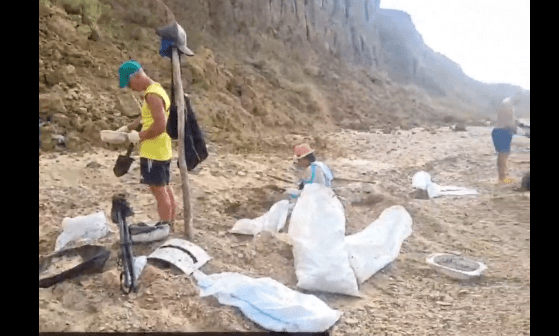
A thick layer of fuel oil lies under the sand at Cape Tuzla, and new fragmentary emissions are added to this, the Dolphins headquarters reported, whose volunteers collected 55 bags of fuel oil in two days. The operational headquarters reported no new emissions in Anapa from September 3 to 9.
As "Kavkazsky Uzel" wrote, from July 25 to August 26, the authorities did not record new fuel oil emissions on the coast of Anapa, although volunteers during this period stated that emissions were continuing. On August 4, the volunteer headquarters confirmed that local emissions of oil products continue on the beaches of Taman, and the pollution is also visible on satellite images. A few volunteers continue to work in the Temryuk district of Kuban, removing fuel oil from places inaccessible to equipment. The authorities have stopped volunteer activity on official beaches and report that the cleanup of the fuel oil spill has been completed. After the installation of cofferdams over the sunken parts of tankers with fuel oil began, fuel oil emissions appeared on the shore, and their appearance was also acknowledged by the operational headquarters.
On September 10, at Cape Tuzla in the Temryuk district, 15 volunteers cleared 30 meters of the coastline, collecting 35 bags of fuel oil. On September 9, volunteers collected 20 bags in the same location, according to the Telegram channel of the Dolphins headquarters.
"Under the sand and among the algae are thick layers of fuel oil. A clean, black oil product left over from the latest emissions," says the video from September 9, filmed at Cape Tuzla. According to volunteers, the layer of fuel oil hidden under the sand stretches for tens of meters. "Nearby are algae and fuel oil "buns" from the smallest to the largest," says the message from September 9.
On September 9, the Krasnodar Territory Operational Headquarters reported the absence of fuel oil emissions. "No new fuel oil emissions were detected in Anapa from September 3 to 9. These are the results of daily monitoring of the coastline," the operational headquarters' Telegram channel said.
In December 2024, two tankers carrying fuel oil sank in the Kerch Strait, which led to catastrophic environmental consequences. Details can be found in the "Caucasian Knot" reference "Fuel oil spill in the Kerch Strait". Materials on the consequences of the fuel oil spill have been collected by the "Caucasian Knot" on the thematic page "Eco-disaster in Kuban".
The pollution of the Black Sea with fuel oil continues, satellite images showed leaks from sunken parts of tankers in August. Most of the fuel oil settled to the bottom, including in the area of Taman, Anapa and the Bugay Spit, concluded scientists from the Institute of Oceanology of the Russian Academy of Sciences.
As a result of the environmental disaster, Rospotrebnadzor recognized 141 beaches in Anapa and nine beaches in the Temryuk district as unsuitable for recreation. Fuel oil was found on all beaches in Anapa, on the coast in the Temryuk district and on the coast of the Sea of Azov in the Slavyansk district of Kuban, according to the Caucasian Knot report "The extent of fuel oil pollution in southern Russia".
We have updated the applications on Android and IOS! We would appreciate criticism and ideas for development both in Google Play/App Store and on KU pages in social networks. Without installing a VPN, you can read us in Telegram (in Dagestan, Chechnya and Ingushetia - with VPN). Using a VPN, you can continue reading "Caucasian Knot" on the website as usual, and on social networks: Facebook*, Instagram*, "VKontakte", "Odnoklassniki" and X. You can watch the video of "Caucasian Knot" on YouTube. Send messages to WhatsApp* to the number +49 157 72317856, to Telegram - to the same number or write to the address @Caucasian_Knot.
* the activities of the Meta company (which owns Facebook, Instagram and WhatsApp) are prohibited in Russia.
Translated automatically via OpenAI from https://www.kavkaz-uzel.eu/articles/415315


![Tumso Abdurakhmanov. Screenshot from video posted by Abu-Saddam Shishani [LIVE] http://www.youtube.com/watch?v=mIR3s7AB0Uw](/system/uploads/article_image/image/0001/18460/main_image_Tumso.jpg "Tumso Abdurakhmanov. Screenshot from video posted by Abu-Saddam Shishani [LIVE] http://www.youtube.com/watch?v=mIR3s7AB0Uw")