

Lawyers consider Baku's demand for compensation for the AZAL plane crash appropriate
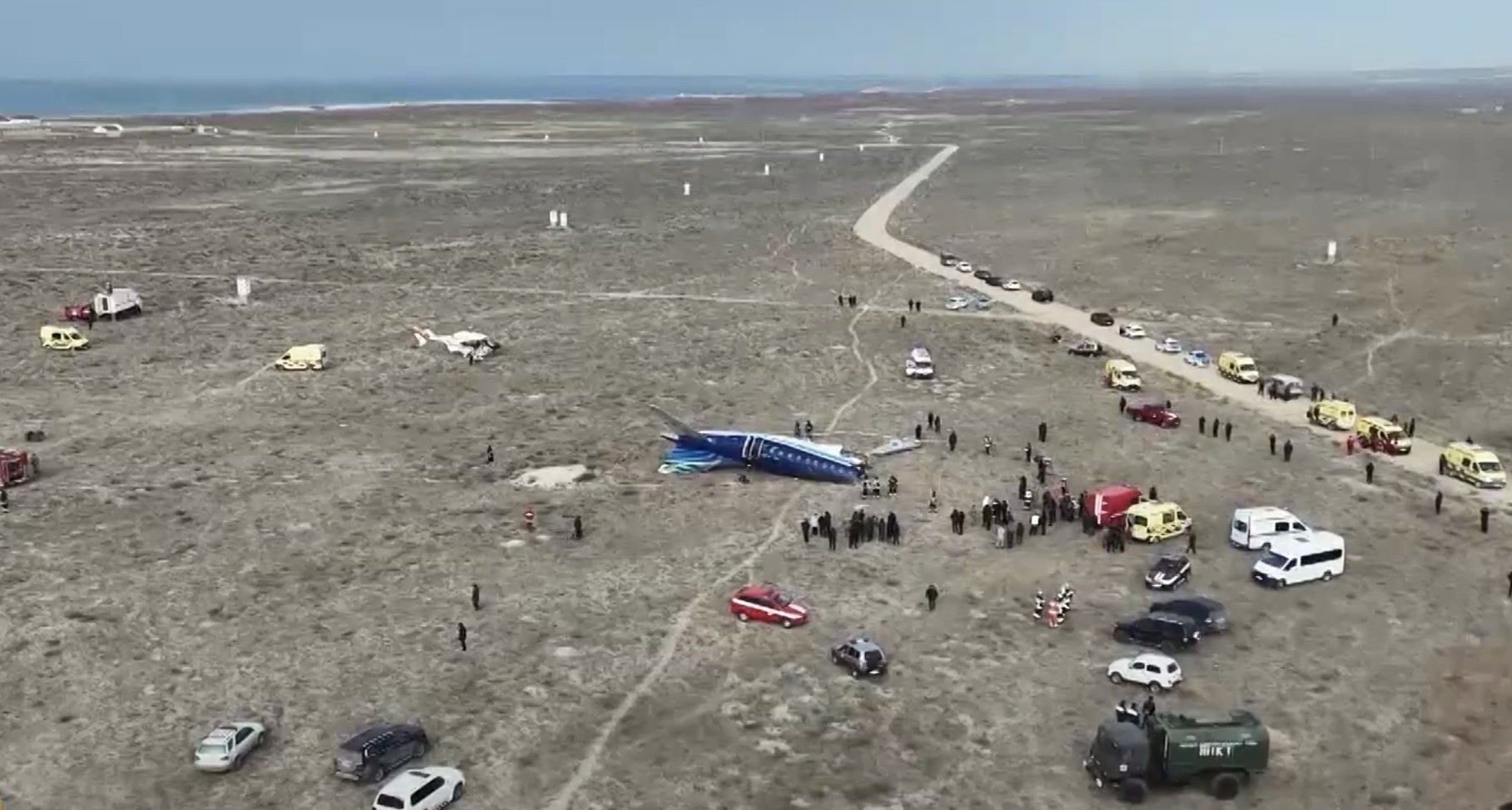
Payments of compensation by the state for the defeat and destruction of a foreign aircraft are accepted in international relations with the condition of admitting guilt for the disaster. Russia chose not to admit guilt, but to consider the crash of the AZAL airliner as an accident, which is why the insurance payments are related.
As "Kavkazsky Uzel wrote, in March, the company "AlfaStrakhovanie" paid compensation under the aviation hull insurance for the crash of the Baku-Grozny plane and began to pay for the damage to passengers. On September 4, the Russian Foreign Ministry announced that Russia had fully paid compensation for the Azerbaijani plane and insurance payments to most of the families of the victims. In response, official Baku indicated that insurance payments and compensation should not be confused.
Relations between Moscow and Baku have noticeably worsened after the crash of an Azerbaijan Airlines plane with 67 people on board in Kazakhstan on December 25, 2024, flying from Baku to Grozny. You can read more about this in the "Caucasian Knot" reference "Baku-Grozny Air Crash" and in the article "Geopolitical Confrontation: What Did the AZAL Plane Crash Led to".
The demand for compensation in addition to insurance payments, which the Azerbaijani authorities voiced after the Russian Foreign Ministry's statement on fulfilling its obligations, was commented on to the "Caucasian Knot" by lawyers Marina Agaltsova and Timofey Shirov, as well as Sergey Boyko, an employee of the Adam Smith Research Center.
In international practice, a state whose actions led to the death of people pays compensation to the families of the deceased, although with various reservations, political scientist Boyko pointed out. He cited examples of similar interstate disputes that took place in the past.
"So, on July 3, 1988, when the Americans shot down the Iranian passenger Airbus, the US initially did not admit responsibility for a long time, but Iran filed a lawsuit in the International Court in 1989 and won. Only seven years later, in 1996, the US agreed to pay Iran compensation in the amount of 61.8 million US dollars for 248 victims, at a rate of 300 thousand dollars for each able-bodied victim and 150 thousand for each child. The US refused to compensate for the cost of the plane (about 30 million dollars), "he said.
After the accidental downing of the Russian Tu-154 by air defense forces over the Black Sea on October 4, 2001, the Ukrainian authorities paid 200 thousand dollars for each passenger without legally admitting guilt, Boyko also noted. "In the Russian case, it is clear that under the current regime, the authorities will avoid paying in every possible way, but ultimately either the current authorities will pay, or new authorities will in the future," he believes.
In July, Azerbaijani President Ilham Aliyev announced the preparation of documents to file claims in international courts regarding the crash of the AZAL plane, since Russia did not admit guilt and did not punish those responsible for the deaths. Soon after, the Azerbaijani publication Minval published the names of the Russian military personnel involved in the crash of the AZAL plane. The commander of one of the divisions, who gave the order to shoot down the plane, was promoted after the disaster, the journalists noted.
Insurance payments do not depend on whether someone is at fault for the plane crash or not, lawyer Marina Agaltsova noted. "There is no need to prove guilt, and this is the point of insurance. This makes it easier to receive monetary compensation: then the insured may or may not go to the person who caused the damage (for compensation for the damage). This is how any insurance usually works," she said.
Agaltsova also noted that insurance, as a rule, does not cover all damage. "Insurance is a fixed amount, it is usually aimed at partial compensation. Full coverage of even material damage by insurance does not occur, because it takes a long time to litigate to ensure that everything is accurately compensated," the lawyer noted.
In her opinion, victims can file a class action lawsuit in a Russian court for full compensation, relying, among other things, on the Russian state's actual recognition of its responsibility. An appeal to an Azerbaijani or international court is unlikely to help, because its decision may be ignored.
"And if the Russian state has admitted its guilt for this, it turns out that the guilt has already been proven, and a tort obligation arises. At the same time, in a Russian court it is necessary to prove the amount of damage and demand that the difference - the delta - between what the damage actually was and what the insurance company paid be recovered. It is also necessary to select the object of the claim, the person who caused the damage: perhaps it is the Ministry of Defense or the airport security service, or some specific military unit. But finding and proving the guilt of the person who caused the damage is a very difficult task," Agaltsova explained.
The consent of one or another state to compensation in such cases is largely an expression of goodwill, lawyer Timofey Shirokov pointed out.
"There is no code of international relations, it is very situational. This is a matter of goodwill: from a formal point of view, as far as I understand, the Russian side is right. Another issue is that there are customs in international relations, according to which the guilty party pays compensation. But Russia, apparently, does not want to admit its guilt," he said.
The refusal of the Russian Federation to pay compensation in connection with the crash of the Malaysian Boeing is connected with the non-recognition of the court's decision, he said.
"Because Russia does not recognize the jurisdiction of the international investigation - from Russia's point of view, the procedure was not followed, the court is illegitimate, and therefore compensation is not paid. If Russia had participated in the activities of this court, it could (agree to payments). In those cases when someone paid, for example, the Americans, they still recognized the jurisdiction of those courts. It can be assumed that the Americans participated in this investigation, so they agreed with the conclusion," Shirokov explained.
The desire to limit itself to insurance payments indicates that the state considers the crash of the Azerbaijani plane an accident and is effectively absolving itself of responsibility, he believes.
"If the plane's engine jams, or the pilot loses control, this is exactly the case for insurance. You need to look at the contract, but often force majeure circumstances are specified in contracts as grounds for non-fulfillment of the contract. Combat operations, for example, a defeat in a combat zone. The insurance company could say that they have nothing to do with it at all, but since it admitted liability and paid compensation, it turns out that the crash is recognized as an accident, and not a defeat of the aircraft as a result of military operations," Shirokov said.
He also did not rule out the possibility for the victims to file a claim in Russian courts, although he doubted the prospects of such a claim. "Such decisions are made on the basis of investigation documents. For example, some investigation can be conducted by ICAO (International Civil Aviation Organization), but knowing the practice, it is very difficult to achieve that a Russian court finds the nature of the state's actions guilty," Shirokov summed up.
We have updated the applications on Android and IOS! We would appreciate criticism and ideas for development both in Google Play/App Store and on KU pages in social networks. Without installing a VPN, you can read us in Telegram (in Dagestan, Chechnya and Ingushetia - with VPN). Using a VPN, you can continue reading "Caucasian Knot" on the website as usual, and on social networks: Facebook*, Instagram*, "VKontakte", "Odnoklassniki" and X. You can watch the video of "Caucasian Knot" on YouTube. Send messages to WhatsApp* to the number +49 157 72317856, to Telegram - to the same number or write to the address @Caucasian_Knot.
* the activities of the Meta company (which owns Facebook, Instagram and WhatsApp) are prohibited in Russia.
Translated automatically via OpenAI from https://www.kavkaz-uzel.eu/articles/415285
![Tumso Abdurakhmanov. Screenshot from video posted by Abu-Saddam Shishani [LIVE] http://www.youtube.com/watch?v=mIR3s7AB0Uw](/system/uploads/article_image/image/0001/18460/main_image_Tumso.jpg "Tumso Abdurakhmanov. Screenshot from video posted by Abu-Saddam Shishani [LIVE] http://www.youtube.com/watch?v=mIR3s7AB0Uw")