


Volunteers discover fuel oil emissions in Temryuk district
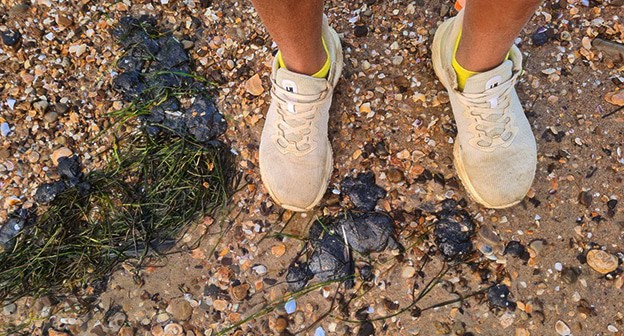
Near the village of Volna, volunteers from the Dolphins headquarters recorded a fuel oil slick, and then beaching. They asked for help from local residents in cleaning up new fuel oil slicks.
"Kavkazsky Uzel" wrote that from July 25 to August 26, the authorities did not record new fuel oil emissions on the coast of Anapa, although volunteers during this period stated that emissions were continuing. On August 4, the volunteer headquarters confirmed that local emissions of oil products were continuing on the beaches of Taman and pollution is visible on satellite images. A few volunteers continue to work in the Temryuk district of Kuban, removing fuel oil from places inaccessible to equipment. The authorities stopped volunteer activity on official beaches and report that the liquidation of the consequences of the fuel oil spill is complete.
A large slick with fuel oil fractions was discovered near the port in Volna. The Marine Rescue Service eliminated the bulk of the pollution. However, the remains of the slick began to flow onto the shore near the village, the Dolphins headquarters reported on September 1.
On September 2, emissions appeared on the shore. "Within one or two hours, the environmental situation on the beaches of the village of Volna changes significantly: a barely noticeable scattering of fuel oil fractions in the sea water turns into surf waves blackened by oil products. Part of the beach is covered with large fuel oil stains and requires urgent cleaning," volunteers reported on their Telegram channel, calling on local residents to help clean the shore.
Before that, they reported that over the week, the most polluted locations on the coast where the headquarters volunteers work were the beaches of the village of Volna (Port Taman) and Cape Tuzla, however, in other areas, many kilometers away from there, the volunteers of the Dolphins headquarters discovered places of localization of fresh fuel oil emissions (Belaya Gora beach in the area of the village of Artyushchenko).
Over the week, 213 bags of fuel oil and oil-contaminated soil were collected, and 1,220 bags were removed from the beaches, the headquarters reported.
The headquarters' message about fuel oil on the beaches of the village of Volna was published by the Telegram channel Kub_mash, which has 113,364 subscribers. It had collected 37 comments by 11:22 Moscow time.
We were in Blagoveshchenskaya the day before yesterday, no one was swimming, it was already evening, at first we didn’t understand, and then we understood.... Everything is stained with fuel oil, oily, the stains don’t wash off and there’s a terrible stench,” wrote the user I see it that way.
We just returned from Anapa, the central beach. If you go out to sea, where it’s at least a little deeper than a meter, you can sometimes smell it, but I’ll remember it for the rest of my life since December after the liquidation. I came across two small oily stains, then we decided to move away from the central beach towards the river and the sea is clean there, there’s no smell,” said Yana, noting that she’s going to the beach in Dzhemete next time
“In Dzhemete, even walking on the sand, you get fuel oil on your feet,” she objected. Marina.
"They reported that the money was spent. Excellent work. Everything as usual. They simply forgot about the one that settled on the bottom. Tide, current, storm - and here it is again," Evgeny noted.
Other commentators objected that the sea is clean. "Blagoveshchenskaya. The cleanest sea," wrote a user with the nickname Man.
"I live in Anapa, was with my child on the central beach, everything is clean! There is not even any disgusting mud!", Irina Anapa commented.
In December 2024, two tankers with fuel oil sank in the Kerch Strait, which led to catastrophic environmental consequences. Details can be found in the "Caucasian Knot" reference "Fuel oil spill in the Kerch Strait". Materials about the consequences of the fuel oil spill have been collected by the "Caucasian Knot" on the thematic page "Eco-disaster in Kuban".
As a result of the eco-disaster, Rospotrebnadzor has declared 141 beaches in Anapa and nine beaches in the Temryuk district unsuitable for recreation. Fuel oil was found on all beaches in Anapa, on the coast in the Temryuk district and on the coast of the Sea of Azov in the Slavyansk district of Kuban, according to the Caucasian Knot report "The extent of fuel oil pollution in southern Russia".
We have updated the applications on Android and IOS! We would appreciate criticism and ideas for development both in Google Play/App Store and on KU pages in social networks. Without installing a VPN, you can read us in Telegram (in Dagestan, Chechnya and Ingushetia - with VPN). Using a VPN, you can continue reading "Caucasian Knot" on the website as usual, and on social networks: Facebook*, Instagram*, "VKontakte", "Odnoklassniki" and X. You can watch the video of "Caucasian Knot" on YouTube. Send messages to WhatsApp* to the number +49 157 72317856, to Telegram - to the same number or write to the address @Caucasian_Knot.
* the activities of the Meta company (which owns Facebook, Instagram and WhatsApp) are prohibited in Russia.
Translated automatically via OpenAI from https://www.kavkaz-uzel.eu/articles/415098




![Tumso Abdurakhmanov. Screenshot from video posted by Abu-Saddam Shishani [LIVE] http://www.youtube.com/watch?v=mIR3s7AB0Uw](/system/uploads/article_image/image/0001/18460/main_image_Tumso.jpg "Tumso Abdurakhmanov. Screenshot from video posted by Abu-Saddam Shishani [LIVE] http://www.youtube.com/watch?v=mIR3s7AB0Uw")