


Antonio Guterres is satisfied with accommodation of IDPs in Azerbaijan
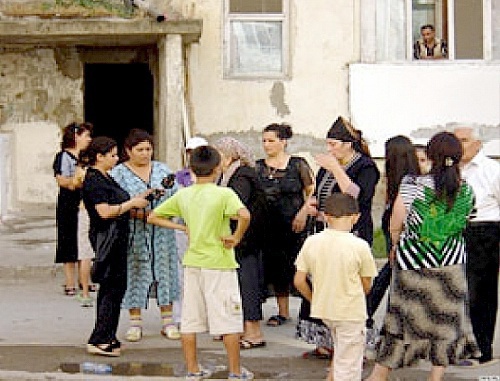
The main goals of the May 17-19 visit of Antonio Guterres, the UN High Commissioner for Refugees, to Azerbaijan were to study the living conditions of internally displaced persons (IDPs) and to attract the attention of the world community to the unsettled Karabakh conflict and its heavy humanitarian consequences.
As reported by the "Caucasian Knot" correspondent, this was stated by Mr Guterres himself at a press conference held in Baku.
"By visiting Azerbaijan, I wanted to show to the world that the problem remains. The globe faces crises following one another; and it's important for the international community to remember that this conflict is alive for 20 years; and IDPs have no chance to return to their homes. The world community should do everything possible to resolve the conflict," said Antonio Guterres.
He noted that over the 5 years after his previous visit to Azerbaijan, the country has done "a great work" to improve the living conditions of the IDPs from the Nagorno-Karabakh conflict. Mr Guterres noted with satisfaction that the government had fully committed itself to resolve their problems: after the elimination of tent camps, they now build houses and apartments for those who live in hostels.
According to his story, "Azerbaijan is the world leader in terms of investment per capita for this category of persons."
"Usually, when I visit countries, they try to show me only good examples. But in Azerbaijan I saw not only the new settlements for IDPs, but also places, where people still live in harsh living conditions," continued the UN High Commissioner.
In the course of his visit he toured the frontal zone and visited new settlements for IDPs built in the Agdam and Evlakh Districts. There, one-storey houses with gardens have been built for displaced persons. A few years ago these people lived in tent camps in the desert.
Mr Guterres also spoke to the IDPs who live in one of the hostels in the Binagadin District of Baku.
The Azerbaijani government has undertaken all the expenses related to accommodation of IDPs; thus, the UN High Commissioner for Refugees is no longer engaged in providing them with material aid. At the same time, this UN body works, according to Guterres, towards "supporting the measures aimed to ensure repatriation of forced migrants to their homes and create safe environment for their stay, in case of political settlement of the conflict is achieved."
In Armenia, the High Commissioner continues attracting donors' help. As explained by Guterres, although the Armenian government is also taking steps to help refugees, but they have no funds to implement programmes for building houses for refugees from Azerbaijan. That is why, Antonio Guterres had appealed to international donors asking them to finance the Armenian construction programme of 1200 houses for refugees.
At the same time, Mr Guterres has stressed that the UN High Commissioner for Refugees does not and will not conduct any activities in Nagorno-Karabakh and adjacent territories, until the parties reach an agreement on political settlement of the conflict. "Our activities are built on the principles of consensus between the parties," he said.
Meanwhile, as stated by Gasanov, head of the State Committee for Refugees of Azerbaijan, recently they started resettlement of 1210 displaced families into temporary new houses in Baku and Sumgait, built in accordance with the state programme.
According to Mr Gasanov, in total, the 2011 state budget has allotted 190 million manats (about 228 million US dollars) for the needs of IDPs; 110 million mantas (about 132 million US dollars) have been additionally allotted from the State Oil Fund.
"At present, Azerbaijan spends 684 manats every year on every IDP - the highest figure among all the conflict zones of the world," said Gasanov. In total, according to Deputy Prime Minister, after 1993, Azerbaijan has spent 3.7 billion mantas on the needs of IDPs.
Apart from building houses, the state continues providing IDPs with a number of benefits. Thus, every IDP receives a monthly allowance of 15 manats (USD 18) for foodstuffs (after January 1 this benefit no longer applies to the IDPs employed by state structures and those, whose one parent is not a refugee, in total about 70,000 persons, - note of the "Caucasian Knot"). Besides, every IDP may consume 150 kWh of electricity and 35 cubic meters of gas per month free of charge. They are also exempted from payment for water supply and fixed telephony (subscribers, connected before 2007). Those who have no gas get free kerosene in the period from October to February. Besides, students from families of IDPs, who study at paid departments of state universities, pay nothing for their studies.
Source: CK correspondent

![Tumso Abdurakhmanov. Screenshot from video posted by Abu-Saddam Shishani [LIVE] http://www.youtube.com/watch?v=mIR3s7AB0Uw](/system/uploads/article_image/image/0001/18460/main_image_Tumso.jpg "Tumso Abdurakhmanov. Screenshot from video posted by Abu-Saddam Shishani [LIVE] http://www.youtube.com/watch?v=mIR3s7AB0Uw")