

Lebedev's expedition to the Caucasus: Azerbaijan - "in juncture of civilizations", Georgia - "not the States yet, but tries a lot"
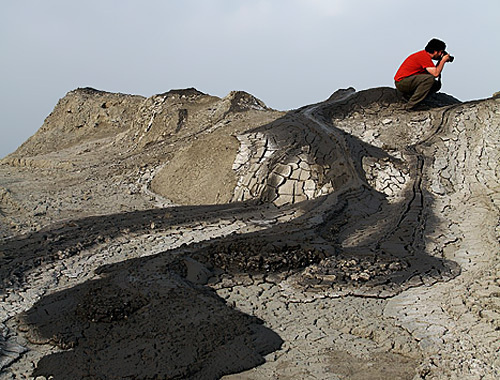
The participants of the ethnographic expedition, which started from Moscow to the Caucasus on July 15 and organized by the well-known Russian designer and blogger Artemiy Lebedev, have already visited the south of Russia and are now getting acquainted with Southern Caucasus. After the North-Caucasian republics, the crews have visited Azerbaijan and Georgia.
They received their first impressions about the distinctions between Northern and Southern Caucasus already in the Azerbaijani border. In particular, blogger Gennady Vernikov reports that there are only two ways to get in a car to the territory of Azerbaijan: to drive in for the 30 days established by the immigration legislation, but with the right to drive out only through the same border check point ("the vehicle registration certificate remains at the customs; instead, you get a heap of papers, including a copy of the certificate"); or to drive in under transit documents ("the registration certificate remains with you, but you may stay in the country only for 72 hours at most"). "I've never met anything of the sort anywhere before," Mr Vernikov has noted.
He treats Baku as "a city of contrasts" and "a city with the population of about three million, staying in the juncture of civilizations."
The blogger emphasizes that Baku is a very expensive city. In 2009, it was recognized as the most expensive city in the territory of the CIS for travelling businessmen.
The travellers tell that Azerbaijan faces a sharp problem of corruption; "local residents are constantly complaining of it." Artemiy Lebedev also draws attention "peculiarities of Azerbaijani bribe-taking," especially on roads. "Azerbaijan has rather tough speed limits and draconian cops," he writes in his Livejournal. "There's one salvation: a bribe is the basis of the existence of the Azerbaijani society. Bribes are extorted by everyone, and, whenever possible, for everything. They call it 'magarych' (backsheesh)."
Vernikov notes that Baku "lacks almost any traces of globalization." "I saw no hypermarkets, or even no large grocery shops," he writes. "Most of the shops have no names. Instead, just a piece of plywood with inscription made with a marker: 'Market'."
Impressions of Georgia, unlike what they saw in Azerbaijan, in Russian bloggers are almost not related with the Caucasian nature or with local national colouring. In their "Georgian" reports the members of the expedition emphasize, first of all, absence of corruption and de-Russification of the markers of city infrastructure.
"For the time I wasn't here, three things happened: cops stopped taking bribes, youth ceased understanding Russian, everywhere Russian inscriptions are replaced by English ones, and ruins turn into beauty in places," Artemiy Lebedev notes in his story about Georgia.
"Corruption at the bottom level here is absent," this is the conclusion of Gennady Vernikov. "A customs officer refused to take our club desk calendar with Rams, saying that only his boss may take gifts, but he was absent at that time."
"The capital looks absolutely European. People are dressed brightly and many quite with a good taste," he writes. "There are no national specificities in fashion. Women have bright make-up and are rather free in their clothes."
Vernikov writes as follows about Georgian-Russian relations: "It's surprising that at the level of interstate relations we see a rather aggressive confrontation. Nothing of the sort is felt here. The attitude to Russians is very good. By the way, local schools have the Russian language as one of the main subjects."
Residents of Georgia, as the blogger writes, "look somewhat like Russians." "For example, they drink quite a lot here," he writes.
Artemiy Lebedev, initiator and organizer of the ethnographic expedition to the Caucasus, writes, while summing up his impressions about Georgia and, first of all, about Tbilisi: "Simple people lived in ruins and do it now. However, the ruins are elements of national colouring."


![Tumso Abdurakhmanov. Screenshot from video posted by Abu-Saddam Shishani [LIVE] http://www.youtube.com/watch?v=mIR3s7AB0Uw](/system/uploads/article_image/image/0001/18460/main_image_Tumso.jpg "Tumso Abdurakhmanov. Screenshot from video posted by Abu-Saddam Shishani [LIVE] http://www.youtube.com/watch?v=mIR3s7AB0Uw")