

Criticism from the Armenian side regarding the visits of diplomats to Karabakh met with objections in Azerbaijan.
Foreign diplomats have the right to visit Karabakh as an internationally recognized territory of Azerbaijan, and the demands to condemn such trips are unfounded, Azerbaijani analysts stated.
As reported by "Caucasian Knot", on September 16, about 50 organizations and public figures from Armenia, Nagorno-Karabakh, and the diaspora called on diplomatic missions in Yerevan to provide a political and legal assessment of the trips of foreign representatives to Karabakh and not to participate in actions that, in the opinion of the authors of the appeal, could contribute to the international legitimization of Azerbaijan's policy regarding the region and its Armenian heritage.
On September 14, Karabakh activists considered the visit of diplomats accredited in Azerbaijan as a legitimization of the destruction of Armenian cultural heritage. The trip took place on September 11 and 12: a delegation of 150 people representing 58 countries and nine international organizations visited Khankendi, Shusha, Agdere, and Kelbajar districts. The Azerbaijani side stated that this was the 22nd visit of the diplomatic corps to the region since 2020, and the participants of the trip were shown the progress of restoration work and the condition of historical and cultural heritage sites.
Farhadoglu and Juvarly considered the claims regarding the visits of diplomats to be unfounded
The negative reaction in Armenia to the visit of foreign diplomats to Karabakh and Eastern Zangezur and the demands for explanations are unfounded, believes Turan analytical service employee Tapdyg Farhadoglu.
"Karabakh and Eastern Zangezur are internationally recognized territories of Azerbaijan, and Baku has the right to invite foreign diplomats to these regions. By the way, Armenia itself recognized the territorial integrity of Azerbaijan in a number of international documents, including the Washington Declaration adopted last August, and the peace treaty that was initialed at the same time," he said to a correspondent of "Caucasian Knot".
Foreign diplomats have previously visited territories that came under Azerbaijan's control as a result of the hostilities in 2020 and 2023, but such a strong reaction in Armenia did not occur, Farhadoglu pointed out. He linked the current reaction to the large composition of the delegation and the presence of ambassadors from countries that are traditionally considered supportive of Armenia in Yerevan, primarily France.
After the 2020 war, the ambassadors of the co-chairing countries of the Minsk Group of the Organization for Security and Cooperation in Europe (OSCE) refrained from traveling to Karabakh. Now, according to Farhadoglu, the situation has changed: the conflict is over, Armenia and Azerbaijan have initialed a peace agreement, economic ties are developing between the countries, Azerbaijan supplies fuel to Armenia and provides its communications for the transit of goods from Kazakhstan and Russia, and the Minsk Group of the OSCE has been dissolved.
"In this situation, foreign diplomats have neither legal nor moral grounds to refuse to visit the regions of Azerbaijan affected by the conflict. Moreover, according to international law, they are obliged to respect the laws and sovereign rights of the host country," Farhadoglu said.
The pragmatic interests of states also contribute to the development of their relations with Azerbaijan, which plays an increasingly active role in regional cooperation not only in the South Caucasus but also in Central Asia and partially in the Middle East. He named the goals of the diplomatic corps visit as demonstrating the scale of restoration work in the territories affected by the war and drawing attention to landmine contamination, Farhadoglu noted.
The analyst also disagreed with accusations of "destruction" and "appropriation" of Armenian historical and cultural heritage. The medieval Christian monuments of the region, including the Gandzasar and Khudavang monasteries, he associated with the culture of Caucasian Albania. According to him, the Albanian church existed until the 19th century, and in 1836, the Holy Synod of the Russian Empire abolished it, after which the property and churches were transferred to the Armenian church.
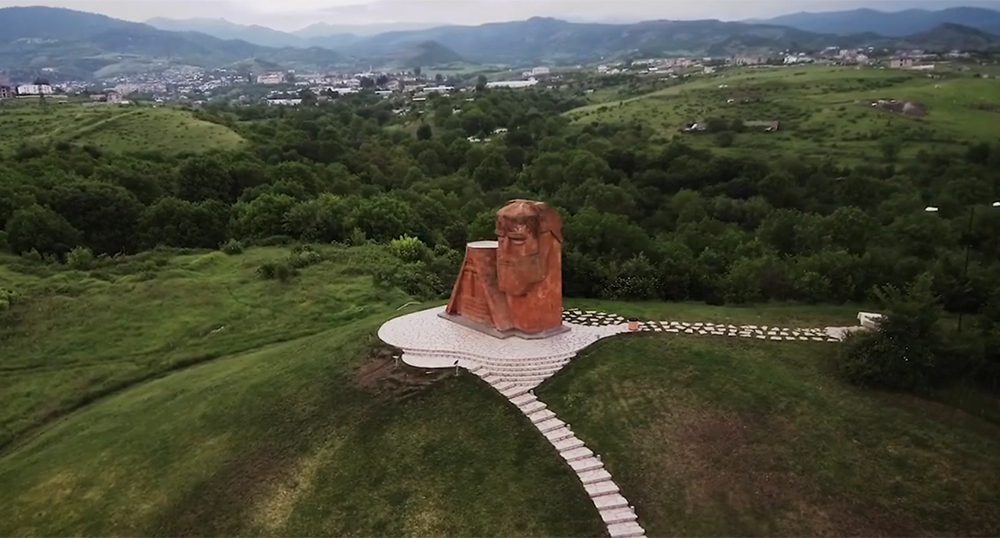
Disputes over the cultural heritage of Karabakh regularly become the subject of discussions on social networks. Thus, on June 29, participants in the discussion argued about the possible demolition of the monument "We are our mountains" and the impact of such a decision on Armenian-Azerbaijani peace negotiations. On March 18, a publication calling to preserve the Armenian heritage of Karabakh gained more than a thousand comments, in which users exchanged mutual accusations of vandalism and debated the need to involve the international community.
"The existence of Caucasian Albania and its historical heritage is a well-known fact in world historical science," Farhadoglu said.
Azerbaijani historical and cultural heritage in Armenia, according to Farhadoglu, is presented as Persian. "All Azerbaijani-Turkic historical heritage in Armenia is presented as "Persian". The only surviving Azerbaijani mosque in modern Armenia – the Blue Mosque in Yerevan – is presented as Persian, although it was built by the Yerevan khan of the Turkic dynasty. All Azerbaijani cemeteries have been destroyed in Armenia," the analyst noted.
The international community has accepted the post-conflict realities of the region, he continued. According to the analyst, the South Caucasus can become a bridge for the development of transport communications between the East and the West, and European states are interested in regional projects in the fields of infrastructure, transport, energy, agriculture, and technology. "Therefore, the narratives about "Armenian Karabakh" are supported only by Armenian diaspora organizations and their lobbying groups," Farhadoglu pointed out.
Christian cultural-historical and religious monuments of Karabakh belong to Albanian heritage, noted member of the Azerbaijani National Public Committee for Eurointegration Togrul Juvarly. According to him, Armenian cultural and religious monuments in the region appeared after the mass resettlement of Armenians from Persia and Ottoman Turkey to the South Caucasus after the region was conquered by the Russian Empire in the early 19th century.
"Subsequently, many Albanian monuments were Armenianized <…>. Now they are being returned to their original appearance. All cultural and religious monuments are under state protection, including Armenian ones. In particular, the "Kazanchi" church was restored in Shusha," Juvarly told a correspondent of "Caucasian Knot".
According to Juvarly, objects built in violation of the laws of Azerbaijan, architectural and urban planning norms may be subject to demolition.
Claims regarding the visit of foreign diplomats to Karabakh and Eastern Zangezur are also unfounded, Juvarly believes. He pointed out that no state recognized the unrecognized republic that existed in Karabakh, and Armenia in 2022 in Prague recognized the territorial integrity of Azerbaijan, supporting the settlement based on the Almaty Declaration on the establishment of the Commonwealth of Independent States. In 2025, according to him, Armenia and Azerbaijan mutually recognized each other in the Washington documents.
According to the Vienna Convention on Diplomatic Relations of 1961, the movement of accredited diplomats on the territory of the host state is regulated by the authorities of that state, Juvarly pointed out. "Therefore, any claims against both Azerbaijan and the countries whose diplomats participated in the trip are completely unfounded," he concluded.
Social media users debated the legality of diplomats' visits to Karabakh
A post stating that Armenian activists called on diplomats to condemn their colleagues' visits to Karabakh was published today on the "Caucasian Knot" Facebook page*, which has about 164,000 users. As of 20:25 MSK, this post received 15 user reactions and 29 comments. Users debated the legality of diplomats' visits and the status of the region.
"The goal of these actions, organized by the highest political leadership of Azerbaijan, is to legitimize in every sense the de-Armenization of this historically Armenian region. Azerbaijan is conducting a policy of changing the historical and cultural heritage of Armenians in Nagorno-Karabakh, simply physically and informationally destroying it," stated Karen Babayan.
"It is high time to recognize and understand that "the impressions of the international acceptability of the current situation" – everything that happens, happens within the internationally recognized borders of Azerbaijan, recognized by the world community, to which they appeal," noted Tofik Abbasov.
"I urge the leadership of Azerbaijan to demand that diplomats from different countries not visit the city of Gafan and the entire Basarkechar region of Western Azerbaijan," wrote Turan Camal.
Gafan is the current city of Kapan in the Syunik region of Armenia, Basarkechar is the former name of the current Vardenis.
Translated automatically via OpenAI from https://www.kavkaz-uzel.eu/articles/426683


![Tumso Abdurakhmanov. Screenshot from video posted by Abu-Saddam Shishani [LIVE] http://www.youtube.com/watch?v=mIR3s7AB0Uw](/system/uploads/article_image/image/0001/18460/main_image_Tumso.jpg "Tumso Abdurakhmanov. Screenshot from video posted by Abu-Saddam Shishani [LIVE] http://www.youtube.com/watch?v=mIR3s7AB0Uw")