

Tourism industry representatives consider dress code recommendations in Elbrus region acceptable
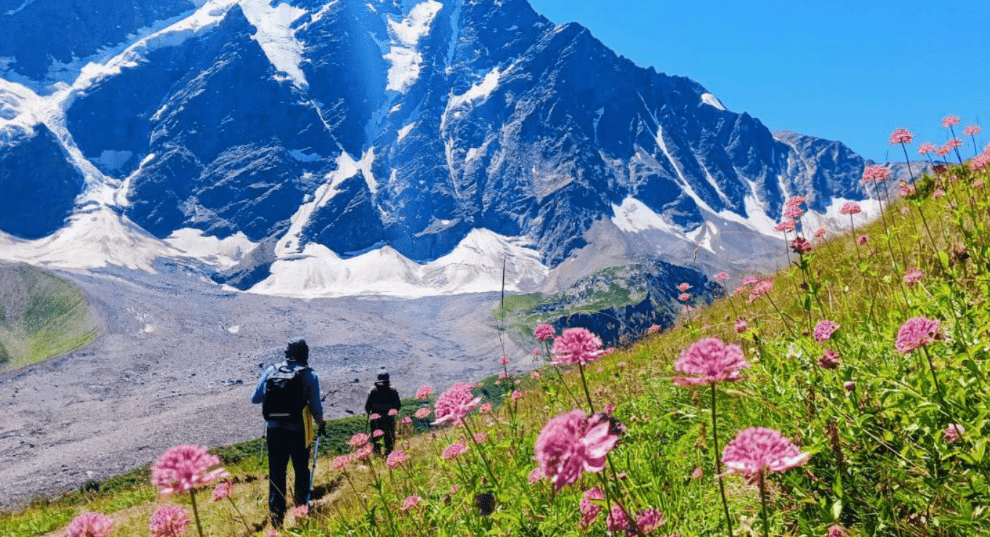
The Ministry of Tourism of Kabardino-Balkaria reported that it did not install posters with recommendations for tourists on clothing in the Elbrus region. Regardless of the author of the initiative, the recommendations are reasonable, and tourists mostly adhere to them in mountainous areas, noted representatives of hotels and travel agencies.
As "Kavkazsky Uzel" wrote, stands appeared in the Elbrus region calling on tourists to observe the traditions existing in Kabardino-Balkaria. Local residents often do not comply with these requirements themselves, social network users pointed out, considering recommendations on clothing in the mountains excessive. The proposed dress code is reasonable, others objected.
In the republics of the North Caucasus, including Kabardino-Balkaria, the issue of legislatively introducing a dress code for tourists, whose behavior and style of clothing, in the opinion of local residents, violate the traditions and customs of the Caucasus, has been repeatedly raised. In July 2024, the Ministry of Resorts of Kabardino-Balkaria stated that tourists should observe the customs and traditions of the republic and not wear excessively short skirts, short shorts and dresses with deep necklines. Residents of Kabardino-Balkaria were surprised by the recommendations; according to them, the authorities would be better off worrying about the poor condition of tourist sites and the problem with illegal dumps. The introduction of a dress code for tourists in Kabardino-Balkaria is a forced measure; such recommendations had to be issued after local residents saw two topless girls sunbathing on the river bank, the head of the Ministry of Resorts explained.
The Ministry of Resorts and Tourism of Kabardino-Balkaria told a "Caucasian Knot" correspondent that the installation of these posters was not the initiative of the ministry. "There is no information about who did this, and it is unclear who to contact," the ministry emphasized.
Representatives of the tourism business in the Elbrus region were divided in their opinions regarding the need for such posters. A representative of the Elbrus.guide organization, noting that he had heard of such posters for the first time, emphasized that in his opinion, the main thing is that "the reproductive organs are covered, and the rest is optional."
The administrator of the Gornaya Skazka Hotel in the village of Elbrus considered such posters useful. "You don't need to wear bras either," he noted. The hotel employee also emphasized that, in his opinion, such posters could lead to a decrease in the number of tourists, but he did not see anything bad in this. "Some tourists who respect the traditions and customs of other religions will come in any case," he concluded.
An employee of the Elbrus Hotel in the village of Terskol also approved of the posters. "This is the Caucasus, there are restrictions here. After all, other countries also impose restrictions on clothing and all tourists who want to go there are accepted," he told a "Caucasian Knot" correspondent.
None of the hotel employees have heard of any of the residents of Kabardino-Balkaria openly expressing indignation at the "wrong" clothing of tourists or offering them to change it.
The Startour travel company told a "Caucasian Knot" correspondent that such warnings are meaningless for organized groups of tourists. "We ourselves give tourist groups instructions on how to dress in accordance with Caucasian traditions," the company noted.
The Pyatigorsk mountain club "Country of Winds" emphasized that tourists going to the mountains are already dressed in closed clothing. "We always tell tourists to wear closed clothing - this is a guarantee of skin protection from the sun and from the changeable mountain weather," they noted. there.
Both Startour and Strana Vetrov told the Caucasian Knot correspondent that they were not aware of a single case where local residents in the Elbrus region would point out to tourists that they were “dressed incorrectly.”
The Marem crisis group, which helps women in the Caucasus, noted that such calls are not limited to Kabardino-Balkaria. “Approximately such calls appear once a year at the beginning of the tourist season in almost any North Caucasian republic,” the Caucasian Knot correspondent was told in the organization.
A representative of Marem also noted that she does not see discrimination in the posters and considers them quite polite. “Of course, this cannot be discrimination, because here, according to the criteria, there is no discrimination. Everything is written normally here, thank you for respecting our traditions, we are waiting you again. It is written very politely. I do not see, again, any requirement here. It is not written anywhere that you must do this, and if you do not do this, then we will kick you out. This is a recommendation. There is nothing wrong with recommendations. In general, when, for the sake of safety, tourists are advised on options on what to do so that some kind of trouble does not happen to them, this is normal. So that they do not have problems and can calmly spend their vacation, they are advised to throw something over their shoulders, this is completely normal, usually, and in many countries of the world you can see this. I am sure that a lot of people from Russia flying to Thailand on vacation are not outraged by the fact that in some places there, where they enter the territory of some temple complex or something else, they are told that they need to throw something over their shoulders. Here, the situation is approximately the same,” she said.
The representative of “Marem” also said that she had never heard residents of the KBR say anything about the overly free behavior of women, caused by the example of tourists.
The head of the Adyge Khase organization in the Kabardino-Balkarian Republic, Muhammad Khafitse, told the "Caucasian Knot" that he had seen lightly dressed tourists
and refugees from the regions bordering Ukraine. "But none of the locals wear anything
Recall that residents of Karachay-Cherkessia and Dagestan had also previously expressed complaints about tourists for their appearance. In 2023, the Ministry of Tourism of Dagestan issued a memo for guests, recommending that they wear "modest" clothing and follow local rules of conduct. Some artists, including rappers MC Doni, Eldzhey, pop singer Stas Mikhailov, were forced to cancel concerts in Makhachkala, as reported in the "Caucasian Knot" article "Fighters for morality came to Dagestan nightclubs".
We have updated the applications on Android and IOS! We would appreciate criticism and ideas for development both in Google Play/App Store and on KU pages in social networks. Without installing a VPN, you can read us in Telegram (in Dagestan, Chechnya and Ingushetia - with VPN). Through VPN, you can continue to read "Kavkazsky Uzel" on the website, as usual, and in social networks Facebook*, Instagram*, "VKontakte", "Odnoklassniki and X. You can watch the "Caucasian Knot" video on YouTube. Send messages to WhatsApp* to +49 157 72317856, to Telegram - to the same number or write to @Caucasian_Knot.
* the activities of Meta (owner of Facebook, Instagram and WhatsApp) are prohibited in Russia.
Translated automatically via OpenAI from https://www.kavkaz-uzel.eu/articles/415381



![Tumso Abdurakhmanov. Screenshot from video posted by Abu-Saddam Shishani [LIVE] http://www.youtube.com/watch?v=mIR3s7AB0Uw](/system/uploads/article_image/image/0001/18460/main_image_Tumso.jpg "Tumso Abdurakhmanov. Screenshot from video posted by Abu-Saddam Shishani [LIVE] http://www.youtube.com/watch?v=mIR3s7AB0Uw")